Independent comparisons. We may earn from shop links. More info

How to use an Einhell table saw

Updated: 21 October 2026

The carton is open, the blade is real, and the stand saw’s instructions are a complaint in 14 of 50 UK reviews. This page is how to use an Einhell table saw for the first rip: guard, riving knife, push stick, dust, and where you stand. The model is already chosen. A crooked scale belongs on the [Einhell table saw fence not square](/hub/power-saws/einhell-table-saw/sub/einhell-table-saw-fence-accuracy) page, and the choice of model belongs on the [Einhell table saw buying guide](/hub/power-saws/einhell-table-saw/sub/einhell-table-saw-buying-guide). The [Einhell table saw comparison](/hub/power-saws/einhell-table-saw) is the four listings. Peter F. wrote this on 19 October 2026 from those listings, Health and Safety Executive guidance and the UK review themes. It is not a lab test and it is not your manual. A qualifying purchase can earn a commission at no extra cost to you.

The carton is open, the blade is real, and the stand saw’s instructions are a complaint in 14 of 50 UK reviews.

Our top picks

Einhell Einhell TE-TS 36/210 Li-Solo

Best overall

Einhell Einhell TE-TS 36/210 Li-Solo
7.4/10about £269.04
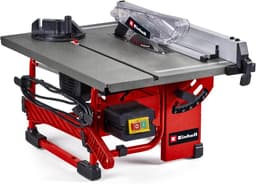
Einhell Einhell TC-TS 8 I

Best value

Einhell Einhell TC-TS 8 I
6.8/10about £99.95
On this page

Before the plug or the batteries

Unplug the stand saw, or leave the Power X-Change packs off the cordless body, until the blade is guarded and the fence has been looked at. The TC-TS 2025/2 U is corded. One UK review describes a 3-pin plug and a green start button. The TE-TS 36/210 takes two packs. Fitting them is the last step, not the first. The stand saw’s listing field says 240 V. UK mains are nominally 230 V. The compact TC-TS 8 I datasheet says 230–240 V. Check that a guard is on the saw and that a riving knife, or the splitter a TC-TS 8 I reviewer had to nudge, is behind the blade. HSE’s guidance on circular saw benches is written for employers, and it still describes the physical parts a home saw uses. If the guard or the knife is missing from the carton, stop. Assembly on the stand saw is the part UK reviews call vague or mirrored, so lay the parts out against the diagram before you tighten anything, and check the table top for a bend. One buyer found the table bent. That is one report. It is a reason to look, not a modification to copy if you are unsure. The fence face should meet the table at 90°, and the fence should run with the blade or open very slightly at the outfeed. If the fence is obviously crooked, fix that before you care about dust.

Guard, knife, and push stick

HSE’s rip-saw page asks for a riving knife within 8 mm of the blade at work, thicker than the plate and thinner than the kerf, so the timber cannot close on the back of the blade. The top guard should cover the gullet. The front of the fence should not reach further than the gullet at table level, which is the kickback limit in HSE’s woodworking sheet WIS16. Fence overlap past the blade should be no more than 18 mm on the rip-saw page when the saw is work equipment. Those figures are the employer’s standard. A householder is not that employer. PUWER 1998 binds the employer, not a person ripping a shelf in their own garage. If someone is employed to use the saw, this setup is the employer’s duty. The push stick is not optional for the end of the cut. HSE wants a push stick at least 450 mm long for the last 300 mm, and WIS16 also wants one for any cut under 300 mm. Only the TC-TS 8 I listing names a push stick in the box, and it does not give the length. A UK review of the stand saw says a push stick is included. The cordless box list names the saw, an angle stop and a carbide blade. If the stick in your carton is short, or missing, make one before you cut. Do not use your hand for the last 300 mm. HSE’s take-off distance, from the spindle to the back of the table, is at least 1,200 mm when a second person takes the timber off. These Einhell tables are smaller than that. One person, one push stick, and the offcut supported, is the home setup. HSE also says not to make a deep rip in two passes. If the board is thicker than the saw will cut in one height, it is the wrong saw for that board. The TC-TS 8 I datasheet stops at 45 mm at 90°. The cordless datasheet stops at 70 mm at 90°. The stand saw’s Amazon bullets do not state millimetres.

Dust and noise on these Einhells

The stand saw’s bullets give a dust port on the housing and on the blade cover. UK reviews say a household vacuum leaves the dust on the floor. One buyer names a 20 litre wet and dry vacuum as the smallest they would connect. The TC-TS 8 I title includes a dust extraction adaptor. The cordless bullets do not describe a port. At work, HSE wants local exhaust above and below the table, a class M vacuum for wood dust, and respiratory protection with an assigned protection factor of at least 20. The workplace limits HSE quotes are 3 mg/m³ for hardwood and 5 mg/m³ for softwood, with mixtures at 3 mg/m³. Do not sweep the dust up. A home garage is not that workplace, and a domestic vacuum is still a poor match for the stand-saw reviews. None of the four listings prints a decibel figure. Do not invent one. Stand-saw reviews call the start very loud. More than one review says the start tripped a circuit breaker. That is a report, not a rate, and it is not a reason to declare that the saw needs a 16 A supply. Einhell lists S1 1,800 W and S6 2,000 W for the stand saw, so the 2,000 W line is not a continuous current you can turn into a plug rule. Ear defenders are a sensible response to a saw reviewers call very loud. They are not a measured attenuation from this page. Cordless UK reviews are the contrast. Several call the saw quiet next to what they expected, with a soft start in the bullets. Quiet, in those reviews, is not the same claim as a class M extraction system.

The first rip, and when you stop

Stand to the side of the blade, not in line with it. Support the board so the offcut does not drop and twist the kerf onto the plate. Feed at a pace the motor holds. On the TC-TS 8 I, UK reviews say hardwood is slow if you push, and angled cuts are the jobs it does not like. On the cordless saw, one UK review says denser wood makes it cut out. On the stand saw, reviewers do rip pallets and oak architrave, and they still complain about the fence. Set the width with a rule against the tooth, not with the sticker, then lock the fence and measure again. The first cut should be a scrap, not the finished shelf. If the edge is burnt, the fence is pinching or the blade is blunt. If the edge wanders, stop and go to the fence page rather than taking a second, deeper pass. If the guard will not close down to the work, or the riving knife is more than a small gap from the blade, stop. If the table rocks because a leg is loose, stop. Hand the job to someone competent when an employee will use the saw, when you need all-day full sheets, when the stock is above the height that saw can state, when the guard or the knife is missing, or when the cut is steel. These listings are for solid wood, fibreboard and similar materials, or, on the cordless bullets, sizing and cross-cutting softwood and hardwood.

Common questions

What do you check before the saw is plugged in or the packs are fitted?
You check the data plate, that the guard and the riving knife are present, that the table is not obviously bent, and that the fence face is square to the table. The stand saw’s instructions are a repeated UK complaint, so follow the diagram slowly. Packs go on the TE-TS 36/210 last. The corded saws stay unplugged until that check is done. One UK review of the stand saw describes a 3-pin plug and a green button. That is the switch, not a substitute for the guard.
How close should the riving knife and the guard be?
HSE’s rip-saw guidance for work equipment asks for the riving knife within 8 mm of the blade, thicker than the plate and thinner than the kerf, and for the top guard over the gullet. The front of the fence should not pass the gullet at table level. A householder is not under PUWER in the way an employer is. The gap is still the gap that stops the timber closing on the back teeth. If you cannot see a knife, do not start the cut.
When do you pick up the push stick?
You pick it up for the last 300 mm of a rip, and for any cut under 300 mm, which is the HSE position in WIS16. The stick they describe is at least 450 mm long. Only the TC-TS 8 I components line names a push stick, and it does not state the length. A stand-saw review says one is included. The cordless box list does not. If yours is missing or short, make one before the first board. Your hand does not finish the cut.
Will a household vacuum do on the Einhell port?
On the stand saw, UK reviews say no. Dust falls to the floor, and one buyer would start at a 20 litre wet and dry vacuum. The port is real. The capture is the complaint. At work, HSE names a class M vacuum and tells you not to sweep. A home vacuum is not that class. Use the port you have, and do not treat a domestic cylinder as extraction that meets a workplace limit.
Why did a stand-saw review trip a breaker, and is that a 16 A rule?
More than one UK review says start-up tripped breakers. It is a report, not a count of how often it happens, and it is not a rule that the saw requires a 16 A circuit. The listing is a corded saw with a 3-pin plug in one review, and Einhell’s S6 2,000 W figure is not a continuous rating. If a shared garage circuit already trips on other tools, move the saw to a quieter circuit and do not add a second motor at the same moment.
Where do you stand relative to the blade?
You stand to the side, so a kickback does not come at your body, and you keep the push stick between your hand and the teeth for the end of the cut. A second person at the outfeed needs the long take-off distance HSE states for work equipment, at least 1,200 mm from spindle to the back of the table. These benches are shorter than that. Support the offcut yourself, or with a stand, rather than with a helper crowded against the blade.
When do you stop and not finish the cut?
You stop when the fence pinches, the guard will not sit close to the work, the riving knife is missing, the motor bogs down in hardwood, or the board is thicker than one pass. You also stop if the breaker trips, and you look at the circuit before you reset and try again. HSE’s warning against a two-pass deep rip is the limit. Forcing the last inch is how a small saw, and a hand, get into trouble.

Related pages

Sources

Public UK sources and the amazon.co.uk listings compared on this page. Prices captured 19 October 2026.

  1. Einhell TC-TS 2025/2 U (retrieved October 2026)
  2. Einhell TC-TS 8 I (retrieved October 2026)
  3. Einhell table saws (retrieved October 2026)
  4. Datasheet TE-TS 36/210 Li-Solo, 4340450 (retrieved October 2026)
  5. HSE: Circular saw benches (retrieved October 2026)
  6. HSE: Wood dust (retrieved October 2026)
  7. GOV.UK: Supply of Machinery (Safety) Regulations 2008 (retrieved October 2026)
  8. Control of Noise at Work Regulations 2005, regulation 4 (retrieved October 2026)