When saw rules apply at home UK: know your duties

When saw rules apply at home in the UK depends on household DIY, self-employed work, or employing someone. A faulty saw is a separate consumer-rights issue.
On this page

You can use the same circular saw in your spare room, in a client's kitchen, or while directing a paid helper, yet when saw rules apply at home in the UK changes with the situation. The decisive question is not whether the address looks domestic. It is whether you are doing private household DIY, working for yourself in circumstances that may affect others, or providing equipment to someone you employ.
Products Compared checked HSE work-equipment guidance, GOV.UK pages on faulty and misdescribed goods, Electrical Safety First on UK plugs, and the amazon.co.uk listing for the Bosch PKS 55. We did not run a laboratory test, and we did not decide anyone's employment status. This is general information, not legal advice. If you buy through a link, we may earn a commission at no extra cost to you.
In short
HSE guidance says the Provision and Use of Work Equipment Regulations, usually called PUWER, do not apply to domestic work in a private household. They can apply to work done at home, to employers, and to relevant self-employed work, so identify which role you are in before borrowing a rule from a DIY guide or a workplace manual. A saw that is faulty or not as described is a separate consumer-rights issue.
Three situations, not one law
Start by asking which hat you are wearing for this particular cut. If you bought a board and are making shelves for your own house, that is ordinary household DIY. If you are a self-employed joiner fitting the shelves for a client, you are at work even though the saw is running in a private home. If somebody is working for you and using equipment you provide, the employer question enters the picture.
Those distinctions matter because PUWER is about work equipment, not every powered object used behind a front door. The HSE PUWER Approved Code of Practice says the regulations do not apply to domestic work in a private household. The same guidance makes clear that work equipment used by homeworkers is within scope. "At home" describes a place. It does not by itself settle whether an activity is domestic or occupational.
Write down four facts before you quote a rule: who benefits from the job, whether anyone is being paid, who controls the equipment, and whether the work can put another person at risk. This is a sorting exercise, not a substitute for legal advice. If the answer points to work, consult the HSE work-equipment guidance for that role and machine.
Household DIY
For a householder cutting their own shelves, HSE's domestic-work exclusion means PUWER is not automatically the governing regime. That is the narrow answer to "does PUWER apply to DIY?" It is not a declaration that the saw, blade, dust, noise, or mains connection cannot harm you, and it does not turn workplace language into a domestic legal duty.
A recommendation to control wood dust can be useful during a home cut, but COSHH-style controls are framed for employment or construction work. Do not describe those workplace controls as a household obligation without a source that says so. Sweeping up afterwards is not a legal analysis for a joiner generating wood dust as paid work. Our wood-dust guide explains the practical issue and keeps that limit.
The same discipline applies to noise. Choosing hearing protection for private DIY does not prove that workplace action values bind every householder. Our guide to hearing protection for power saws holds the two contexts apart. Making your own bookcase on Saturday is a different situation from using the same saw for a customer's fitted unit on Monday.
Self-employed work
Self-employed work needs a more careful answer than "PUWER always applies" or "it is my own saw, so it does not". HSE's work-equipment FAQ says PUWER binds the relevant self-employed. It also indicates that a self-employed person whose work creates no potential risk to anyone else may be outside the law. "May" is not a blanket exemption for anyone who owns the business and the tool.
Consider a self-employed joiner using their circular saw in a client's room. The client, family members, or other trades may be nearby, and the result of the work is for the client. Check the HSE test against the real work and the people who could be exposed, not against the postcode. Work in your own home can still be work: a spare room, shed, or garage does not remove the occupational setting.
When you employ someone
If you employ a person to use a saw, the domestic-work exclusion no longer answers the situation on its own. PUWER places duties on employers in relation to work equipment. A task at your home, a job that lasts a day, or a helper you call a friend does not itself establish that this is merely your DIY. "Helping out", "mate's rates", and "only one cut" are descriptions, not conclusions about employment.
This guide cannot decide employment status from a label. The sources do not provide a cash threshold or a minimum number of hours. If you are employing the person, use current HSE guidance before the work starts. The practical requirements depend on the machine and its use, and this article does not replace the manufacturer's instructions or a machine-specific assessment.
Decide the role before you decide which legal framework to quote. That pause helps a householder avoid overstating workplace law, and it helps someone directing paid work avoid understating it.
Hand-held saws and bench rules
A hand-held circular saw and a bench saw both expose a rotating blade, but their guarding arrangements are not interchangeable. A bench machine presents the work to a fixed cutting set-up. A hand-held saw moves across supported material and uses its own guarding. Advice written for one should not be pasted onto the other without checking the actual machine and its instructions.
A search phrase such as "saw guarding rules" may tell you that PUWER applies to the work. It does not turn every saw into the same equipment. Begin with the model, the configuration, and the task, then read the official and manufacturer material for that machine. Our table saw comparison is a separate destination because a bench saw is not a circular saw under another name. A chainsaw comparison concerns different equipment, so do not transfer its machine-specific advice to a circular saw. If the advice does not name the saw type, it is too general for a machine-specific question.
Listing, supply or work equipment?
Not every dispute about a saw is a workplace-regulation dispute. If the product is faulty or does not match its description, the Consumer Rights Act 2015 and the retailer's returns obligations are the relevant route. GOV.UK says a trader must offer a refund for goods that are faulty or not as described. The separate 14-day online cancellation route should not be confused with a defect or with PUWER.
The Bosch PKS 55 shows why these questions stay separate. Its amazon.co.uk listing, recorded in our Bosch circular saw comparison, describes a corded 1,200 W saw with a 160 mm blade at about £87. The specification rows leave voltage empty. One UK reviewer reported receiving a 240 V saw when they had wanted 110 V. That review is one buyer's report. It is not a rule that the PKS 55 is a 110 V model, or that every site requires 110 V. The listing shows 4.6 stars from 881 reviews.
Site supplies are often 110 V. Do not turn that common practice into a universal legal requirement. Match the exact tool to the available supply and the site's arrangements before ordering. For a mains saw intended for an ordinary UK connection, Electrical Safety First points consumers towards the expected UK three-pin plug. Verify the listing rather than inferring the plug from a photograph. A refund cannot establish workplace suitability, and PUWER is not the route for an inaccurate retail description.
Common questions
Does PUWER apply if I cut shelves in my own house?
What if I am self-employed and the client is in the room?
What if I employ a friend for the day?
Are bench-saw guarding rules the same as hand-held saw rules?
What can I do if the saw is not what the listing showed?
Is a 110 V tool required on every UK site?
Does workplace noise law apply to DIY at home?
Who prepared this guide and what was checked?

Peter F. is the editor for DIY & tools at productscompared.co.uk. Comparisons in this category are checked against amazon.co.uk listings, review evidence and public UK sources.
Related articles

Wood dust from power saws: extract it before you mask
Understand when wood dust is more than household mess and how the legal context changes with work.

Hearing protection for power saws: UK noise rules
Separate sensible home protection from the duties that UK noise law places on employers.
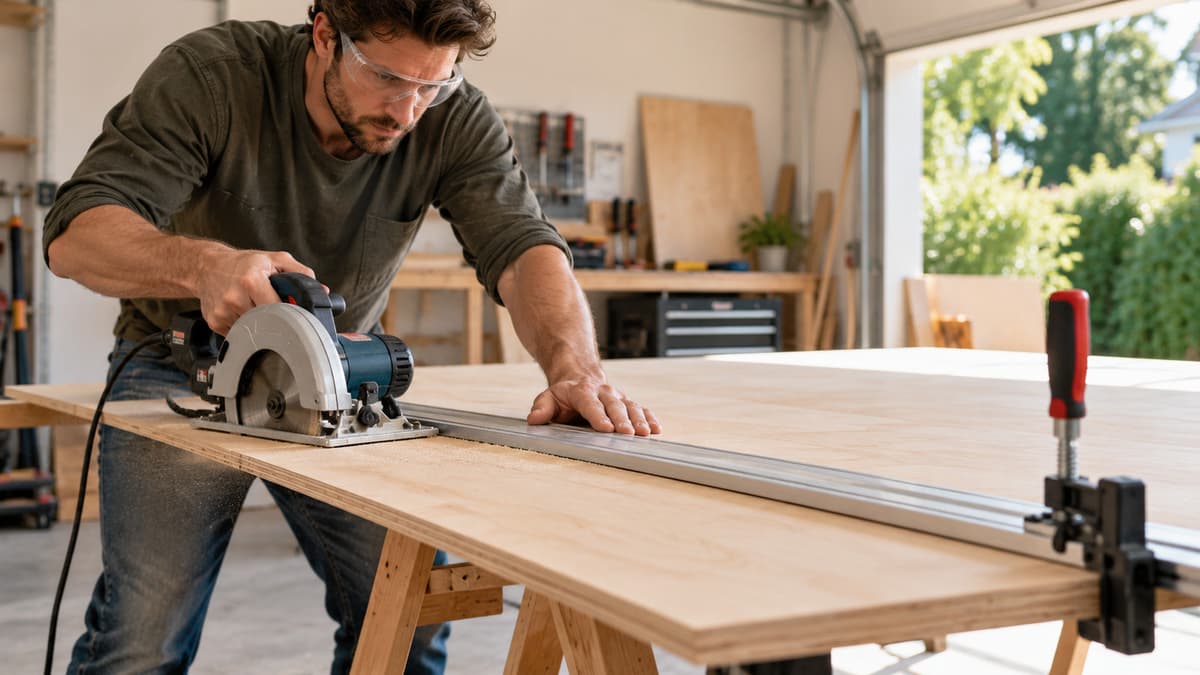
Which saw for a sheet of timber: choose the right tool
Choose between a circular saw, jigsaw and table saw according to the sheet and the cut.