Independent comparisons. We may earn from shop links. More info

Portable electric heater for the bedroom

Updated: October 2026

The bedroom is cold, and the heater is beside the duvet. A portable electric heater for the bedroom can take the chill off while you are awake. It should not run after you sleep. The Products Compared editorial team wrote this on 16 October 2026 from Electrical Safety First, Hertfordshire, and the listings in our [portable electric heater comparison](/hub/portable-heaters/portable-electric-heater). We did not measure a bedroom. If you buy through our links, we may earn a commission at no extra cost to you. Plug steps are on the [how to use](/hub/portable-heaters/portable-electric-heater/sub/portable-electric-heater-how-to-use) page, and leftover heat is on the [versus page](/hub/portable-heaters/portable-electric-heater/sub/portable-electric-heater-vs-oil-filled).

The bedroom is cold, and the heater is beside the duvet. A portable electric heater for the bedroom can take the chill off while you are awake. It should not run after you sleep.

Our top picks

On this page

Heat the room, then switch it off

Electrical Safety First says not to leave a portable heater on while you are asleep. If someone still runs a heater overnight, the charity points to an oil-filled radiator as the lower-risk type, not to a fan heater. energy.org.uk says the same. Dorset and Wiltshire say unplug before bed. None of the twelve listings here is an oil-filled radiator, and none is an overnight exemption. A shop’s 45–60 minute pre-heat is a rule of thumb, not a standard. A timer or a child lock does not make overnight use approved.

Where it can stand

Keep about one metre between the heater and the bed, the curtains, and the way to the door. A heater beside a hanging duvet fails it even when a tip-over switch is real. Do not put the lead where you will step on it in the dark, and do not run it under a rug. The socket is a wall socket, not an extension reel. If a foot can knock it, prefer a listing that states tip-over. That includes the Dreo models, the ComDomus, the JVISION and the Amazon Basics. UK reviews of the £9 Warmlite say there is no tilt switch. The Ballu and the Elovaris do not clearly state one. The gold Atom 316 states 220–240 V, which the white model does not. The Amazon Basics states 230 V and tip-over at about £9.90, and says it is not for bathrooms. No row has an IP rating, so an en-suite is out.
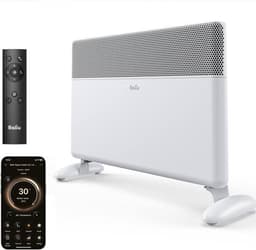
Ballu Ballu 2000 W WiFi panel

Testsieger

Ballu Ballu 2000 W WiFi panel
9.6/10about £149.99

Noise in this comparison

A safe place can still keep you awake. Several Dreo listings and the ComDomus claim 34 dB. The JVISION claims 39 dB and the Elovaris claims 50 dB. Those are manufacturer lines, not a measured night. UK reviews still mention a hum. Amazon Basics reviewers call high noisy, and low can feel cool, so the quiet setting may not be the warm one. The gold Atom 316 is the top pick on the best page because of voltage, tip-over, a thermostat and 4.6 from 10,466 reviews, not because we measured it as the quietest. Atom 320 reviews mention quiet low settings, and the specification line says 120 V, so confirm the plug. The Ballu is fanless, at about £149.99, with tip-over not clearly stated.

If you need heat after you are asleep

If the bedroom must stay warm after you sleep, this folder is the wrong type. An oil-filled radiator keeps releasing heat after switch-off. Which? describes about half an hour of leftover warmth in a test room. Electrical Safety First calls that the lower-risk type only for someone who will not follow the off-at-bedtime rule. We do not list an oil-filled model. A tested smoke alarm does not make a fan heater safe overnight. If a baby sleeps in the room, the same rule applies. For a cold half hour before sleep, the gold Atom 316 or the Amazon Basics, switched off when you get into bed, is what this comparison can support.

Common questions

Can I leave it on all night?
No. Electrical Safety First says not to leave a portable heater on while you sleep. Hertfordshire says switch it off at bedtime unless the manufacturer states overnight use, and these listings are not that exemption. If you still want heat through the night, the charity points to an oil-filled radiator, which is not in this comparison. Unplug a fan heater before you sleep.
How far from the bed?
About one metre from the bed, bedding, curtains and the path to the door. Fire services use that clearance. A heater touching a duvet is too close even with a tip-over switch. Keep the lead out of the walkway and out from under the rug. The grille stays uncovered.
Which of these is quieter?
We cannot rank them by a bedroom test. Dreo and ComDomus print 34 dB as a manufacturer claim, JVISION prints 39 dB and Elovaris prints 50 dB. Amazon Basics reviews call high noisy. The Ballu is fanless, at about £149.99, with tip-over not clearly stated. A lower fan setting while you are awake matters more than the decibel line.
Should I pre-heat and switch off?
Yes. Warm the room while you are awake, then unplug before you get into bed. A shop’s 45–60 minutes is a rule of thumb, not a standard. A small room may need less with a 1500 W heater and the door shut. A 2000 W heater on full is about 53 pence an hour on the Great Britain cap rate until it cycles.
Is a fan heater bad for a baby’s room?
The overnight rule is the same, and you may not wake to a problem. Do not leave a fan heater beside a cot. Keep a metre clear, and prefer the normal heating if the room must stay warm for hours. A child lock is not approval for unattended use. If the only heat is a plug-in heater, raise that with a landlord or a heating engineer.
Will a timer make overnight use safe?
No. A 12-hour timer can stop a heater you forgot while you were awake. It does not make it safe to sleep with a fan heater running until the timer ends. You will not notice a blocked grille. Use the timer for a pre-heat you will switch off yourself, not as a night mode.

Related pages

Sources

Public UK sources used for this comparison. Listing prices, stars, and review counts are the amazon.co.uk lines from 16 October 2026.

  1. Electrical Safety First — portable heaters (retrieved 16 October 2026)
  2. Ofgem — energy price cap, 1 October to 31 December 2026 (retrieved 16 October 2026)
  3. Energy Saving Trust — electric heating (retrieved 16 October 2026)
  4. Centre for Sustainable Energy — room heaters (retrieved 16 October 2026)
  5. energy.org.uk — electric heaters compared (retrieved 16 October 2026)
  6. GOV.UK OPSS — portable heater plug report B0BRW4YQ7S (not in this set) (retrieved 16 October 2026)
  7. NBS — BS EN 60335-2-30 (retrieved 16 October 2026)
  8. Hertfordshire Fire and Rescue — portable heater safety (retrieved 16 October 2026)