Independent comparisons. We may earn from shop links. More info

Plug-in heater for a small room: when the watts are enough

Updated: 16.10.2026

You are trying to take the chill off a box room, a kitchen corner or the chair at your desk, and the listing says the heater covers about 10 m². A plug-in heater for a small room can do the first job. On the UK reviews in this set, it does not warm the far side of a normal living room. The model rows are on the [plug-in fan heater comparison](/hub/portable-heaters/plug-in-fan-heater). The Products Compared editorial team used the amazon.co.uk listings on 16 October 2026, not a lab test. A qualifying purchase can earn a commission at no extra cost to you.

You are trying to take the chill off a box room, a kitchen corner or the chair at your desk, and the listing says the heater covers about 10 m². A plug-in heater for a small room can do the first job.

Our top picks

On this page

When 400–700 W is enough

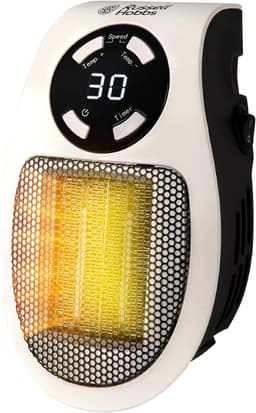
It is enough when you want heat close to you, in a well insulated small space, for a while rather than all evening as the only heat. The Russell Hobbs RHPH7001 manual says that model is only suitable for well insulated spaces or occasional use. UK reviews talk about a desk, a kitchen corner or a camper on hook-up, not a flat brought up to temperature. At 400 W the AVCXEC is £14.99 and has no UK reviews here. At 500 W, the RHPH2001 is £25.99 and 4.0 from 6,510 reviews, and one kitchen review put the useful warmth at about half a metre. The Ventox PHI-328 is £15.01 and 4.1 from 76. At 700 W, the RHPH7001 is £19.70 and the Swan SH27010N is £9.20. At 26.32p per kWh, a 500 W element is about 13p an hour while it draws 500 W, and a 700 W element about 18p. The hour is cheaper because the output is smaller.

When the 10 m² claim is too hopeful

The RHPH7001, the RHPH2001, the Ventox and the AVCXEC each print about 10 m². The Swan’s Amazon field says 150 square feet. That is a listing field, not a measured room. ZUSKYZU and both Cakoai rows do not state a coverage figure. UK reviews describe close-range heat, not the far side of a lounge getting warm. Other watt-per-metre tables are rules of thumb for different heaters. One retailer uses about 100 W per square metre. A panel-heater maker uses about 80 W per square metre, which would put a 10 m² room near 800 W on that column. Those figures are not the measured output of a socket fan heater blowing from one point on the wall. An 800 W ZUSKYZU or a stated 1,200 W Cakoai YL-01 is still a socket heater. The other Cakoai title and its PTC-800CR model code disagree on wattage.

A small room is not only a bedroom

A kitchen corner, a porch or a workshop socket is a different job from sleeping. Swan reviews sit in those places, if you can accept a fan that many reviewers call too loud for night. A box room where you work for an hour can use the same 500 W or 700 W heater that would be miserable beside a bed. Noise is flagged on the Russell Hobbs 700 W and the Swan. The Ventox has a review at about 59 dB against a quieter claim. Do not plan to sleep next to them. A caravan on a hook-up is a small space with an amp budget. The Camping and Caravanning Club describes Club sites at 16 A or 10 A, and some certificated sites at as little as 5 A. On their sums, 10 A at 230 V is 2,300 W for the whole pitch. Their table lists a 2 kW domestic fan heater at 8.7 A and a 750 W camping fan heater at 3.3 A. The RHPH7001 states 3.04 A, in that smaller neighbourhood. The kettle and the water heater still share the pitch. The Caravan and Motorhome Club suggests limiting blown-air heating to 500 W as that club’s own guide, not as a regulation. None of this clears a heater for overnight running.

The point where you need a corded heater

Stay with a socket heater while the person, the desk or the corner is the target, and the socket can take the clearance. Move on when you need the air in the room warm, not only the air by the socket. That is the condition for a corded fan heater around 2 kW. This set does not include that corded heater. The split is on the plug-in heater vs fan heater page. A lower wattage will not finish that larger job more cheaply. energy.org.uk notes that a resistive heater turns the electricity it uses into heat, so the saving comes from heating only the space you occupy, and from a thermostat and a timer. If the room never gets warm, you have spent the hour and still need another heater. A 700 W unit that cannot hang with the clearance in the instructions is not a small-room solution either.

Common questions

Is 700 W enough for a box room?
It can be enough to take the chill off you in a well insulated box room, which is how UK reviews describe the RHPH7001 and the Swan. It is too hopeful when you need the whole room, including the side away from the socket, held warm for hours. The RHPH7001 manual limits that model to well insulated spaces or occasional use.
What does a “10 m²” claim actually mean?
It is the seller’s coverage line. The RHPH7001, RHPH2001, Ventox and AVCXEC each print about 10 m². The UK reviews still talk about close-range heat. Use the line as a ceiling on the claim, not as a test result. If your room is draughty or open to a stair, treat 10 m² as already too hopeful.
Will 400 W or 500 W warm a desk, or the whole room?
They are desk and personal-space heaters in this set. The RHPH2001, at 500 W, has the long review file for that job, and one kitchen review put the useful heat at about half a metre. The AVCXEC states 400 W and has no UK reviews in this comparison. Neither output is a whole-room heater.
Is a kitchen corner the same job as a bedroom?
The heat can be the same close-range job. The noise often is not. Swan and Russell Hobbs 700 W reviews complain about fan noise, and bedroom use at night is the case those complaints rule out. A kitchen corner while you are in the room, and can unplug the heater when you leave, matches the reviews more closely.
Why does a lower wattage not cut the bill if I still need the room warm?
Because you are buying less heat per hour, not a more efficient conversion. At 26.32p per kWh, 500 W is about 13p an hour while the element is on, and 700 W about 18p. If that does not warm the room, the cheaper hour has not done the heating. A thermostat only shortens the time the element draws power.
Can I use one on a caravan hook-up?
Yes, as one load on the pitch, not as the whole allowance. A 700 W heater is about 3 A, and the RHPH7001 states 3.04 A. Club sites are often 10 A or 16 A for everything on the pitch, including the kettle. Check the bollard before you add a 2 kW heater later. A 500 W suggestion from the Caravan and Motorhome Club is that club’s guide, not a law.
Will it be quiet enough to work or sleep next to?
Plan on fan noise if you buy the Swan or the Russell Hobbs 700 W. Reviewers call both loud, and the Swan file includes night-time complaints. The Ventox has a note of about 59 dB in one review against a quieter claim. Working beside one for an hour is a different decision from sleeping with it running. Do not assume a silent seller line.

Related pages

Sources

Public UK sources last checked on 16 October 2026. Prices and star ratings are the amazon.co.uk figures on the listings used for this comparison.

  1. Electrical Safety First: Portable heaters (retrieved 16.10.2026)
  2. Electrical Safety First: Plugs and fuses (retrieved 16.10.2026)
  3. Plugs and Sockets etc. (Safety) Regulations 1994 (retrieved 16.10.2026)
  4. Electrical Equipment (Safety) Regulations 2016 (retrieved 16.10.2026)
  5. OPSS product safety report 2212-0070: portable heater (retrieved 16.10.2026)
  6. Ofgem: Energy price cap unit rates and standing charges (retrieved 16.10.2026)
  7. Dorset & Wiltshire Fire and Rescue: Staying warm safely (retrieved 16.10.2026)
  8. SELECT: BS 7671 Section 701, bath or shower rooms (retrieved 16.10.2026)