Independent comparisons. We may earn from shop links. More info

Plug-in fan heater buying guide: the checks before you pay

Updated: 16.10.2026

You are looking at a cold box room or a desk beside one wall socket, and the amazon.co.uk titles all say plug in. Some heaters hang on the socket and have no cable. Others are corded fan heaters of 1,500–2,000 W that simply use a mains plug. This plug-in fan heater buying guide is the order of checks before you pay: a true socket heater, the stated watts, the clearance, then the thermostat, the timer and the review file. The [plug-in fan heater comparison](/hub/portable-heaters/plug-in-fan-heater) holds the model table. This page does not name a top pick. The Products Compared editorial team read the listings, from £9.20 to £49.99, on 16 October 2026. A qualifying purchase can earn a commission at no extra cost to you.

You are looking at a cold box room or a desk beside one wall socket, and the amazon.co.uk titles all say plug in. Some heaters hang on the socket and have no cable.

Our top picks

On this page

Confirm it hangs on the socket

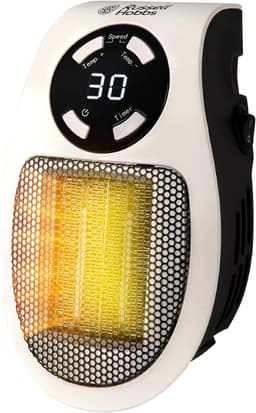
A plug-in fan heater, in this category, is a small PTC or ceramic fan heater whose pins go straight into a BS 1363 wall socket. There is no trailing flex. On a corded heater the same words only mean it uses mains electricity. If the listing prints a cable length, or a tip-over switch for a unit that stands on the floor, drop it before you compare watts or price. This set sits between 400 W and 1,200 W and hangs on the socket. Heat across a whole small room is a different product: see plug-in heater vs fan heater. The plug face still has to be a BS 1363 plug with a BS 1362 fuse. The Office for Product Safety and Standards has reported a portable fan heater with a non-compliant plug face and a grill you could remove by hand.

Match the watts to a small space

This set clusters at 400 W, 500 W, 700 W, 800 W and 1,200 W. Several listings claim about 10 m². UK reviews describe heat close to the person, a kitchen corner or a desk, not a living room that warms through. Treat the 10 m² line as the seller’s claim. A retailer rule of about 100 W per square metre is someone else’s sizing table, not a measurement of these units. At the Ofgem Direct Debit average of 26.32p per kWh for 1 October to 31 December 2026, a 500 W element is about 13p an hour while it draws 500 W, a 700 W element about 18p, and a 1,200 W element about 32p. A lower wattage is less heat, not a more efficient heater. The Cakoai listing coded PTC-800CR shows 1,200 W in the title and 800 in the model code. Do not treat either figure as settled.

Check the socket before you check the features

These units hang down from the outlet, so a skirting socket often fails the clearance even when the plug fits. Russell Hobbs instruction text for the RHPH7001 asks for the heater upright, at least 30 cm from the base to the ground and at least 50 cm from the sides. UK reviews of both Russell Hobbs models repeat that gap. The same manual says the RHPH7001 is only suitable for well insulated spaces or occasional use. Electrical Safety First asks for a UK 3-pin plug, at least one metre from curtains and furniture, and no extension lead. A face that turns does not create the missing gap. If the only sockets are in a bathroom or shower room, stop. No listing here states an IP rating. How the heater should hang is on how to use a plug-in heater.

Controls, cut-out, noise, then the review file

Most thermostats in this set start at 15°C and run to 30°C or 32°C. That floor is already warm if you wanted a frost-watch near freezing. The Cakoai YL-01 starts at 25°C. Timers are 12 hours or a 1–12 hour countdown. Overheat protection is stated on most listings. It is not stated in the feature bullets for the Russell Hobbs RHPH2001, so do not assume it. Fan noise shows up often on the Russell Hobbs 700 W and the Swan 700 W. Review volume changes what a star line means. The RHPH2001 is 4.0 from 6,510 ratings, the RHPH7001 is 4.2 from 1,369, and the Swan SH27010N is 4.0 from 263. A 5.0 from one rating, or from four, is not the same evidence. The AVCXEC 400 W at £14.99 has no UK review line here. If a check fails, stop.

Common questions

Is a plug-in fan heater the same as a fan heater with a cable?
No. In this guide a plug-in fan heater hangs on a BS 1363 socket and has no trailing flex. A corded fan heater around 1,500–2,000 W is still sold as plug-in because it uses mains electricity. Read the cable-length line before the wattage. If a flex is listed, it is the other product, even when the title matches your search.
What wattage should I look for at a desk or in a box room?
Look at 400–700 W when you want heat close to you, not across a lounge. The 500 W and 700 W listings that claim about 10 m² are still described by UK reviewers as local heat. An 800 W or 1,200 W socket heater is a higher stated output, not an automatic upgrade, and the thin review files on those rows matter as much as the watts.
Will a skirting socket work?
Often it will not. The RHPH7001 instructions ask for at least 30 cm from the base of the heater to the ground, and UK reviews of the Russell Hobbs plug-in heaters say a low socket makes the unit unusable. Rotating the plug does not create that gap. If every socket is at skirting height, this product type is the wrong buy until the socket is moved.
Why does the thermostat start at 15°C?
On the Russell Hobbs and Swan listings the stated range starts at 15°C, which is too high for a frost-watch that should hold a space much colder. The Cakoai YL-01 starts at 25°C, so the lowest set-point is warmer still. If you need a setting under 15°C, none of these ranges does that job.
Can I use it in a bathroom if the listing mentions one?
No. A bathroom word in a bullet, with no IP rating on the listing, is not permission. Dorset & Wiltshire Fire and Rescue say standard portable electric heaters stay out of bathrooms and shower rooms. If the only sockets are in a bath or shower zone, ask an electrician about a suitable installation rather than hanging this heater there.
Is a cheaper, lower-watt model more efficient?
It uses less electricity because it delivers less heat. At 26.32p per kWh a 500 W element is about 13p an hour while it is on, and a 700 W element about 18p. That gap is not a better technology. If you still need the room warm, the smaller heater has not finished the job at a lower cost.

Related pages

Sources

Public UK sources last checked on 16 October 2026. Prices and star ratings are the amazon.co.uk figures on the listings used for this comparison.

  1. Electrical Safety First: Portable heaters (retrieved 16.10.2026)
  2. Electrical Safety First: Plugs and fuses (retrieved 16.10.2026)
  3. Plugs and Sockets etc. (Safety) Regulations 1994 (retrieved 16.10.2026)
  4. Electrical Equipment (Safety) Regulations 2016 (retrieved 16.10.2026)
  5. OPSS product safety report 2212-0070: portable heater (retrieved 16.10.2026)
  6. Ofgem: Energy price cap unit rates and standing charges (retrieved 16.10.2026)
  7. Dorset & Wiltshire Fire and Rescue: Staying warm safely (retrieved 16.10.2026)
  8. SELECT: BS 7671 Section 701, bath or shower rooms (retrieved 16.10.2026)