Independent comparisons. We may earn from shop links. More info

How to use a plug-in heater on a UK wall socket

Updated: 16.10.2026

You have a small fan heater in your hand, or you are checking the sockets before you buy one, and the question is whether it can hang there safely. How to use a plug-in heater comes down to a sound BS 1363 outlet, clearance that matches the instructions, and unplugging when you leave or go to bed. This page covers where it may sit, the timer, what a cut-out means, and when to stop. The model rows are on the [plug-in fan heater comparison](/hub/portable-heaters/plug-in-fan-heater). The Products Compared editorial team used the listings and public UK safety pages on 16 October 2026. A qualifying purchase can earn a commission at no extra cost to you.

You have a small fan heater in your hand, or you are checking the sockets before you buy one, and the question is whether it can hang there safely.

Our top picks

On this page

Where it may sit

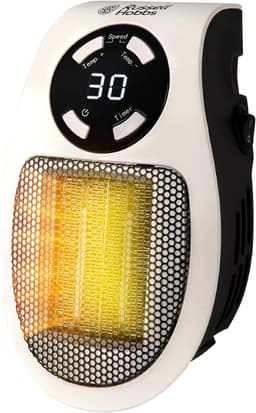
Plug it straight into a wall socket. Electrical Safety First says not to run a portable heater from an extension lead, and to keep it at least one metre from paper, furniture and curtains. These heaters hang on the socket, so the outlet has to be high enough for the body to clear the floor. A skirting socket is the usual failure. The clearance figures are for the Russell Hobbs RHPH7001 only, not a manual for the Swan, the Ventox or either Cakoai. It should sit upright, more than 30 cm from the base to the ground and more than 50 cm from the sides. If the socket cannot give that gap, the heater is unusable there. Do not cover the vents or dry clothes on it. Reject a low socket before you pay, using the buying guide.

How to set the timer and the temperature

Set the temperature first, then the timer, so the heater is not still running when you are out. In this set the timer is either a 12-hour control or a 1–12 hour countdown. The thermostat often runs from 15°C to 30°C or 32°C. The Cakoai YL-01 is the exception: 25°C to 32°C, so you cannot ask it for a cooler set-point. A 15°C minimum is already too high for a frost-watch near freezing. RHPH2001 reviews say the timer is hard to follow, so use the sheet in the box. Choose a run of one or two hours while you are in the room. A thermostat shortens the time the element draws power. It does not make 500 W equal a larger heater. One UK review says the RHPH7001 does not resume its last setting when power returns, so a smart plug will not start the heat.

What a cut-out means

Two different things get called “it switched itself”. On the Russell Hobbs 700 W and the Swan 700 W, UK reviews say the fan keeps blowing after the room reaches the set temperature. That is the thermostat holding the setting, not an emergency stop. Separately, the RHPH7001 instructions say the fan may run for about a minute after you switch the heat off, to cool the inside. Do not copy that minute onto the Swan or the other brands. Their cool-down times are not in this comparison. An overheat cut-out is a stop. Most listings state one. The RHPH2001 feature bullets do not, so do not invent a reset for that model. If the case is hot, switch off, unplug if that is safe, and let it cool. Clear a blocked vent only when the case is undamaged. If it cuts out again at once, leave it unplugged. Tip-over switches are usually absent because the unit hangs. A loose socket is a reason to stop.

When to unplug, and when to call someone

Unplug the heater before you go to bed and before you leave the room. Dorset & Wiltshire Fire and Rescue say that, and GOV.UK winter fire advice says to unplug electric heaters when you go out or go to bed. A timer does not make overnight use acceptable. Stop if the socket is hot, buzzing or discoloured. Do not move the heater to the next socket once there are scorch marks, a burning smell or crackling. Call an electrician if the socket scorches, buzzes or runs hot, if you need a new socket at a safe height, if the only sockets are in a bathroom or shower zone, or if the consumer unit trips and the cause is not obvious. None of these listings states an IP rating. If the heater itself smoked, as one Swan review reported of a previous unit, leave it unplugged and use the seller’s returns route.

Common questions

How far under the socket does the heater need to hang?
For the Russell Hobbs RHPH7001, the instructions ask for more than 30 cm from the base to the ground and more than 50 cm from the sides, with the heater upright. UK reviews of the Russell Hobbs plug-in models cite that sort of gap, and low sockets fail it. Other brands in this set do not share that manual. Read the sheet for the unit you bought, and still keep about a metre from curtains and furniture.
Can I use a skirting socket or an extension lead?
A skirting socket usually cannot give the clearance, so the heater should not hang there. An extension lead is the wrong fix. Electrical Safety First says not to power a portable heater from one. If every outlet in the room is too low, the next step is a different heater type or a socket moved by an electrician, not a reel of cable.
Why is the fan still running after the room reaches the set temperature?
On the Russell Hobbs 700 W and the Swan 700 W, reviewers say the fan keeps going after the set temperature. That is not the same event as an overheat cut-out. The RHPH7001 manual also describes a cool-down of about a minute after you switch the heat off. If the heater cuts out at once, the case is damaged, or you smell burning, unplug it and do not keep restarting it.
What should I do if it cuts out?
Switch it off and unplug it if that is safe, then let it cool. If a vent was blocked and the case is intact, you can clear the vent once it is cool. If it cuts out straight away on the next start, or the plug or socket looks scorched, stop using it. These notes do not give a reset procedure you should cycle through.
Can I leave it on overnight if it has a timer?
No. A timer limits a session while you are there. It does not override the advice from Dorset & Wiltshire and from GOV.UK to unplug electric heaters before bed. The same applies when you leave the house. Fan noise on several of these models is a separate reason not to sleep beside them.
Can I dry clothes near it, or use it in a bathroom?
Do not dry clothes on it or close beside it. GOV.UK fire advice says not to. Do not use a standard portable electric heater in a bathroom or shower room. No listing in this set states an IP rating. If the only sockets are in that zone, ask an electrician rather than hanging the heater there anyway.
When do I stop and call an electrician?
Stop when the socket is hot, buzzing, cracked or discoloured, when you need a socket raised to a safe height, when the only sockets are in a bathroom zone, or when the consumer unit trips and you cannot see why. Unplug first if you can do so safely. Do not keep testing the heater in another room once there is a burning smell or scorch marks.

Related pages

Sources

Public UK sources last checked on 16 October 2026. Prices and star ratings are the amazon.co.uk figures on the listings used for this comparison.

  1. Electrical Safety First: Portable heaters (retrieved 16.10.2026)
  2. Electrical Safety First: Plugs and fuses (retrieved 16.10.2026)
  3. Plugs and Sockets etc. (Safety) Regulations 1994 (retrieved 16.10.2026)
  4. Electrical Equipment (Safety) Regulations 2016 (retrieved 16.10.2026)
  5. OPSS product safety report 2212-0070: portable heater (retrieved 16.10.2026)
  6. Ofgem: Energy price cap unit rates and standing charges (retrieved 16.10.2026)
  7. Dorset & Wiltshire Fire and Rescue: Staying warm safely (retrieved 16.10.2026)
  8. SELECT: BS 7671 Section 701, bath or shower rooms (retrieved 16.10.2026)