Independent comparisons. We may earn from shop links. More info

Ceramic vs wire fan heater

Updated: 16 October 2026

You have been told a ceramic fan heater costs less to run than a wire element. On a ceramic vs wire fan heater choice, a full-power hour costs the same if the watts are the same. Buy ceramic when you want the setpoint and the tip-over switch the listing writes down. Buy wire when the shelf price is the point and you will watch a short blast. Pence are on the [running-cost page](/hub/portable-heaters/energy-saving-fan-heater/sub/energy-saving-fan-heater-running-cost). Rows are on the [energy-saving fan heater comparison](/hub/portable-heaters/energy-saving-fan-heater). The Products Compared editorial team compared these amazon.co.uk listings on 16 October 2026. We did not lab-test duty cycle. A qualifying purchase can earn a commission at no extra cost to you.

You have been told a ceramic fan heater costs less to run than a wire element. On a ceramic vs wire fan heater choice, a full-power hour costs the same if the watts are the same.

Our top picks

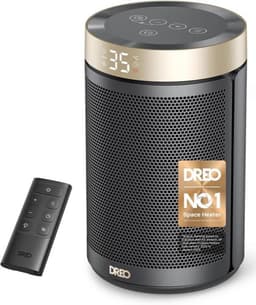
Dreo Dreo Atom 316 1500 W

Best overall

Dreo Dreo Atom 316 1500 W
9.2/10about £49.99
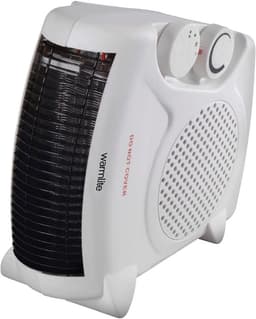
Warmlite Warmlite WL44001 2000 W

Preis-Tipp

Warmlite Warmlite WL44001 2000 W
8.6/10about £14.99
Philips Philips CX2120/01 1500 W

Alternative

Philips Philips CX2120/01 1500 W
8.4/10about £49.99
On this page

Same watts, same full-power cost

A plug-in electric heater turns the electricity it draws into heat at the point of use. The Centre for Sustainable Energy treats that conversion as effectively complete. Energy Saving Trust warns that far more efficient claims are usually misleading, because a 2 kW hour is a 2 kWh hour. At 2,000 W, ceramic and wire cost the same for a continuous hour. Philips’ up to 25%, and a Dyson line about using less energy, are not results for these ASINs. A setpoint, a timer and a written tip-over switch change how long the element stays on. They do not change the price of a minute that is on. The field checks are on the buying guide.

What PTC ceramic changes

PTC ceramic is sold as an element whose resistance rises as it heats, so it tends to limit its own temperature instead of glowing as an open coil. That is not permission to cover the grille, skip the one-metre clearance, or leave it on overnight. Controls show up more often on the ceramic rows. Philips, the Dreo Atom 316, PALINTH, Zuquik and Timiyou state a tip-over switch, and several state eco mode or a timer. Eco mode cycles around a setpoint. It does not mean ceramic draws fewer watts than wire on the same setting. A ceramic badge also does not guarantee 230 V and a BS 1363 plug. A 120 V or two-prong line is out until the live listing is clearly for UK mains.
Dreo Dreo Atom 316 1500 W

Testsieger

Dreo Dreo Atom 316 1500 W
9.2/10about £49.99

What the wire heaters in this set are

Two Warmlite listings are the wire rows. The WL44001 (ASIN B008XF8HBS) is £14.99. The WL44002 (ASIN B006UJDGB0) is £9.00. Both are heating wire, 240 V, and 1,000 W or 2,000 W. The full-power hour matches any other heater on the same setting. Reviews mention a first-use smell and fan noise. Electrical Safety First calls wire-coil heaters fast and noisy. Smoke means stop. The WL44002 does not state a tip-over switch, and reviews say there is none. If a child or a pet can knock it over, leave the £9 and buy a row that writes the switch down. If you will stay for a short blast, the WL44002 can still be the cheap purchase.

When to pick which

Choose PTC ceramic if you want a setpoint and a stated tip-over switch, and that row shows about 220–240 V and a BS 1363 plug. In this set that points to the Philips CX2120/01 or the Dreo Atom 316. Choose the Philips if you want 600 W beside 1,500 W. You pay more than £9. You do not buy a cheaper 2,000 W hour. Choose Warmlite wire if the lowest shelf price matters and you only need a watched blast. The WL44001 at £14.99 is the same element family. Neither is the pick for eco mode or a written tip-over switch.

Common questions

Does ceramic use less electricity than wire at the same wattage?
No. At the same wattage, with the element on continuously, ceramic and wire use the same electricity. A thermostat, more common on the ceramic rows here, can shorten the on-time. That is a control difference, not a lower draw while the element is heating.
Why do wire heaters smell when autumn starts?
Dust settles on the coil in storage, and the first run blows that smell into the room. Warmlite reviews mention it, along with fan noise. Keep about a metre clear and stay for the first minutes. The smell should fade. Smoke, or hot plastic at the plug, means switch off and do not restart to test it.
Is PTC safer because it limits its own temperature?
PTC ceramic is sold as an element that limits its temperature as it warms, compared with an open coil. That is a design difference. It does not make the heater safe to cover, safe overnight, or safe without the clearance Electrical Safety First asks for. A ceramic row that omits the tilt switch has the same gap as the WL44002.
Which listings in this set are wire, and which are ceramic?
Wire: Warmlite WL44001 at £14.99 (B008XF8HBS) and WL44002 at £9.00 (B006UJDGB0), both 240 V and 1,000 W or 2,000 W. The others are sold as ceramic or PTC. Philips, the Atom 316, PALINTH, Zuquik and Timiyou are among those that state a tip-over switch. Confirm the element on the live page. A 120 V specification is a reject whichever element it uses.
If both are 2,000 W, which costs less per hour?
Neither, for a continuous hour. Two thousand watts is the same electricity on ceramic or wire. At the Great Britain cap used on the running-cost page, that hour is about 53p from 1 October to 31 December 2026 in England, Scotland and Wales. A thermostat can shorten the on-time. The element material does not.
When is the £9 wire heater the rational buy?
The WL44002 at £9.00 is rational for a short blast you will watch, on 240 V, after you accept the missing tip-over switch. It is a poor buy if someone can knock it over, or if you hoped £9 meant a cheaper 2,000 W hour. The extra pounds buy the controls, not a lower cost per minute at the same wattage.

Related pages

Sources

Public UK sources for the running-cost and safety points. Star lines and shelf prices are from the amazon.co.uk listings in this set. Last checked 16 October 2026.

  1. Ofgem price-cap unit rates (retrieved 16 October 2026)
  2. Centre for Sustainable Energy: room heaters (retrieved 16 October 2026)
  3. Energy Saving Trust: electric heaters compared (retrieved 16 October 2026)
  4. GOV.UK: placing energy-related products on the UK market (retrieved 16 October 2026)
  5. Electrical Safety First: portable heaters (retrieved 16 October 2026)
  6. Electrical Equipment (Safety) Regulations 2016 (retrieved 16 October 2026)
  7. BS EN 60335-2-30: room heater safety (retrieved 16 October 2026)
  8. Hertfordshire Fire and Rescue: portable heater safety (retrieved 16 October 2026)