Independent comparisons. We may earn from shop links. More info

Electric garage heater

Updated: 16.10.2026

The garage is cold and you want an hour at the bench without hiring a site dryer. An electric garage heater, here, means one of eight plug-in fans of 2 kW to 3 kW on a normal 13 A socket. The [construction heater comparison](/hub/portable-heaters/construction-heater) lines them up. This page stays in one building: a domestic garage, or one you use as a gym or workshop. Close the door and heat a small bay, or accept that these fans are not a building dryer. Figures are from the amazon.co.uk listings on 15 October 2026 and the reviews in those files. We did not measure your garage. A qualifying purchase can earn us a commission at no extra cost to you.

The garage is cold and you want an hour at the bench without hiring a site dryer. An electric garage heater, here, means one of eight plug-in fans of 2 kW to 3 kW on a normal 13 A socket.

Our top picks

On this page

What the reviews actually managed

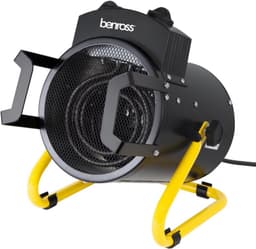
No source we used states an official UK square-metres-per-kilowatt figure for a garage. Seller lines are not that figure. The Benross claims 30 m². The 2 kW DAHTEC fields say 215 sq ft, and the yellow bullets also say up to 20 m². The 2.8 kW fields say 301 sq ft. Do not turn 301 sq ft into a promise about a double garage. The reviews are anecdotes. One Benross buyer raised a small insulated workshop of about 770 cubic feet from 6°C to 15°C in 25 minutes. Another could not heat a wooden garage. Do not average those two. Daylight under the door puts you nearer the cold wooden bay.

2 kW or 3 kW in a garage

If the socket also runs the door, a freezer or a charger, stay at 2 kW. At 230 V that is about 8.7 A. The BGP1506-02 and the yellow BGP2305-20 both state 8.33 A. The BGP1506-02 is £46.75 and 4.1 from 87, with a 1.60 m lead. The yellow one is £29.74 and 4.4 from 129, and no tip-over switch is stated. Neither fixes an open door. Three kilowatts is the whole 13 A socket. The Benross states 13.64 A, over a 13 A fuse, with hot-plug reviews. Use it only on a dedicated sound socket, and stop if the plug warms. The socket rule in full is the construction heater buying guide. IPX4 does not make a wet garage an outdoor test. The field says Indoor.

Leaving it on before you work

People who were pleased had usually switched on before they started. The 25-minute rise from 6°C to 15°C is one insulated workshop of about 770 cubic feet, not your bay. A garage gym is the same idea, with you in the room, not a reason to leave the heater overnight. Placement and unplugging are on the how to use a construction heater page. If the bay is still cold after half an hour with the door shut, more time on the same fan will not turn it into a different building.

The hourly cost at home

Ofgem’s Direct Debit average for 1 October to 31 December 2026 is 26.32p per kWh in England, Scotland and Wales: about 53p an hour at a true 2 kW, 74p at 2.8 kW and 79p at 3 kW, before the thermostat cycles. That is a home tariff, not a site supply, and not a separate Northern Ireland rate. The Benross bullets still say 34p per kWh. That is the listing’s older claim. Once a small closed room hits the thermostat, the hour costs less. A draughty bay that never gets there costs the full hour and still feels cold.

When to stop looking at this set

Stop if the door stays open, if a double garage has already stayed cold, or if the only power is a 110 V yellow socket. None of these eight states 110 V, so swapping the plug is not a repair. Stop as well if you want all-day heat with nobody there. These are temporary heaters for a person in the room.

Common questions

Will 3 kW heat a double garage?
Not as a rule from these reviews. One 2.8 kW text mentions a double garage after plaster. A BGP3003-28 reviewer doubted a double garage. Benross reviews include a wooden garage that stayed cold and a small workshop that warmed. The 30 m² and 301 sq ft lines are seller claims. A large or draughty bay is the wrong expectation, and 13.64 A on the Benross is a separate reason to pause.
Is a single closed garage a fair job?
It can be, with the door shut and the space small. That is where Benross reviews most often say the fan helped, sometimes after a head start. A 2 kW ceramic at 8.33 A is the calmer choice on a shared socket. It will not feel like central heating, and a gap under the door changes the result. “Single and closed” is the condition, not “any garage”.
Is 2 kW better if the socket runs other tools?
It leaves headroom. These 2 kW listings state 8.33 A, against about 13 A at 3 kW and 13.64 A on the Benross. A socket that already feeds a door or a charger is a 2 kW conversation. You still need a cool plug and no reel. Headroom does not mean you can cover the heater or leave it on empty.
Why did some 3 kW heaters feel weaker than an older 2 kW?
The room and the listing do not always match. A SISUPASSIE review describes 2,000 W against a 3,000 W title, and another buyer found it colder than their 2,000 W heater. A 2.8 kW review disputed the output and reported a trip. A draught will also make a true 3 kW feel weak. Do not collapse that into “3 kW is worse”.
How much might an hour cost at home?
About 53p at a true 2 kW, 74p at 2.8 kW and 79p at 3 kW, on Ofgem’s 26.32p per kWh Direct Debit average for England, Scotland and Wales from 1 October to 31 December 2026, before the thermostat cycles. It is not a site tariff and not the 34p in the Benross bullets. If the room never warms, you pay the full hour and stay cold.

Related pages

Sources

Public UK sources last checked on 15 October 2026. Prices and star ratings are from the amazon.co.uk listings captured the same day.

  1. Ofgem: Changes to the energy price cap between 1 October and 31 December 2026 (retrieved 15.10.2026)
  2. The Workplace (Health, Safety and Welfare) Regulations 1992, regulation 7 (retrieved 15.10.2026)
  3. HSE: Temperature in the workplace, the law (retrieved 15.10.2026)
  4. HSE CIS59: welfare heat on construction sites (retrieved 15.10.2026)
  5. HSE: Carbon monoxide in construction (retrieved 15.10.2026)
  6. GOV.UK: Electrical Equipment (Safety) Regulations 2016 (retrieved 15.10.2026)
  7. Electrical Equipment (Safety) Regulations 2016, regulation 35 (retrieved 15.10.2026)
  8. Travis Perkins: How to use construction site heaters (retrieved 15.10.2026)