Independent comparisons. We may earn from shop links. More info

Electric or diesel site heater

Updated: 16.10.2026

You have seen a £50 electric fan and a hired diesel heater called the same thing. Choosing an electric or diesel site heater is mostly about fumes and about the size of the space. The [construction heater comparison](/hub/portable-heaters/construction-heater) is electric only: eight amazon.co.uk fans of 2 kW or 2.8–3 kW, from £29.74 to £67.15 on 15 October 2026. This page says when that set is enough and when you should hire. It does not rank the eight. A small closed garage stays on the garage page. Products Compared used the listings and public UK guidance, not a lab. A qualifying purchase can earn us a commission at no extra cost to you.

You have seen a £50 electric fan and a hired diesel heater called the same thing. Choosing an electric or diesel site heater is mostly about fumes and about the size of the space.

Our top picks

On this page

The electric fans in this comparison

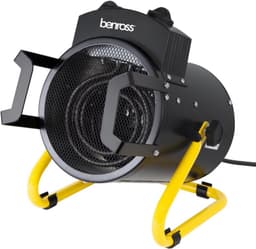
Every heater we kept is a portable electric fan. It does not burn fuel, so it does not put exhaust in the room. That is why HSE’s CIS59 prefers electrical heat in site welfare over LPG, which can give off carbon monoxide in a closed hut. The same fans are still a fire risk if you cover them, run them from a reel, or leave them on in an empty room. Standing and unplugging are on the how to use a construction heater page. Two kilowatts is about 8.7 A at 230 V. The Benross states 13.64 A. None states 110 V. One DAHTEC review describes drying plaster with a 2.8 kW fan. That is a small room, not a building.

Direct-fired heat

Direct-fired diesel or LPG burns in the space you are in. Travis Perkins describes it as a naked flame for ventilated or semi-enclosed places. Heat arrives quickly, and the gases arrive with it. Regulation 7 of the Workplace (Health, Safety and Welfare) Regulations 1992 requires heating that does not release injurious fumes. Those regulations do not cover construction sites. INDG244 says so. On site, HSE’s warning still stands: LPG in enclosed welfare can poison. A hut with the windows shut is the wrong place for a direct-fired heater. HSG150 talks about LPG needing vents that cannot be closed. Keep direct-fired heat where the air changes.

Indirect-fired heat

Indirect-fired diesel keeps the flame in a sealed chamber, flues the exhaust outside, and blows heated air in. Travis Perkins calls that air fume-free and usable indoors. Aggreko hires the class in the UK from 65 kW to 350 kW, including for construction drying. That is not a 3 kW plug. This is the usual answer for a large enclosed shell with people inside. The flue has to end outside. Gas Safe applies to gas work in a home or certain commercial premises, not to every site diesel. A hired unit still has to follow the hire firm’s siting rules.

110 V is neither of those

A yellow 110 V socket is not a reason to choose diesel, and it is not a reason to plug in one of these eight fans. Broughton sizes 110 V heaters at about 1.5 kW on a 16 A yellow plug and about 3 kW on 32 A. None of these amazon.co.uk listings states 110 V. Do not fit a yellow plug to a 230 V fan: the voltage is wrong, not just the pin shape. If the site is 110 V only, hire a 110 V heater. The construction heater buying guide explains the 13 A ceiling for the 230 V fans. It does not convert them into site plugs.

Which to choose

Use a plug-in fan from this set when the room is small, enclosed and on 230 V, and you will unplug it as you leave. Use indirect-fired heat, usually hired, when people are inside a large shell and the exhaust can go outside. Aggreko’s UK range starts at 65 kW, not 3 kW. Keep direct-fired heat in genuinely ventilated air. An alarm does not make an unflued heater safe indoors.

Common questions

When is an electric fan the right site heater?
When the room is small, enclosed and on 230 V, such as a site office, and you have a sound 13 A socket. These fans are 2 kW or 2.8–3 kW and they do not put combustion gases in the room. They are wrong for a whole shell, a 110 V socket, or a job that needs tens of kilowatts. You still switch them off when you leave, because fire risk is separate from fumes.
What is the difference between direct-fired and indirect-fired?
Direct-fired heat burns in the room. Travis Perkins treats it as a naked flame for ventilated or semi-enclosed places, so the fumes stay with you. Indirect-fired heat burns in a sealed chamber, flues outside, and blows heated air in, described as usable indoors. Aggreko’s UK indirect range runs from 65 kW to 350 kW. A 3 kW electric fan is neither machine.
Can I run a diesel heater in a closed room?
Only if it is indirect-fired, the exhaust is flued outside, and the siting rules are followed. Direct-fired diesel or LPG in a closed hut puts combustion gases where people are. HSE warns that LPG in enclosed welfare can cause carbon monoxide poisoning. Shut windows are not the ventilation that guidance expects. If you cannot flue it, do not run it there.
Why do site huts get told to avoid LPG?
LPG heaters and cookers in enclosed welfare can release carbon monoxide. CIS59 prefers electrical heat for that reason. Regulation 7 also requires heating without injurious fumes, though INDG244 says those workplace regulations do not cover construction sites. Use electric heat in a small closed hut when the socket can feed it, rather than an unflued gas heater.
Will a 3 kW electric fan dry a whole building?
No. Three kilowatts is one socket, and the Benross states 13.64 A. One review mentions drying plaster with a 2.8 kW fan. That is a small room. Building drying is the Aggreko indirect range from 65 kW, with the exhaust outside. More hours on a plug-in fan do not make that hire unit.
What if the site only has 110 V sockets?
Hire or buy a 110 V heater. Broughton puts about 1.5 kW on 16 A and about 3 kW on 32 A. None of these eight fans states 110 V. Do not fit a yellow plug to a 230 V heater. Diesel is not the automatic substitute. A proper 110 V electric fan still avoids fumes in a small hut. A large shell may still need indirect heat.

Related pages

Sources

Public UK sources last checked on 15 October 2026. Prices and star ratings are from the amazon.co.uk listings captured the same day.

  1. Ofgem: Changes to the energy price cap between 1 October and 31 December 2026 (retrieved 15.10.2026)
  2. The Workplace (Health, Safety and Welfare) Regulations 1992, regulation 7 (retrieved 15.10.2026)
  3. HSE: Temperature in the workplace, the law (retrieved 15.10.2026)
  4. HSE CIS59: welfare heat on construction sites (retrieved 15.10.2026)
  5. HSE: Carbon monoxide in construction (retrieved 15.10.2026)
  6. GOV.UK: Electrical Equipment (Safety) Regulations 2016 (retrieved 15.10.2026)
  7. Electrical Equipment (Safety) Regulations 2016, regulation 35 (retrieved 15.10.2026)
  8. Travis Perkins: How to use construction site heaters (retrieved 15.10.2026)