Independent comparisons. We may earn from shop links. More info

Construction heater buying guide

Updated: 16.10.2026

You are in a cold garage, or a site cabin with one wall socket, and every listing shouts a wattage. This construction heater buying guide is the step before a model name: what the plug can feed, what the element does, and what a splash code does not promise. The [construction heater comparison](/hub/portable-heaters/construction-heater) ranks eight amazon.co.uk electric fans, from £29.74 to £67.15 on 15 October 2026. None is a 110 V heater, and none burns diesel. The Products Compared editorial team used those listings and the UK sources named here. We did not run a lab test. A qualifying purchase through our links can earn us a commission at no extra cost to you.

You are in a cold garage, or a site cabin with one wall socket, and every listing shouts a wattage.

Our top picks

On this page

What you are actually choosing

Hire shops use “construction heater” for almost anything temporary. This set is eight portable electric fans of 2 kW or 2.8–3 kW, for a garage, a workshop or a small site room on ordinary mains. If the only power is a yellow 110 V socket, none of these eight is the tool. Broughton’s guide puts about 1.5 kW on a 16 A yellow plug and about 3 kW on 32 A. Changing a domestic plug for a yellow one is not a conversion to improvise. A large enclosed shell belongs on the electric or diesel site heater page, usually as a hire.

The 13 A socket

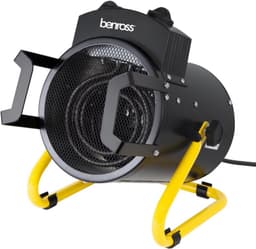
Greater Manchester Fire and Rescue Service treats about 3,000 W as the top of a domestic wall socket, and a hot plug as a fault. At 230 V, 2 kW is about 8.7 A and 2.8 kW is about 12.2 A. A 3 kW load is the whole socket, so an extension reel is the wrong way to buy distance. The two 2 kW DAHTEC ceramics both state 8.33 A. The BGP3003-28 states 12.7 A. The BGP3007-28 pair states 12.73 A at 220 V. The Benross 42450 states 13.64 A at 220 V, above a 13 A fuse, and reviews describe hot plugs. One heater, one sound wall socket. If the plug warms, switch off. Whether that wattage can lift your bay is the electric garage heater page.

Element, thermostat and tip-over

The BGP1506-02 bullets say noticeable warmth in about 3 seconds. The 2.8 kW coil listings say about 5–10 minutes to feel comparable with ceramic. That gap is warm-up, not proof the coil is weaker once hot. A ceramic element is not cheaper per hour than a coil at the same true output. Prefer a stated thermostat and overheat cut-out. Most of these eight have both. Only the TCP 2 kW heater states a tip-over switch, and that listing is 5.0 from 2 reviews, with the element field saying coil while the bullets say PTC.

Splash ratings

On the Creoven table to EN 60529, a second digit 4 means splashing water, and a first digit 2 means solids larger than 12.5 mm. IP24, on the black and silver BGP3007-28, is that pair. IPX4, on the Benross, is the splash test with no solids claim. Neither code is a hose, and neither means you can leave the heater in rain. The Benross title says waterproof. The code is IPX4, and the indoor field says Indoor, so the title overclaims the code. A patio line with no IP number is incomplete.

What to do with the price

On 15 October 2026 the prices fell into three bands. Under £40: the yellow DAHTEC at £29.74 (4.4 from 129) and the TCP at £34.00 (5.0 from 2). Around £45 to £50 sit the BGP1506-02, the Benross and the SISUPASSIE. At £67.15 sit the BGP3003-28 and the BGP3007-28 pair. A higher price here does not buy a larger sample. Ofgem’s Direct Debit average for 1 October to 31 December 2026 is 26.32p per kWh in England, Scotland and Wales: about 53p an hour at a true 2 kW, 74p at 2.8 kW and 79p at 3 kW, before the thermostat cycles. A site tariff is not this cap.

Common questions

Can I run a 3 kW construction heater from a normal UK socket?
A 13 A wall socket tops out near 3,000 W. Greater Manchester Fire and Rescue Service treats that as the ceiling, and treats a hot plug as a fault. At 230 V, 3 kW is about 13 A, so nothing else should share that outlet. The Benross 42450 states 13.64 A, already over a 13 A fuse. Plug one heater straight into a sound wall socket, and do not use an extension reel.
Why do people say the plug gets hot?
A hot plug or socket means too much current, or a poor contact. In this set the pattern is in the Benross reviews: hot plugs, hot sockets and hot extensions, including one comment that sockets went red hot. The listing states 13.64 A. Switch off and unplug. If the faceplate or plug is damaged, that is an electrician’s job, not a lower setting to try again.
Is 2 kW enough, or do I need 3 kW?
Two kilowatts leaves headroom. The 2 kW DAHTEC listings state 8.33 A. Three kilowatts is the whole socket, and the Benross states more than 13 A. Reviews sometimes warm a small closed garage and often fail in a draughty or double bay. More watts on the title do not close a gap under the door. If the circuit already runs lights or a charger, stay at 2 kW.
What does IPX4 waterproof actually mean?
IPX4 is a splash test. The X means no solids rating is claimed. It is not a hose seal and not rain protection. The Benross title says waterproof while the code is IPX4 and the field says Indoor. IP24, on the 2.8 kW DAHTEC pair, adds solids larger than 12.5 mm and is still only a splash rating. Keep both indoors, clear of standing water.
Do I need a 110 V heater on a building site?
You need 110 V if that is the only socket on site. Broughton puts about 1.5 kW on a 16 A yellow plug and about 3 kW on 32 A. None of these eight listings states 110 V. A 230 V fan belongs on a 230 V socket, such as a site office that has one, not on a plug you have changed yourself.

Related pages

Sources

Public UK sources last checked on 15 October 2026. Prices and star ratings are from the amazon.co.uk listings captured the same day.

  1. Ofgem: Changes to the energy price cap between 1 October and 31 December 2026 (retrieved 15.10.2026)
  2. The Workplace (Health, Safety and Welfare) Regulations 1992, regulation 7 (retrieved 15.10.2026)
  3. HSE: Temperature in the workplace, the law (retrieved 15.10.2026)
  4. HSE CIS59: welfare heat on construction sites (retrieved 15.10.2026)
  5. HSE: Carbon monoxide in construction (retrieved 15.10.2026)
  6. GOV.UK: Electrical Equipment (Safety) Regulations 2016 (retrieved 15.10.2026)
  7. Electrical Equipment (Safety) Regulations 2016, regulation 35 (retrieved 15.10.2026)
  8. Travis Perkins: How to use construction site heaters (retrieved 15.10.2026)