Independent comparisons. We may earn from shop links. More info

Pool test strips vs tablets: when the pad is enough

Updated: 21 October 2026

You are choosing between a bottle of pool test strips and a Lovibond block at about £20, and both of them are still a colour you match by eye. Pool test strips vs tablets is a question of which colour, how often you will test, and which chemicals the method cannot see. Strips in the [pool tester comparison](/hub/pool-care/pool-tester) are a few pence a dip and cover more names on one strip. The kept tablet kit is 20 tests at £19.99 and reads free chlorine and pH only. Shelf prices are the saved amazon.co.uk listings. We did not lab-test either method. A qualifying purchase can earn a commission at no extra cost to you.

You are choosing between a bottle of pool test strips and a Lovibond block at about £20, and both of them are still a colour you match by eye.

Our top picks

On this page

What each method actually reads

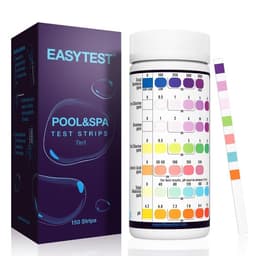
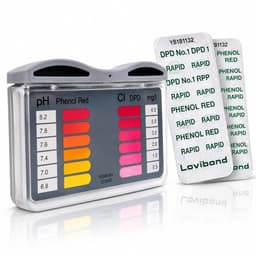
EASYTEST’s 7-way at £15.99 names free and total chlorine, so you can subtract and see combined chlorine. RAP at £12.92 does not name total chlorine. AquaChek at £12.15 names free chlorine, pH, alkalinity and cyanuric acid, and it does not name bromine. A name that is missing is a chemical you cannot dose from that bottle. The Lovibond kit, ASIN B01NBGWSXA, is DPD No.1 Rapid for free chlorine and phenol red Rapid for pH, on scales of 0.5–6.0 mg/l and 6.8–8.2. Alkalinity, hardness, cyanuric acid and bromine are not named. Camlab notes that total chlorine needs a further tablet, and that tablet is not in the kept kit. If cyanuric acid changes your outdoor dose, this block is the wrong instrument. That case is on the pool test kit buying guide.

Why the colours disagree

The rapid tablets on this listing are described as individually sealed, with a five-year shelf life stated. EASYTEST strips are 90 days once opened. A pot left by the tub in July is not the chemistry you bought. Pads also fail while they are still in date. UK reviews on EASYTEST’s 3-in-1 describe a chlorine pad that stayed white. HLLNWB reviews say colours are missing from the bottle chart. Canadian Spa reviews describe strips that disagreed on one dip. A faint pad is not a low result. Tablets are not automatically right. Of 13 UK reviews on the Lovibond kit, several say the block is easier to read than strips. One showed a high chlorine colour on tap water. The star line is 4.4 from 57. The manufacturer field says Mrfilm.

Cost, and how fast you will run out

A 150-strip bottle in this set is a few pence a dip. EASYTEST’s 3-in-1 is £11.04, about 7p if 150 arrive. AquaChek’s 50 strips at £12.15 are about 24p each. The Lovibond kit is £19.99 for 20 tests, about £1 a test before a refill whose price is not stated. Four soaks a week is about 16 tests a month, so 20 Lovibond tests last a little over a month. The spa habit is on hot tub water test.

A sensible split

Use strips for the frequent screen, and the tablet block when two strips disagree or a large dose hangs on one colour. You still only learn free chlorine and pH from that block. If the argument is alkalinity or cyanuric acid, a pool-shop sample is the next step, not a third strip from the same pot. Choose the block as your only tester when you rarely test and liquid colours are easier for you than pads. Skip it as a daily hot-tub kit. Choose strips when you test often and UK reviews of that bottle do not describe colours that run. Canadian Spa at £5.99 fails that test. A passing colour is not a Cryptosporidium, Pseudomonas or Legionella result. If paying guests use the water, or a second method still leaves it cloudy or green, stop and call a pool engineer or the retailer. The timed steps are on how to use pool test strips.

Common questions

Why do tablets cost more per test?
The Lovibond kit is £19.99 for 20 tests, about £1 each before a refill. A 150-strip bottle in this set is a few pence a strip, and AquaChek’s 50 is about 24p. You are paying for a liquid colour on a printed mg/l scale, and for fewer tests. Refill sizes 100, 250 and 500 are named. The refill price is not stated. The block also reads fewer parameters than a wide strip.
What does this Lovibond kit not measure?
Alkalinity, hardness, cyanuric acid, bromine and total chlorine. It is free chlorine on DPD No.1 Rapid, 0.5–6.0 mg/l, and pH on phenol red Rapid, 6.8–8.2. A DPD tablet for total chlorine is not in the listing. If you need combined chlorine, this kit cannot show it. If the pool is outdoors on trichlor, you still need a cyanuric acid check somewhere else.
Do the tablets go off once the box is open?
The listing says the rapid tablets are blister-packed and states a five-year shelf life. That is not the same as an opened strip pot. EASYTEST strips are 90 days once opened. BISHTA says you do not use out-of-date strips or tablets. A five-year claim is not a reason to use a tablet that is crushed, damp or past the date on the foil.
Can I use strips most days and tablets when the colour looks wrong?
Yes. That is the sensible split for a home chlorine pool. Strips for the frequent screen. The Lovibond block when two strips disagree or before a large dose. The block still only tells you free chlorine and pH. It will not settle an alkalinity or cyanuric acid argument. One UK review read high chlorine on tap water, so the tablet is a second colour, not an automatic correction.
Which accuracy claim is off limits?
Do not say this Lovibond kit is professionally accurate because the brand says so. The listing states the scales, 4.4 from 57 reviews, a high chlorine colour on tap water, and a manufacturer field of Mrfilm. Do not say a passing strip or tablet means the water is free of Cryptosporidium, Pseudomonas or Legionella. Do not say any kept strip meets PWTAG.

Related pages

Sources

Public UK sources for managed-pool chemistry, hot-tub factsheets and chlorine colour chemistry, taken from the research digest. Listing prices, stars and review counts are from amazon.co.uk on 19 October 2026.

  1. PWTAG code of practice (retrieved 19 October 2026)
  2. HSE HSG179 — Health and safety in swimming pools (retrieved 19 October 2026)
  3. HSE — swimming pool safety (retrieved 19 October 2026)
  4. PWTAG TN53 — microbiological testing (retrieved 19 October 2026)
  5. BISHTA — water treatment factsheet (retrieved 19 October 2026)
  6. BISHTA — regular maintenance factsheet (retrieved 19 October 2026)
  7. BISHTA — responsibilities for HSG282 for hot tubs (retrieved 19 October 2026)
  8. Camlab — measuring chlorine in a swimming pool or hot tub (retrieved 19 October 2026)
  9. Pool Chemicals — testing guide (retrieved 19 October 2026)