Independent comparisons. We may earn from shop links. More info

Pool test kit buying guide: which readings to pay for

Updated: 21 October 2026

You have a garden pool or a hot tub, a bottle of chlorine or bromine, and a search for a pool test kit buying guide that keeps offering a seven-way strip as if more pads were the same as a better reading. The useful order is the sanitiser you actually dose, then pH and alkalinity, then only the extra pads you will change a dose for. Shelf prices are the ones in the [pool tester comparison](/hub/pool-care/pool-tester) on amazon.co.uk on 19 October 2026, from £5.99 to £19.99. We did not lab-test a bottle. A qualifying purchase can earn a commission at no extra cost to you.

You have a garden pool or a hot tub, a bottle of chlorine or bromine, and a search for a pool test kit buying guide that keeps offering a seven-way strip as if more pads were the same as a better reading.

Our top picks

On this page

What you actually need to read

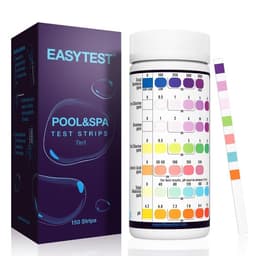
A normal domestic check is the sanitiser you use, pH, and total alkalinity. Free chlorine is the pad for a chlorine pool. Bromine is the pad for a bromine tub. A shared free-chlorine/bromine description is one colour on the chemical already in the water. If alkalinity is well off, pH wanders. PWTAG’s extract says alkalinity 80–200 mg/l. BISHTA’s water-treatment sheet says 80–120 mg/l, and its maintenance sheet says 80–160 ppm. Quote the sheet that matches the water. Spa bands sit on hot tub water test. The EASYTEST 3-in-1 at £11.04 names alkalinity, free chlorine, bromine and pH, while the title still says 3-in-1. Clearwater CH0067 at £9.99 names chlorine, pH, alkalinity and bromine. If those four are what you will act on, a wider bottle is an extra you can skip. Dip times stay on how to use pool test strips.

When extra pads earn their place

Cyanuric acid is worth a pad when the pool is outdoors on dichlor or trichlor. It is the wrong extra for a bromine tub. AquaChek yellow, model 511244, 50 strips at £12.15, adds cyanuric acid and does not name bromine. RAP’s 100 strips at £12.92 add cyanuric acid and total hardness, with free chlorine and bromine on one description. Total chlorine earns its place only if you will subtract free chlorine and look at combined chlorine. EASYTEST’s 7-way at £15.99 and HLLNWB’s 7-in-1 at £7.99 both name free and total chlorine. Hardness is a scale question, not a Sunday top-up of sanitiser. EASYTEST’s 7-way is 4.5 from 20,849 reviews, and UK reviews in the file still doubt the cyanuric acid pad,.HLLNWB is 4.4 from 455, and UK reviews say colours are missing from the bottle chart.

Strips or a tablet block

Strips are one dip and a chart. A tablet comparator is two liquid colours in a plastic block. Lovibond at £19.99 covers 20 tests. DPD No.1 Rapid reads free chlorine from 0.5 to 6.0 mg/l. Phenol red Rapid reads pH from 6.8 to 8.2. Alkalinity and cyanuric acid are not named. If the missing pad is the one you would act on, the block is the wrong method. One UK reviewer says the parcel had no usable instructions. Another saw a high chlorine colour on tap water. The star line is 4.4 from 57 reviews. A printed scale helps when pad colours defeat you. It is not a professional-accuracy certificate, and the manufacturer field says Mrfilm. The method choice is on pool test strips vs tablets.

What the listing prices are for

Under £10: Canadian Spa at £5.99 for 50, HOVIRAN at £7.29 for 125, HLLNWB at £7.99 for 150, and Clearwater at £9.99. Lovibond is £19.99 for 20 tablet tests. As a rule of thumb, a 150-strip bottle is a few pence a dip, AquaChek’s 50 is about 24p a strip, and a Lovibond test is about £1 before a refill. Clearwater’s title says 50 strips and one bullet says 25. EASYTEST states 90 days once opened, so twice a week will not finish 150 strips in that window. Canadian Spa is 3.9 from 782, The cheapest line is not the default buy.

Common questions

Which three tests matter every week?
Sanitiser, pH and total alkalinity. Use a free-chlorine pad for chlorine and a bromine pad, or a shared chlorine/bromine description, for bromine. ManoMano’s UK buying guide suggests sanitiser and pH at least weekly and ideally daily, with alkalinity less often. That is a retailer guide, not a statute. A hot tub is tested before use, which is a different habit from a weekly pool check.
When is a cyanuric acid pad worth paying for?
When the pool is outdoors and you dose dichlor or trichlor. Stabiliser changes how you read the chlorine residual. A bromine tub does not need that pad. AquaChek’s yellow 50-pack at £12.15 is the kept four-way that names cyanuric acid and does not name bromine. A seven-way that names the pad is not proof the pad works. UK reviews on EASYTEST’s 7-way doubt it.
Is a seven-way strip better than a three-way?
Only if you will act on the extra pads and you can match the chart. Free chlorine or bromine, pH and alkalinity cover a normal check. Total chlorine helps if you will subtract it from free chlorine. Hardness is for scale. EASYTEST’s 3-in-1 title says 3-in-1 while a bullet lists four tests, so read the named parameters, not the slogan on the title.
Do I need a total-chlorine pad?
You need it if you want to see combined chlorine, which is total minus free. PWTAG’s managed-pool extract says combined chlorine should stay under half the free chlorine and no more than 1 mg/l. A single chlorine pad cannot show that split. EASYTEST’s 7-way and HLLNWB name both. RAP’s listing does not name total chlorine, and one UK reviewer says it reads free chlorine only.
Are strips enough, or do I need tablets?
Strips are enough for a frequent screen of the pads you can read. The Lovibond block in this set is the better check when you only need free chlorine and pH on a printed scale, or when a pad colour would make you add a large dose. It does not read alkalinity or cyanuric acid. Pool Chemicals calls strips quicker and less precise. Neither method is a laboratory result.

Related pages

Sources

Public UK sources for managed-pool chemistry, hot-tub factsheets and chlorine colour chemistry, taken from the research digest. Listing prices, stars and review counts are from amazon.co.uk on 19 October 2026.

  1. PWTAG code of practice (retrieved 19 October 2026)
  2. HSE HSG179 — Health and safety in swimming pools (retrieved 19 October 2026)
  3. HSE — swimming pool safety (retrieved 19 October 2026)
  4. PWTAG TN53 — microbiological testing (retrieved 19 October 2026)
  5. BISHTA — water treatment factsheet (retrieved 19 October 2026)
  6. BISHTA — regular maintenance factsheet (retrieved 19 October 2026)
  7. BISHTA — responsibilities for HSG282 for hot tubs (retrieved 19 October 2026)
  8. Camlab — measuring chlorine in a swimming pool or hot tub (retrieved 19 October 2026)
  9. Pool Chemicals — testing guide (retrieved 19 October 2026)