Independent comparisons. We may earn from shop links. More info

How to use your pool test strips: skip a late colour

Updated: 21 October 2026

You are holding a strip bottle or a Lovibond block, and the last reading sent you to the shed for a dose you now doubt. How to use pool test strips, on the bottle in your hand, is a short timed colour match. A generic internet method is the usual way to get the wrong shade. The times below are the ones printed on the listings in the [pool tester comparison](/hub/pool-care/pool-tester). Where a listing does not state a wait, this page does not invent one. We did not dose a pool. A qualifying purchase can earn a commission at no extra cost to you.

You are holding a strip bottle or a Lovibond block, and the last reading sent you to the shed for a dose you now doubt. How to use pool test strips, on the bottle in your hand, is a short timed colour match.

Our top picks

On this page

Before the strip touches the water

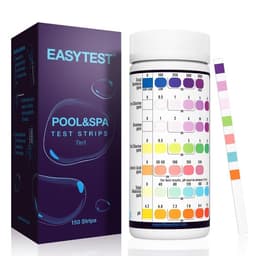
Start with a bottle that is still in date. BISHTA says you do not use out-of-date strips or tablets. EASYTEST states two years from manufacture and 90 days once opened. Clearwater does not state a shelf life, and one UK reviewer found no date on that bottle. Dry fingers matter, because wet fingers spoil the unused strips in the pot. Take the sample away from a return jet or a waterfall. PWTAG’s managed-pool code says sample at about 100–300 mm below the surface. Turn spa jets off before you dip. Follow the chart and the dip time on the bottle you opened.

Dip, wait, hold the strip flat

The kept listings do not share one clock. EASYTEST says dip for 1 second, then hold the strip level for 15 seconds. Clearwater says remove immediately, then wait 15 seconds. HOVIRAN says 2 seconds in the water, then 30 seconds. RAP says wait 30 seconds and does not state a dip time. HLLNWB says dip for 2 seconds, and the wait is not stated. AquaChek and Canadian Spa do not state a wait. Do not copy 15 seconds onto those two. Hold the strip flat so one pad does not run into the next. Read at the stated second. An EASYTEST review says the colour keeps changing after that time, so a late glance drifts. If you are still matching an EASYTEST 7-way at 40 seconds, you are reading a different test from the one the listing describes.

Match the colour in daylight

Natural daylight is the light these charts assume. A warm kitchen bulb shifts reds and greens, and LaMotte notes that indoor sodium lighting can move an alkalinity colour. Keep the strip and the chart in the same light. If two neighbouring blocks both look possible, you do not have a result yet. Two strips that disagree are a failed reading, not an average. Canadian Spa’s UK reviews include strips used together that did not agree. HLLNWB reviews say colours are missing from the bottle chart. A colour that is not on the chart is a reason to stop. If this keeps happening, the method choice is on pool test strips vs tablets.

When the pad lies

A white chlorine pad is not automatically zero chlorine. EASYTEST’s 3-in-1 reviews include a pad that stayed white. Camlab says a DPD colour can bleach when chlorine is high and look empty. If a second strip is also blank and the water smells strongly of chlorine, suspect too much, not none. The Lovibond block is the second method when two strips disagree or a large dose hangs on the colour. DPD No.1 Rapid is free chlorine, 0.5–6.0 mg/l. Phenol red Rapid is pH, 6.8–8.2. One UK review showed a high chlorine colour on tap water. If the water stays cloudy or green, or paying guests use it, stop dosing and call a pool engineer or the retailer. Hot-tub timing is on hot tub water test.

Common questions

How long do I leave the strip in the water?
Use the seconds on that bottle. EASYTEST says 1 second. HOVIRAN and HLLNWB say 2 seconds. Clearwater says remove immediately. RAP, AquaChek and Canadian Spa do not state a dip time in seconds. Another brand’s dip is not a substitute. Follow the bottle you opened.
When do I read the colour?
EASYTEST and Clearwater say 15 seconds. RAP and HOVIRAN say 30 seconds. HLLNWB states a 2-second dip and does not state the wait. AquaChek and Canadian Spa do not state a wait, so do not borrow 15 seconds from a different listing. Read at that mark. An EASYTEST review says the colour keeps moving after the stated time.
Why did two strips from one bottle disagree?
They were out of date, the pads got wet in the pot, you read one of them late, or that batch does not match its chart. Canadian Spa reviews describe strips in one test that disagreed. Repeat once. If they still disagree, do not average them and do not dose from them. Use a second method or a pool-shop sample.
The chlorine pad is white. Is the chlorine zero?
Not necessarily. A white pad can be a dead strip, which shows up in EASYTEST reviews, or a high chlorine level that has bleached the reagent. Camlab describes DPD bleach-out above about the top of the scale, with a flash of colour that fades. Dip again before you add shock. A strong chlorine smell with a blank pad is a reason to suspect too much, not none.
Can I read the strip under the kitchen light?
Daylight is the safer light. Warm bulbs and sodium lighting shift reds, greens and alkalinity colours. LaMotte warns about indoor sodium light. Take the bottle to a window and compare the strip and the chart together. If you cannot separate two neighbouring blocks, you do not have a number yet.
How do I use the Lovibond block?
Fill the comparator, dissolve DPD No.1 Rapid for free chlorine and phenol red Rapid for pH, and match the liquid to the scales printed on the kit: 0.5–6.0 mg/l and 6.8–8.2. A wait time is not stated. One parcel arrived without usable instructions. The kit does not name alkalinity or cyanuric acid. Tablets are stated as blister-packed, with a five-year life claimed for the rapid tablets.

Related pages

Sources

Public UK sources for managed-pool chemistry, hot-tub factsheets and chlorine colour chemistry, taken from the research digest. Listing prices, stars and review counts are from amazon.co.uk on 19 October 2026.

  1. PWTAG code of practice (retrieved 19 October 2026)
  2. HSE HSG179 — Health and safety in swimming pools (retrieved 19 October 2026)
  3. HSE — swimming pool safety (retrieved 19 October 2026)
  4. PWTAG TN53 — microbiological testing (retrieved 19 October 2026)
  5. BISHTA — water treatment factsheet (retrieved 19 October 2026)
  6. BISHTA — regular maintenance factsheet (retrieved 19 October 2026)
  7. BISHTA — responsibilities for HSG282 for hot tubs (retrieved 19 October 2026)
  8. Camlab — measuring chlorine in a swimming pool or hot tub (retrieved 19 October 2026)
  9. Pool Chemicals — testing guide (retrieved 19 October 2026)