Independent comparisons. We may earn from shop links. More info

How to use pH minus

Updated: 21 October 2026

The test says the water is high, the tub is in your hand, and the next mistake is easy: a dry dump on the liner, a second dose before the first has mixed, or a jug that still holds chlorine. This is how to use pH minus on a UK pool or spa without treating a blog as the label. The grams on your tub beat any rate on this page. Pack choice lives on the [pH minus comparison](/hub/pool-care/ph-minus). The Products Compared editorial team used amazon.co.uk listing text and public UK sources on 19 October 2026. We did not dose a pool. A qualifying purchase can earn a commission at no extra cost to you.

The test says the water is high, the tub is in your hand, and the next mistake is easy: a dry dump on the liner, a second dose before the first has mixed, or a jug that still holds chlorine.

Our top picks

On this page

Test, then read this tub

Dose only after a fresh test that shows the water is high. A reducer will not correct a low reading, and it will not sanitise the water. If you do not know the litres, you cannot use even a clear label. A spa and a garden pool are not the same spoon. Labels in the UK do not agree. Some 2you bullets say 10 g per 1,000 litres lowers pH by 0.2. Clearwater-style spa tables use about 10 g per 1,000 litres for a 0.1 move. All Swim and Blue Horizons use about 50 g per 4,545 litres. Neither rate was measured by us. If your parcel has no table, do not borrow the 2you bullet.

Dissolve, then pour

Pre-dissolve unless the label in your hand truly says otherwise. The usual instruction on UK pool brands is chemical into water, not water into a heap of powder, in a clean plastic bucket. All Swim's sheet says add the chemical to water, wear eye and face protection, and never mix it with chlorine. Blue Horizons describes up to 100 g in 10 litres of warm water, with the pump running. That ratio is one brand's method. Use it only if it matches your label. Do not broadcast dry granules across a liner. Keep the pump or the spa jets running. A Relax review is the warning on temperature: mixing water that was too warm gave off a cough-inducing vapour. Warm, as the label says, is not hot water from the kettle. Use a bucket that has not just held chlorine or bromine.

Retest and bathing are different waits

The clock on the label is for the next test, not a promise that you may swim. Blue Horizons and All Swim tell you to recheck after a minimum of eight hours. Shatchi's listing says at least four hours. Hydrospares prints a recheck around 30 minutes on a small-tub method. Those are three different products. Pick the number printed on yours before you pour. Bathing is a second clock. 1st Direct Pools treats pH balancers as about 20–30 minutes, says an hour is wiser, and still says follow the manufacturer. That note does not overrule an eight-hour recheck. A second dose before the first test is how a spa gets driven too low.

Eyes and chlorine gas

Sodium bisulphate is classified, on the GB safety data sheet All Swim publishes, as causing serious eye damage (Eye Dam. 1, H318). Goggles are part of the dose. If powder or solution gets in an eye, rinse and get medical help. This page will not invent a first-aid routine beyond that. HSE guidance treats acid meeting hypochlorite as a chlorine-gas risk: a bucket that held liquid chlorine, a shared scoop, or powders in one damp cupboard. Store the reducer cool and dry, away from chlorine and children. If you are still choosing liquid hydrochloric acid, read dry acid versus liquid acid before the two share a jug.

Common questions

Which dose do I use if blogs disagree?
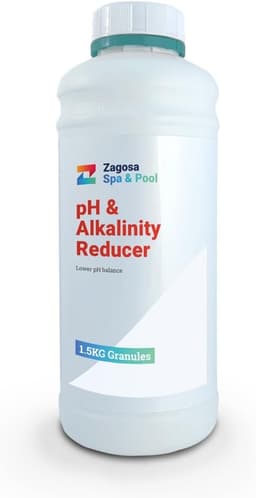
The dose printed on the tub in your hand. Seller bullets in this comparison are not one UK standard. One line says 10 g per 1,000 litres moves pH by 0.2. Spa tables elsewhere use a similar mass for a 0.1 move. Pool sheets often say about 50 g per 4,545 litres. If Zagosa, Deep Blue, HTH, Bayrol or Waterman arrived with no grams, do not copy the 2you bullet. Read the label in the parcel or contact the seller.
How long until I test again?
Use the recheck time on your label, and choose it before you pour. Examples on UK pages include about 30 minutes on a spa method, at least four hours on one amazon.co.uk listing, and a minimum of eight hours on Blue Horizons and All Swim. Those clocks belong to those products. Testing two minutes after the pour does not describe the whole pool.
When can I get back in?
Follow the manufacturer. A general UK article puts pH balancers at about 20–30 minutes before bathing, and says an hour is wiser. That is not permission to ignore a label that says wait eight hours before you retest. Swim-wait and retest-wait are different. A fresh test after the label's interval still has to show a sane pH and a residual sanitiser.
Can I mix it in a jug that held chlorine?
No. Acid and hypochlorite can release chlorine gas, which is the HSE warning, not a tidiness tip. Use a clean plastic bucket that has not just held chlorine or bromine. Do not combine dry acid and liquid pool acid to save a step. Store the tubs apart, dry, and closed. If a mix has already happened and anyone is coughing or distressed, get out and get emergency help.
What if powder gets in an eye?
The GB classification used on the All Swim sodium bisulphate sheet is serious eye damage, H318. Rinse and get medical help. Do not finish the dose first, and do not rely on this page for a treatment plan. Goggles before you open the tub are the control you still have. Skin contact is a reason to wash as the safety sheet says, and an eye is the injury to treat as urgent.

Related pages

Sources

Public UK sources used for this page in October 2026. Shelf prices and star lines are the amazon.co.uk figures for these eleven listings.

  1. PWTAG: Choosing an acid pH correctant (retrieved 21 October 2026)
  2. PWTAG: Carbon dioxide for pH control (retrieved 21 October 2026)
  3. PWTAG: Sulphate attack TN3 (retrieved 21 October 2026)
  4. HSE: Swimming pools (retrieved 21 October 2026)
  5. HSE: Managing health and safety in swimming pools (HSG179) (retrieved 21 October 2026)
  6. BISHTA: Water treatment (retrieved 21 October 2026)
  7. BISHTA: Daily, weekly, monthly and annual hot tub checks (retrieved 21 October 2026)
  8. All Swim: Pool acid safety data sheet (retrieved 21 October 2026)