pH minus granules buying guide
You have a high reading on a UK test strip, and the basket is full of tubs that all say pH minus. This pH minus granules buying guide is about matching the grams in the tub to the vessel you actually treat, and about refusing a listing whose weight or chemical name does not hold together. Shelf prices below come from the [pH minus comparison](/hub/pool-care/ph-minus) on 19 October 2026. They are this batch on amazon.co.uk, not a cheapest-in-Britain survey. The Products Compared editorial team compared those listings with public notes from BISHTA and PWTAG. We did not lab-test a tub. A qualifying purchase can earn a commission at no extra cost to you.
You have a high reading on a UK test strip, and the basket is full of tubs that all say pH minus.
You have a high reading on a UK test strip, and the basket is full of tubs that all say pH minus. This pH minus granules buying guide is about matching the grams in the tub to the vessel you actually treat, and about refusing a listing whose weight or chemical name does not hold together. Shelf prices below come from the pH minus comparison on 19 October 2026. They are this batch on amazon.co.uk, not a cheapest-in-Britain survey. The Products Compared editorial team compared those listings with public notes from BISHTA and PWTAG. We did not lab-test a tub. A qualifying purchase can earn a commission at no extra cost to you.
Our top picks
| Badge | Product | Pack size | Chemical named | Suitable for | Note | Price | Offer |
|---|---|---|---|---|---|---|---|
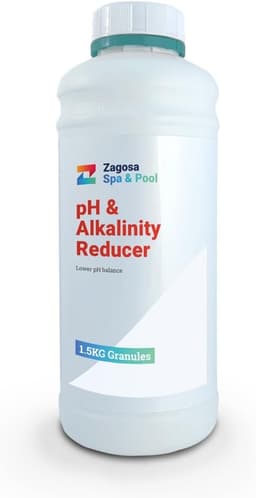
| Best overall |  Zagosa Zagosa pH minus granules, 1.5 kg | 1.5 kg (type says 1 kg) | Not named | Hot tub, spa and pools | 6.2 | about £10.95 | View offer |
 Zagosa Zagosa pH minus granules, 5 kg | 5 kg (1 kg bullet) | Not named | Spa, hot tub and pools | 8.1 | about £18.25 | View offer | |
| Alternative |  2you 2you pH reducer granules, 500 g | 500 g | Sodium bisulphate | Spa, pool, paddling pool | 5.0 | about £5.97 | View offer |


On this page
Start from the test, not the tub
Match the kilograms to the vessel
Read the listing before the price per kilo
Sodium bisulphate on the label
Common questions
Is 500 g enough for a hot tub?
Who should not buy an 18 kg bucket?
What if the title and the unit count disagree?
Is a pH plus and pH minus twin pack the same as pH minus?
Should I compare price per kilogram across a 1 kg spa tub and an 18 kg bucket?
Related pages
Sources
Public UK sources used for this page in October 2026. Shelf prices and star lines are the amazon.co.uk figures for these eleven listings.
- PWTAG: Choosing an acid pH correctant (retrieved 21 October 2026)
- PWTAG: Carbon dioxide for pH control (retrieved 21 October 2026)
- PWTAG: Sulphate attack TN3 (retrieved 21 October 2026)
- HSE: Swimming pools (retrieved 21 October 2026)
- HSE: Managing health and safety in swimming pools (HSG179) (retrieved 21 October 2026)
- BISHTA: Water treatment (retrieved 21 October 2026)
- BISHTA: Daily, weekly, monthly and annual hot tub checks (retrieved 21 October 2026)
- All Swim: Pool acid safety data sheet (retrieved 21 October 2026)