Independent comparisons. We may earn from shop links. More info

pH minus for a hot tub

Updated: 21 October 2026

You tested the spa before anyone got in, and the pH is sitting above the band again. On a domestic hot tub in the UK, including an inflatable of a few hundred litres up to about 1,500 litres, pH minus is the reducer you add only when that fresh test is high. You then retest, because the tub will not stay put on its own. The full pack table is the [pH minus comparison](/hub/pool-care/ph-minus). The Products Compared editorial team used BISHTA's factsheets and the amazon.co.uk listings in this set on 19 October 2026. We did not treat a tub. A qualifying purchase can earn a commission at no extra cost to you.

You tested the spa before anyone got in, and the pH is sitting above the band again.

Our top picks

On this page

The band you are aiming at

BISHTA's water-treatment sheet puts a domestic hot tub at pH 7.0–7.6. The daily-checks sheet says to add a reducer when the reading is above 7.6, and an increaser when it is below the bottom of the band. Lay-Z-Spa's guide uses pH plus below 7.2 and pH minus above 7.6. Add reducer because this morning's test is high. The checks sheet prefers a reading nearer 7.0. That is not a reason to drive a 7.3 down with a large scoop. Pool labels that print 7.2–7.6 are a pool target. If the reading is already inside 7.0–7.6, leave the reducer closed and check the sanitiser. A twin pack of pH plus and pH minus is the wrong grab when the only problem is a high reading.

Alkalinity is why one dose seems to fail

pH is the number you see. Alkalinity is the buffer that pulls it back. BISHTA does not print one alkalinity range. The daily-checks sheet says 80–160 ppm. The water-treatment sheet says 80–120 mg/l. Quote the sheet you are holding. Do not average them. Dry acid lowers pH and alkalinity. Very high alkalinity can swallow a modest dose and still read high. Bring both down in steps, with the jets running. One heaped scoop, because the first did nothing after ten minutes, is how you overshoot. Clearwater prints about 10 g per 1,000 litres for a 0.1 move. A 2you bullet prints the same mass as a 0.2 drop. If your tub has a gram table, use that.

A small tub is the right object

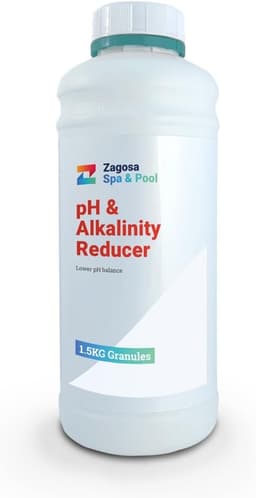
A 500 g to 1.5 kg tub matches this volume. A 5 kg bucket is a lot of powder for one inflatable unless you also run a pool. An 18 kg Bayrol bucket at £68.30 is the wrong object beside a Lay-Z-Spa. 2you and Zagosa name a hot tub. Waterman's bullets say swimming pools, and HTH and Bayrol do not name a vessel. The reviewed small packs that name a spa are Zagosa's 1.5 kg at £10.95 and Relax's 1.5 kg at £11.00. The bucket, the eyes and the chlorine rule are on how to use pH minus.

When pH climbs back

A high reading the next morning is common. Aeration strips dissolved carbon dioxide, and the pH rises, which is why PWTAG treats carbon dioxide gas as a poor tool for spas. Jets and a cover coming off push the same way. A mains top-up brings in the tap's alkalinity, and hypochlorite can nudge pH up. If pH is above 7.6, add a small reducer from the label, circulate, and wait out that clock. If label-correct doses still do not move the spa, ask a technician. pH minus is not the sanitiser.

Common questions

When do I add reducer rather than increaser?
Add pH minus when the fresh test is above 7.6. Add pH plus when the test is below the bottom of the band you are using. Do not add reducer because the tub was high last week. A twin pack that contains both chemicals is easy to open on the wrong side. If the test is already inside 7.0–7.6, leave both tubs shut and check the sanitiser residual instead.
How much for about 1,000 litres?
Use the gram table on your own tub. Clearwater's spa guide prints about 10 g per 1,000 litres to move pH by 0.1. A 2you seller bullet prints 10 g per 1,000 litres as a 0.2 drop. Those rates are not interchangeable, and neither was measured for this page. One UK review used about 60 g on a tub of about 950 litres. That is one result, not a standard. If your pack prints no grams, do not borrow another brand's table.
Why is it high again the next day?
Jets and aeration drive carbon dioxide out of the water, and the pH rises. A top-up from the mains brings in more alkalinity. Some sanitisers nudge pH up. Testing again before the first dose has mixed makes the climb look worse than it is. Check alkalinity before you blame the granules, and add the next dose only after the label's retest time. A second scoop ten minutes later is how you overshoot.
Will pH minus work if alkalinity is very high?
It can, and it will take more than one step, because the buffer resists the change. BISHTA prints alkalinity as 80–160 ppm on the checks sheet and 80–120 mg/l on the water-treatment sheet. Stay with the sheet you are using. Lower both in small additions with the jets running, and retest between them. If label-correct doses still do not move the spa, stop and get a technician.
Can I use the same granules with bromine?
Yes, as a pH reducer, if the listing is a dry-acid pH product and you do not mix the powders in one bucket. Bromine still has to be present as a residual. A tighter 7.4–7.6 habit appears on some bromine labels. That is a label pattern, not a second BISHTA band, unless the factsheet you are reading says it. Dose pH from the pH test, and dose bromine from the bromine test.

Related pages

Sources

Public UK sources used for this page in October 2026. Shelf prices and star lines are the amazon.co.uk figures for these eleven listings.

  1. PWTAG: Choosing an acid pH correctant (retrieved 21 October 2026)
  2. PWTAG: Carbon dioxide for pH control (retrieved 21 October 2026)
  3. PWTAG: Sulphate attack TN3 (retrieved 21 October 2026)
  4. HSE: Swimming pools (retrieved 21 October 2026)
  5. HSE: Managing health and safety in swimming pools (HSG179) (retrieved 21 October 2026)
  6. BISHTA: Water treatment (retrieved 21 October 2026)
  7. BISHTA: Daily, weekly, monthly and annual hot tub checks (retrieved 21 October 2026)
  8. All Swim: Pool acid safety data sheet (retrieved 21 October 2026)