Independent comparisons. We may earn from shop links. More info

Laurustinus or guelder rose

Updated: October 2026

You asked for a viburnum and two different shrubs came back: one still green in January, and one bare, with red fruit for birds. Viburnum tinus is laurustinus, evergreen and not native. Viburnum opulus is guelder rose, deciduous and native to Great Britain and Ireland. If you need leaves and winter flowers, choose V. tinus. If you want a native deciduous hedge and red fruit for birds, choose V. opulus. This set can sell you the first as a live plant. It cannot sell you the second as a pot. The [viburnum plant comparison](/hub/plant-accessories/viburnum-plant) is the tinus table. We did not run a garden trial. A qualifying purchase can earn a commission at no extra cost to you.

You asked for a viburnum and two different shrubs came back: one still green in January, and one bare, with red fruit for birds. Viburnum tinus is laurustinus, evergreen and not native.

Our top picks

On this page

Leaves in winter or a native hedge

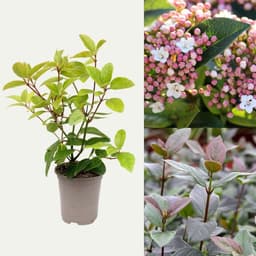
Laurustinus keeps its leaves. The RHS describes white flowers from pink buds in late winter and spring, then blue-black berries, on a shrub of about 2.5–4 m. Hardiness is H4, about −10 to −5°C, which covers most of the UK, with shelter from cold, drying winds. It is not a native British plant. A January screen, or a patio pot that should not go bare, points here. 'Gwenllian' is the named cultivar in this Amazon set, at 1.5–2.5 m on the RHS page. Gardeners' World says about 3 m. Those bands stay separate. Guelder rose drops its leaves. The RHS marks V. opulus as native to GB and Ireland, deciduous, to about 5 m, with white flowers and red fruit. You gain a native hedge plant and a winter that shows the fence. If privacy in January is the brief, guelder rose fails it. A listing that only says arrow wood, with no Latin name, is not evidence for either plant. The viburnum plant buying guide sorts those titles before you order.

Berries, birds, and people

The fruit is not one wildlife claim you can paste onto both shrubs. On V. tinus the berries are blue-black. The RHS says they are ornamental and not to be eaten, including where pets are concerned. Gardeners' World says 'Gwenllian' has no particular known value to wildlife. Use the RHS sentence on eating. Do not treat a magazine line as permission to taste them. On V. opulus the fruit is red. The BTO says bullfinches and mistle thrushes eat guelder-rose berries, and that the berries can cause nausea and vomiting in people. Birds eating the fruit is not evidence that you can. The RHS again says ornamental, not to be eaten. If someone is ill after eating either berry, contact NHS 111. If a pet is ill, contact a vet.

Shade, height, and the beetle

V. opulus is the taller deciduous plant, to about 5 m on the RHS page, so an unclipped guelder rose is a tree-sized shrub, not a neat ribbon at 1.5 m. It fits a native mixed hedge where a bare winter is acceptable. It does not fit a pot by the door that you want green in January. Both are main hosts of the viburnum beetle. Neither is described as the resistant hedge.

What to buy for that choice

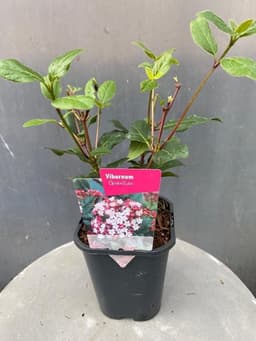
For the evergreen screen, the live plants in this set are all V. tinus: 'Gwenllian' in an 11 cm pot and Carbeth Purpureum in 9 cm pots. Purpureum is not 'Gwenllian', and neither is 'Eve Price'. Spacing sits on the viburnum hedge page. Putting the pot in the ground sits on how to plant viburnum. There is no V. opulus pot in the kept set. Buy guelder rose from a supplier that names Viburnum opulus, the species rather than a snowball cultivar with sterile flowers. Viburnum trilobum seed is not a substitute. The RHS synonym list places it with V. opulus var. americanum. A packet at about £14.45 with a 20-versus-1 count conflict is not a native hedge, and arrow wood seed with no Latin name is not one either.

Common questions

Which one keeps its leaves in January?
Viburnum tinus, laurustinus. It is evergreen, with flowers in late winter and spring. Viburnum opulus, guelder rose, is deciduous, so the hedge is bare in January. If the brief is a winter screen, tinus is the one that meets it. If the brief is a native plant, tinus does not meet that part.
Do birds eat the berries, and can I?
Birds eat guelder-rose berries. The BTO names bullfinches and mistle thrushes, and the RSPB names thrushes, blackbirds, fieldfares and redwings. The BTO also says the berries can cause nausea and vomiting in people. The RHS says the fruit of both V. opulus and V. tinus is ornamental and not to be eaten. Birds eating them is not a human safety test. 'Gwenllian' is not described by Gardeners' World as a particular wildlife plant.
Will both get viburnum beetle?
Yes. The RHS lists both Viburnum tinus and Viburnum opulus as main hosts. Larvae hole the leaves from late April to June, and plants usually recover. Picking the native shrub does not avoid the beetle, and picking the evergreen does not avoid it either. Use the RHS page to identify the damage. Do not treat either hedge as the resistant one.
Can I buy guelder rose in this amazon set?
Not as a live plant. The kept live listings are all Viburnum tinus: 'Gwenllian' at about £14.02 and Carbeth Purpureum at about £9.99 or about £16.99 for three. There is no V. opulus pot in the set. Seed titles do not fill that gap. Order guelder rose from a seller that prints the Latin name Viburnum opulus.
Which should I plant for a privacy screen?
Viburnum tinus, if privacy includes winter. It keeps its leaves. Use a live plant from this set if you are buying here, and expect a 9 cm or 11 cm pot to take more than one season to close a gap. Viburnum opulus is the wrong screen if you need cover in January, and the right one if you want a native deciduous hedge and red fruit for birds instead.

Related pages

Sources

Public UK sources checked for this comparison, plus the amazon.co.uk listing facts in the display file on 16 October 2026. Shelf prices and star lines are those UK figures. They can change.

  1. RHS: Viburnum tinus (retrieved 16 October 2026)
  2. RHS: Viburnum growing guide (retrieved 16 October 2026)
  3. RHS: Viburnum tinus 'Gwenllian' (retrieved 16 October 2026)
  4. RHS: Viburnum beetle (retrieved 16 October 2026)
  5. RHS: Viburnum opulus (retrieved 16 October 2026)
  6. GOV.UK: Issuing plant passports in Great Britain (retrieved 16 October 2026)
  7. APHA: Protecting online plant buyers, 31 January 2025 (retrieved 16 October 2026)
  8. BTO: Berry identification guide (retrieved 16 October 2026)
  9. Wildlife and Countryside Act 1981, section 1 (retrieved 16 October 2026)