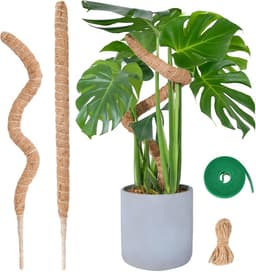
Independent comparisons. We may earn from shop links. More info

How to use a moss pole

Updated: October 2026

The coir pole is out of the bag, fibres are on the floor, and the Swiss cheese plant or pothos is still rooted in compost with nowhere obvious for a spike. How to use a moss pole well is less about the brand row in our [moss stick comparison](/hub/plant-accessories/moss-stick) and more about timing, depth, what you tie, and whether you intend to wet the sleeve. This page is the procedure. It does not rank the listings, and it does not cover fenestrations or sap. If you have not chosen a length yet, settle that before you push anything into the pot.

The coir pole is out of the bag, fibres are on the floor, and the Swiss cheese plant or pothos is still rooted in compost with nowhere obvious for a spike.

Our top picks

Mactoou Mactoou (4 × 41 cm)

Alternative

Mactoou Mactoou (4 × 41 cm)
8.8/10about £11.99
Aileem Aileem (2 × 60 cm)

Best value

Aileem Aileem (2 × 60 cm)
8.4/10about £7.99
On this page

Before the spike goes in

Repotting is the easy moment: set the stake in fresh compost before roots fill the pot. Seller bullets say shape or stack, insert, tie. If the plant is root-bound, a sharp stake through the middle can snap roots. Repot with the pole centred, or slide it down an edge gap and accept less depth. One listing claims a 15 cm base. Most only show a bare tip. Bury enough that the pot does not tip. If you meet resistance, stop. Tips are sharp, so wear gloves. For stacks, stand two sections first. Four 41 cm pieces on day one wobble, so bind each join, as posts on SproutMaven and Garden Sage stacks describe.

How the pole sits

Centre the stake if you can, with the coir facing the way the stem leans. Curve a bendable aluminium pole before you insert it, so the sleeve follows a window. Bending it after the stake is buried stresses the compost around the collar. The pot has to outweigh the lever. A light plastic container, a 120 cm pole and a top-heavy monstera is a common tip-over in UK comments. Aileem mentions sharp wooden sticks. SproutMaven buyers note a sharp end. Push straight down, not through your palm. If the pole rocks, the stake is too shallow or roots have left a void. Add compost and firm it, or repot. Several listings claim outdoor use without a weathering note. On a UK windowsill, treat the pole as indoor furniture unless you accept faded coir and wet compost weight on a balcony.

What you tie

Tie the stem, not the petiole. The RHS tie-in guide applies: soft material, slack for thickening, no wire in the tissue. Hook-and-loop, jute and twist ties from the box work if a finger slides under the band. Put the tie on the face of the stem that meets the pole. Guide aerial roots toward damp coir. Do not tear them off. Two or three ties beat a dozen tight ones. Move bands up as the plant climbs, and loosen old ones before they cut in. If the stem slips on dry coir, add a tie, or dampen the contact zone only when you want roots to hold. That is not a daily chore for every coir stick in this set.

Wet coir or dry coir

The RHS says a moss or coir covering kept moist can let Swiss cheese plant, philodendron and epipremnum stems root in. That is a goal, not a requirement. Thin coir sleeves dry quickly in a heated room. Many owners use them dry as a tie point and still get upright growth. If you want attachment, mist the coir, not a pot left standing in runoff. Sphagnum holds moisture longer. These coir totems need a habit you will keep, or you accept stake-only use. That split is on coir pole vs sphagnum moss pole. When aerial roots grip, remove one tie at a time. If the coir stayed dry and nothing attached, keep the ties and check them yearly for constriction.

A workable first session

If the root ball is tight, repot and set the stake before the compost goes back. If there is a clear gap at the edge, insert there and accept a shallower hold. Shape a bendable pole first, bind stack joints as you add them, and tie the stem with slack. Wet the sleeve only when you want roots to take hold, and keep the pot itself out of a saucer of water.

Common questions

Do I repot first?
If the root ball is tight and the stake meets resistance, yes. If you have a clear gap at the edge and a small plant, you can insert without repotting. The trade-off is shallower anchorage, so press compost around the stake afterwards.
How far does the bare end go into the compost?
As deep as stability needs, without forcing through roots. That is often several centimetres of bare stake, but listings disagree. Do not treat one seller's 15 cm base claim as a rule for every pole.
Which side of the stem faces the pole?
The side where aerial roots emerge, or where the stem already curves toward the support. Tie with slack on that face so the stem can thicken and still touch the coir.
Can I tie a leaf stalk?
No. Tie the main stem only. A petiole breaks, and the leaf then hangs at the wrong angle. Soft ties with a finger's width of slack are the ones to use.
Should I wet coir every day?
Only if you are actively trying for root attachment and you can keep the compost from sitting in water. Dry coir used as a stake is a valid way to run these poles.
The stake hit a root. What now?
Withdraw it. Try another angle at the edge, or repot with the pole placed before the root ball goes back in. Do not hammer through the resistance.
The sections wobble once stacked. What do reviewers do?
They add fewer sections at first, bind each joint with the kit string or twist ties, and switch to a single long bendable pole if the wobble remains.

Related pages

Sources

Public UK sources used for this comparison. Shelf prices, stars and review counts are the amazon.co.uk figures captured for these ten listings. Last checked 22 October 2026.

  1. RHS: how to grow Swiss cheese plants (retrieved 22 October 2026)
  2. RHS: philodendron growing guide (retrieved 22 October 2026)
  3. RHS: epipremnum growing guide (retrieved 22 October 2026)
  4. RHS: coir questions answered (retrieved 22 October 2026)
  5. RHS: how to tie in climbers (retrieved 22 October 2026)
  6. General Product Safety Regulations 2005 (retrieved 22 October 2026)
  7. Consumer Rights Act 2015: goods rights (retrieved 22 October 2026)
  8. GOV.UK: guidance for safe foraging (retrieved 22 October 2026)