Independent comparisons. We may earn from shop links. More info

Moss pole buying guide

Updated: October 2026

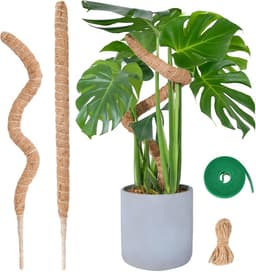
A moss pole buying guide starts before the brand row. You searched amazon.co.uk, clicked a photo of a thick jungle stake, and the product that arrives is a slim coconut-fibre sleeve on a metal or PVC core. That mismatch is normal. Shops call it a moss pole, but every listing in our [moss stick comparison](/hub/plant-accessories/moss-stick) is coir, not sphagnum. Decide what the plant needs in length, thickness and whether you can live with a joint. This page stops at that decision. It does not teach you to tie the stem.

A moss pole buying guide starts before the brand row. You searched amazon.co.uk, clicked a photo of a thick jungle stake, and the product that arrives is a slim coconut-fibre sleeve on a metal or PVC core.

Our top picks

Mactoou Mactoou (4 × 41 cm)

Alternative

Mactoou Mactoou (4 × 41 cm)
8.8/10about £11.99
Aileem Aileem (2 × 60 cm)

Best value

Aileem Aileem (2 × 60 cm)
8.4/10about £7.99
On this page

What a moss stick actually is

A moss stick in these listings is a coco-coir wrap around a stake. The Royal Horticultural Society says Swiss cheese plants, philodendrons and devil's ivy can be tied to a moss or coir pole, and that aerial roots may grow into the covering if you keep it damp. Dry coir mainly holds a stem up. All ten kept products are coir, at about £7.99 to £14.99. A damp sphagnum column is a different shop. That split is on coir pole vs sphagnum moss pole. Treat the brown fur as coconut husk, and read the word moss on the packet as the category name.

Length and the pot

The title length is rarely the climb above the compost. One Aileem review says roughly half of a printed 60 cm can be the soil end. A 60 cm bendable pair, around 150 g to 180 g where a weight is printed, suits a young cheese plant or pothos in a modest pot. It is next year's headroom, not support for a mature monstera. Past a metre of stem, one 120 cm piece avoids stack wobble. RHS Plants sells coco poles up to 150 cm, about £6.99 to £16.99, near 4 cm across. Listings here rarely state a diameter. One Garden Sage review mentions about 2 cm. SZMDLX claims 3 cm. Measure what arrives, and add pot weight when you step up from 60 cm.

One bendable pole or sections

Bendable coir poles use a core you curve before you insert them, so the sleeve can follow a window or a corner. Stackable sets, usually four sections of about 41 cm, let you add height later. UK reviews repeat the trade-off: the first two sections feel acceptable, and the third or fourth wobbles unless you bind the joint. RHS Plants warns that joined poles are never as stable as one longer pole for a heavier plant. Stacked-height arithmetic is unreliable. One SproutMaven title prints 125 cm while four 41 cm sections sum to 164 cm. Mactoou claims a 120 cm stack from the same section length. LANNEY's item row says 149 cm while five sections add to 180 cm. Treat the printed total as a hint. If you hate joints, buy one bendable 120 cm piece. If you accept them, add sections slowly.

What to check on the listing

Before you pay, read three conflicts. Material rows say wood while bullets name coir, PVC or aluminium. Dimension rows sometimes do not describe a pole, such as 60 × 60 cm on Garden Sage. The 60 cm and 120 cm Garden Sage pairs share one 337-review pool, so a comment that a pole was so long may belong to the taller listing. Match ties to the contents bullet, not the photo. The 120 cm Garden Sage pair lists jute without velcro, yet reviews mention missing tape. Price comes last. Pairs around 60 cm cluster near £8 to £9.50. A 120 cm pole or a four-piece stack moves toward £11 to £14.99, and it is still coir.

When length and joints are settled

If the plant is still young and the pot is modest, shop a bendable pair of about 60 cm. If the stem already outgrows the pole, or you will not tolerate a joint, look at one 120 cm piece and a heavier container. If you will add height over months, take short sections and tie each joint before you add the next.

Common questions

Is 60 cm enough for a young cheese plant?
For a juvenile Swiss cheese plant in a small pot, yes, if you accept that the stake uses part of the length and that a slim coir sleeve is support, not a promise of mature leaves. Move toward about 120 cm, or a staged stack, when the stem outgrows the pole or the pot feels light on the windowsill.
Are four short sections as steady as one long pole?
No, not for a heavy stem. UK reviews and RHS Plants both point to the joint as the weak point. Use sections if you will tie each join firmly and add height gradually. Choose one long bendable piece if stability matters more than adding a section later.
Does moss stick mean sphagnum?
Not in this comparison. Every kept listing is coconut coir. A sphagnum pole needs damp maintenance and is a different product. Dry coir on these poles is a textured stake unless you keep the sleeve moist on purpose.
What should be in the packet besides the pole?
At minimum, something to tie the stem: jute, hook-and-loop or twist ties. Many boxes include more than that. Match the contents bullet to your plan before you assume velcro is included because it appears in a photo.
Why do two Garden Sage listings share one review block?
The amazon.co.uk pages for the 60 cm and 120 cm bendable pairs carry the same UK review texts. Read a comment about length with that in mind. Stars on those two listings are not two separate samples of 337 reviews each.
Can I trust a stacked height printed in the title?
Often not, once the section lengths are also listed. Add the sections yourself, or measure after delivery, before you commit to a pot. A title total that is shorter than the sections is a listing conflict, not a second pole hiding in the box.

Related pages

Sources

Public UK sources used for this comparison. Shelf prices, stars and review counts are the amazon.co.uk figures captured for these ten listings. Last checked 22 October 2026.

  1. RHS: how to grow Swiss cheese plants (retrieved 22 October 2026)
  2. RHS: philodendron growing guide (retrieved 22 October 2026)
  3. RHS: epipremnum growing guide (retrieved 22 October 2026)
  4. RHS: coir questions answered (retrieved 22 October 2026)
  5. RHS: how to tie in climbers (retrieved 22 October 2026)
  6. General Product Safety Regulations 2005 (retrieved 22 October 2026)
  7. Consumer Rights Act 2015: goods rights (retrieved 22 October 2026)
  8. GOV.UK: guidance for safe foraging (retrieved 22 October 2026)