Independent comparisons. We may earn from shop links. More info

Expandable garden trellis buying guide for UK gardens

Updated: October 2026

An expandable garden trellis looks like the obvious answer for a bare fence and a waiting climber. Search results also show framed panels, obelisks and coated frames that do different jobs. This guide helps you choose the construction first. Expanding pine around 1.8 m by 0.3 m is not a substitute for a 2 m obelisk or a pressure-treated framed panel. Prices, scores and the full set sit on the [lawn trellis comparison](/hub/plant-accessories/lawn-trellis). A qualifying purchase can earn us a commission at no extra cost to you.

An expandable garden trellis looks like the obvious answer for a bare fence and a waiting climber. Search results also show framed panels, obelisks and coated frames that do different jobs.

Our top picks

Gardman Gardman 07250 lattice

Best overall

Gardman Gardman 07250 lattice
9.3/10about £7.14
RAM ONLINE RAM 2 m obelisk

Rank 2

RAM ONLINE RAM 2 m obelisk
8.5/10about £8.95
KANTA KANTA 3-pack lattice

Best value

KANTA KANTA 3-pack lattice
8.9/10about £13.99
On this page

Four things people call a lawn trellis

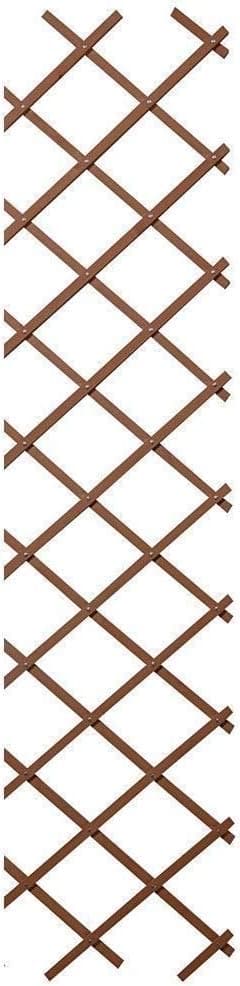
An expanding wooden lattice is the lightest option in this comparison. The Gardman panel is stated at 1.8 x 0.3 m and weighs 343 g. It spreads across a fence or wall for light stems. It is not framed, has no wind-load rating and is not another section of fencing. KANTA, XIANTIAN, LATERN, Toyosport and Bamworld follow the same broad pattern, with different sizes and pack quantities. A framed trellis panel from a fencing merchant is a different object: a rebated, pressure-treated frame that can weigh several kilograms. If you are replacing a fence bay or adding a substantial topper between posts, look in the fencing aisle. An obelisk stands in a bed or pot. The RAM product has a 2 m size line, a separate 190 cm dimension and legs claimed to enter the soil by 40 cm. Coated frames such as MYMULIKE and flowlamp are freestanding too, but their structure mixes metal tubes or cores with plastic rings or grids. If the real choice is fence lattice against a support in the border, use the wooden trellis or metal obelisk page.

What to read on the listing

Start with the dimensions, then check whether every field agrees. KANTA's title and size field say 1.8 x 0.3 m, while its item dimensions say 15 x 43 cm. MYMULIKE gives a 165 cm size and also prints 10 x 10 mm. Write down the size your site needs and measure the product before drilling. An expanding lattice becomes shorter as it opens wider. Read the pack quantity and the included-parts line separately. Bamworld and LATERN claim two panels in their titles while their items fields say one. Several listings suggest nails, hooks or brackets without putting them in the box. Budget for exterior-grade fixings, and read how to attach a lawn trellis before relying on adhesive hooks. Gardman is the only product here with an FSC claim. KANTA claims treated pine, Toyosport claims carbonised wood, and some listings use phrases such as anti-corrosion. None states a timber Use Class, so none of those words proves suitability for permanent ground contact. The RHS advises keeping the bottom of timber around 30 cm above soil when training climbers against a wall. LATERN and Toyosport each claim a 10 kg hanging load. That is not a structural or wind-load test.
Gardman Gardman 07250 lattice

Testsieger

Gardman Gardman 07250 lattice
9.3/10about £7.14

Choose for the plant, then the timber

Clematis, jasmine and annual climbers can use an open lattice when their mature scale suits the area. Supports should normally be installed before planting, with space for air and stems behind them. The RHS suggests about 5 cm off a wall. That gap needs battens or spacers and fixings that suit the wall or fence. Climbing roses do not cling, so their stems need tying. A light rose may work on a sound, securely fixed lattice. A vigorous rambler needs a larger structure. Wisteria becomes heavy and should not be assigned to one of these thin expanding panels because the title includes the word trellis. Thin pine strips joined by rivets can split around a nail or screw, as UK reviews for Gardman and KANTA report. Pre-drilling reduces that risk. A framed pressure-treated panel spreads loads differently. If a panel will sit on top of a boundary, check the trellis fence-height rules before buying.

What this comparison does not include

This set excludes a garden arch, 40 cm support stakes and artificial ivy. Each answers a different job from training a living climber on a light lattice. It also does not contain a substantial framed fencing panel. The products here are light expanding lattices, one painted obelisk and two coated modular frames. Who should choose or skip each listing is a separate page. Use a fencing supplier when the support must function as part of the enclosure.

Common questions

Is an expanding trellis the same as a fence panel?
No. An expanding trellis is a light, unframed lattice fixed to an existing fence or wall. A fencing panel has a rigid frame and is designed to span or top a boundary structure. Similar length and width figures do not make them interchangeable.
What size should I trust when a listing prints two?
Treat conflicting dimensions as unresolved. Record the space you must cover, ask the seller to confirm the opened size and measure the delivered panel before drilling. Making an expanding lattice wider usually makes it shorter.
Does treated or carbonised wood mean Use Class 4?
No. Treated, anti-corrosion and carbonised are seller descriptions, not proof of Use Class 4. None of the kept listings states that classification. If timber will contact soil or form a long-term structural boundary, buy a product with a clear treatment specification for that exposure.
Are screws included with an expanding lattice?
Often they are not. The kept listings commonly suggest screws, brackets, nails, hooks or cord without listing a complete mounting kit. Check the included-parts field and allow for exterior-grade fixings, spacers and possibly battens.
Should a wooden lattice sit directly on soil?
Light expanding timber is better kept clear of soil unless its listing explicitly specifies ground-contact treatment. RHS training guidance suggests keeping the bottom of timber about 30 cm above soil against a wall. A separate obelisk with ground legs is the more suitable construction for a freestanding bed support.
When might a fence topper need planning permission?
When a trellis becomes part of a boundary enclosure, its height is measured with the fence. The permitted limits and exceptions differ across England, Scotland, Wales and Northern Ireland, with extra restrictions possible for listed property, conservation areas, Article 4 directions or planning conditions.

Related pages

Sources

Public UK sources for fence height, climber training, timber treatment and consumer law, plus the amazon.co.uk listing facts in the display file. Shelf prices and star lines are those UK figures, from about £7.14 to about £29.99.

  1. England Class A: gates, fences, walls and other means of enclosure (retrieved 16 October 2026)
  2. Planning Portal: fences, gates and garden walls (retrieved 16 October 2026)
  3. Scotland Class 3E: gates, fences, walls and other means of enclosure (retrieved 16 October 2026)
  4. Welsh Government: planning permission for fences, gates and garden walls (retrieved 16 October 2026)
  5. Northern Ireland 2015 Order, Part 3, Class A (retrieved 16 October 2026)
  6. RHS: training climbers on planting (retrieved 16 October 2026)
  7. BSI: BS 8417, preservation of wood, code of practice (retrieved 16 October 2026)
  8. Consumer Rights Act 2015, section 9 (retrieved 16 October 2026)