Independent comparisons. We may earn from shop links. More info

Wasp powder vs foam for a hidden hole or visible nest

Updated: October 2026

You are holding the choice down to two nest products: a puffer of dust, or a foam can with a trigger. Wasp powder vs foam is whether wasps walk through a hole you can see, or whether you can wet the papery comb itself. Powder wins the first case. Foam wins the second, and only if the jet on that particular can actually reaches. Prices and star lines are on the [wasp killer comparison](/hub/pest-control/wasp-killer). The [buying guide](/hub/pest-control/wasp-killer/sub/wasp-killer-buying-guide) is the wider choice, including leaving the nest alone. A qualifying purchase through our links can earn us a commission at no extra cost to you.

You are holding the choice down to two nest products: a puffer of dust, or a foam can with a trigger. Wasp powder vs foam is whether wasps walk through a hole you can see, or whether you can wet the papery comb itself.

Our top picks

On this page

Use powder when you cannot see the comb

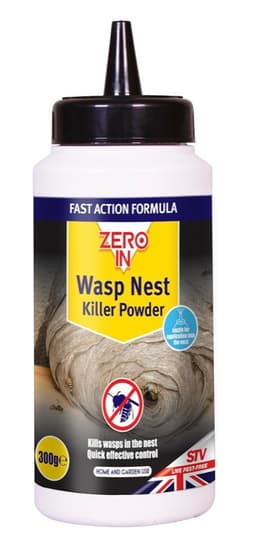
Rentokil’s DIY guidance splits the job the same way: powder for wall and roof spaces you cannot reach, foam when the whole nest is visible. If the only clue is an air brick, a soffit slot or a hole under a sleeper, you are in the powder half. You should not go looking for the comb behind the brick. In this set the powders name permethrin. Zero In ZER910 is £5.50 with 4.3 from 3,921 ratings. Nippon 5NWP300 is £7.99 with 4.4 from 1,265, and its public label is HSE 9219. The maker note for ZER910 is about 60–100 g at an entrance, which is not the listing’s up to 5 nests line. You leave the hole open. The air-brick page is the walk-through for a vent, a cavity and a ground hole.

Use foam when you can see the nest

Foam is the can for a grey paper nest in a shed, a hedge or a loft you can stand in. Zero In ZER556 is the only foam kept here: 600 ml, £12.94, 3.6 from 5,173 ratings. The listing claims a jet up to 4 metres and 4 to 7 nests, late in the evening, and the title includes hornets. The Amazon bullets in this extract do not name an active. The maker’s page names tetramethrin and 1R-trans-phenothrin and repeats the 4 metre line. UK reviews on the same ASIN often describe something shorter: about 12 inches, 18 inches or 2 metres, commonly when the can was not shaken or the pressure was low. A test squeeze tells you which description you have bought. They also say an air brick is the wrong target, because the foam stops on the brick. The star line is set out on the best wasp nest killer page, beside the powders.

What people bought twice

People bought a foam first, saw wasps still using a hidden entrance, and then bought a puffer. That is not proof that powder is always the stronger product. It is proof that foam was the wrong shape for a hole. Stacking both on the same evening is not a method. Pick one form for the entrance you have. If the foam’s test jet reaches a visible comb, use the foam and leave the powder on the shelf. If you only have a hole, use the powder and do not finish it with a blast of foam that blocks the entrance. The BPCA points out that a spray which hits wasps in the air does not clear a nest. Raid’s duo, at £8.70 in this extract, is that third product, not a tie-breaker between powder and foam.

Which to buy in this set

For a hole at ground level, including an air brick you can reach without a ladder, buy a permethrin powder. Zero In at £5.50 is the best value in this set for that job. Nippon at £7.99 is the top pick if you want the published HSE 9219 label. Buy the foam only after a squeeze reaches the comb you can see, and treat the 4 metre claim as unproven on the reviews. Do not buy the foam for a cavity because it costs more. If the entrance is high, someone is allergic, or you suspect a yellow-legged hornet, buy neither and call a trained firm or, for the hornet, report the sighting.

Common questions

Which one for an air brick?
Powder. Dust the holes the wasps use and leave those holes open. Foam is the product reviewers describe as wasted on a brick, because it does not travel through to a comb you cannot see. Rentokil gives the same split for inaccessible wall spaces.
Which one for a nest in a shed I can see?
Foam, if a test jet reaches the paper from where you can stand. If the can only dribbles, do not walk closer just to make the listing’s 4 metre claim true.
Why did foam do nothing in the wall?
Because the nest is not on the face of the wall. Foam that hits brick, render or a soffit board stops there. Powder is meant to be carried in by workers using that gap. A second foam can, aimed at the same brick, repeats the miss.
Does powder reach further than foam?
It reaches further into a hidden nest only in the sense that insects walk it in. It does not shoot further across a garden. Foam’s reach is a jet in open air, and on this can that jet is disputed.
Is foam faster?
People hope so, because a soaked nest looks finished. The reviews do not give you a reliable number of hours, and we are not claiming death overnight. Speed is not a reason to pick the wrong form.
Can I use both?
Not as a stack on the same hole the same night. Use powder for a hidden entrance or foam for a comb you can wet. Using both products at once can block the hole the powder needed.
Where does a fly spray fit?
In a room, against insects in flight, when you have no nest. It is not the powder and it is not the foam. If wasps are coming from a gap in the wall, a fly spray will knock down the ones you hit and leave the colony in place.

Related pages

Sources

Public UK sources and the amazon.co.uk listings in this set, last checked on 16 October 2026.

  1. HSE, garden and home pesticides (retrieved 16 October 2026)
  2. HSE, COPR label guidance (retrieved 16 October 2026)
  3. BPCA, wasp control (retrieved 16 October 2026)
  4. BPCA, after bendiocarb (retrieved 16 October 2026)
  5. NHS, insect bites and stings (retrieved 16 October 2026)
  6. GOV.UK, invasive non-native species rules (retrieved 16 October 2026)
  7. National Bee Unit, Asian hornet reporting (retrieved 16 October 2026)
  8. Nippon wasp nest powder label, HSE 9219 (retrieved 16 October 2026)