Independent comparisons. We may earn from shop links. More info

How to choose a wasp nest killer for your entrance

Updated: October 2026

You have watched wasps using the same gap for a few days, and the first can in the search results is rarely the right one. A wasp nest killer only earns its place if the form matches the entrance you can actually see. Powder is for a hole the workers walk through, foam is for a papery comb you can wet, and a room spray is for an insect in the air. This page stops at that choice. It does not rank the five amazon.co.uk listings. Prices and star lines sit on the [wasp killer comparison](/hub/pest-control/wasp-killer). A qualifying purchase through our links can earn us a commission at no extra cost to you.

You have watched wasps using the same gap for a few days, and the first can in the search results is rarely the right one. A wasp nest killer only earns its place if the form matches the entrance you can actually see.

Our top picks

On this page

What you are trying to treat

Start with the flight line, not the brand name on the tin. If wasps disappear into an air brick, a soffit gap, a crack or a hole in the ground, you cannot see the comb, and a jet aimed at the brick will sit on the surface. That is a powder job, because workers walk through the dust and carry it inside. If you can see the grey paper nest in a shed, a hedge or a loft you can stand up in, the matching product is a foam that can reach that comb. The hidden-nest guide stays with air bricks and cavities. Once you know you are choosing between the two nest forms, the powder versus foam page is the fork.

Powder, foam, or a room spray

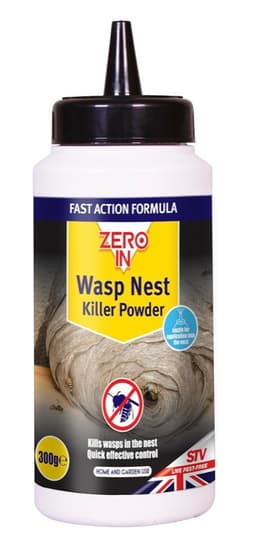
Nest powder in this set is a permethrin dust in a squeeze bottle. You puff it at the entrance or, on the Nippon instructions, into a nest you can reach. The maker of Zero In ZER910 states about 0.5% w/w permethrin. That figure is the maker’s note, not a result measured in these reviews. Foam is a trigger aerosol. The Zero In foam listing claims a jet of up to 4 metres and 4 to 7 nests. UK reviews on that can often describe a much shorter jet. A flying-insect aerosol, such as the Raid duo in the wider set, is a knockdown mist for flies, mosquitoes and a wasp in a room. The British Pest Control Association says spraying wasps that are already flying does not remove the nest. The how to use wasp nest powder page is the method once a tub is already in your hand.

What the label must show

The Health and Safety Executive’s garden and home guidance is that amateurs use amateur products, and that professional packs need training. Nippon’s public label for the 300 g dust is HSE 9219, including bats, bees and covered fish tanks. Zero In’s Amazon bullets name permethrin for the powder. The foam’s Amazon extract does not name an active, even though the maker’s own page names tetramethrin and 1R-trans-phenothrin. Read the statutory box on the tin you receive, not a shortened bullet on a product tile. Do not wash dust into a drain or a pond.

When you should not buy

Stop if the hole is above shoulder height, if you would need a ladder, or if anyone in the house has had a serious reaction to a sting. The NHS says call 999 for swelling of the face, mouth or throat, or for trouble breathing, and use NHS 111 for a sting in the mouth or near the eyes, for multiple stings, or if you have reacted badly before. A suspected yellow-legged hornet is not a shop-powder job. Report it through Asian Hornet Watch or the National Bee Unit, and do not disturb the nest. New Forest published £120 for one nest, which is one council’s fee, not a national price.

Common questions

Is a wasp killer the same as a wasp trap?
No. A wasp nest killer is a biocide aimed at a nest or, for a room aerosol, at insects in flight. A trap lures foragers into a container and does not clear the comb. If the problem is a nest entrance, a trap in the garden will not replace powder at the hole.
Powder or foam if I can only see a hole?
Use powder. You dust the entrance the workers walk through, and you leave the hole open so they carry the dust in. Foam is for a papery nest you can see and wet. Putting foam into an air brick stops on the face of the brick.
Can I use fly spray on the nest?
A room spray can knock a wasp out of the air. It is not a nest treatment, and the BPCA notes that hitting flying wasps does not clear a colony. The Raid listing in this set is an indoor flying-insect aerosol. Use it for a room, not for a cavity.
Do I have to kill a nest at the back fence?
No. Common wasps are not protected, and a nest that does not put people at risk can be left. Treat it if the flight line crosses a door, a path or a place where children play.
Is permethrin the old bendiocarb dust?
No. Permethrin is the active named on the powder listings in this set. Bendiocarb dust, sold as Ficam D, has been withdrawn, and the BPCA says it is illegal to use or store it. Do not hunt an old professional tin because a forum called it stronger.
What should the label say before I buy?
An amateur label should name the active, carry an HSE number, and avoid any claim that the product is non-toxic. It should also cover bees and water, and the Nippon dust adds a warning about bats in the structure.
When is a council or BPCA visit the better purchase?
Choose a visit when the nest is large and late in the season, the entrance is high, someone has a serious sting allergy, you suspect a yellow-legged hornet, or the loft may hold bats. The BPCA says DIY may suit a small early nest you can reach. A visit costs more than a shop tub.

Related pages

Sources

Public UK sources and the amazon.co.uk listings in this set, last checked on 16 October 2026.

  1. HSE, garden and home pesticides (retrieved 16 October 2026)
  2. HSE, COPR label guidance (retrieved 16 October 2026)
  3. BPCA, wasp control (retrieved 16 October 2026)
  4. BPCA, after bendiocarb (retrieved 16 October 2026)
  5. NHS, insect bites and stings (retrieved 16 October 2026)
  6. GOV.UK, invasive non-native species rules (retrieved 16 October 2026)
  7. National Bee Unit, Asian hornet reporting (retrieved 16 October 2026)
  8. Nippon wasp nest powder label, HSE 9219 (retrieved 16 October 2026)