Independent comparisons. We may earn from shop links. More info

How to prime bare wood

Updated: October 2026

When a new door, skirting board or patch of exposed timber is ready for paint, the order matters more than working quickly. To prime bare wood properly, clean and prepare the surface, deal with knots, apply the coat count stated for your primer, and finish with a compatible topcoat. Our [wood primer comparison](/hub/paints-and-varnishes/wood-primer) shows that even closely related amazon.co.uk listings disagree about drying time, so there is no safe universal wait to copy from another tin. If you are still selecting the first coat, use the [wood primer undercoat buying guide](/hub/paints-and-varnishes/wood-primer/sub/wood-primer-buying-guide) before opening a tin.

When a new door, skirting board or patch of exposed timber is ready for paint, the order matters more than working quickly.

Our top picks

On this page

Prepare the wood before priming

Start with sound, dry timber. Remove loose or flaking coating, dust and grease, and repair dents or open joints with a filler that is compatible with your paint system. On previously painted woodwork, wash off grime, allow it to dry, then key a sound glossy surface so the next coat can grip. Pay extra attention to end grain, cut edges and filled patches. End grain absorbs coating much faster than a planed face. A second local coat is a common decorating remedy, but it is a rule of thumb rather than a coverage promise for these six products. Old paint needs a safety check before abrasion. HSE guidance warns that older coatings may contain lead, particularly on pre-1980s buildings. Do not create airborne dust by aggressive dry sanding if lead is possible.

Treat knots, then apply primer

Knots in pine and other softwoods can release resin that migrates through ordinary white paint. Oak and some hardwoods can release tannins, producing yellow or brown marks in pale water-based finishes. None of the six products in this comparison claims to be a dedicated knot or tannin blocker. One UK review of the Dulux tin reports yellow-brown bleed. Apply a compatible knot or stain blocker before coating the whole piece. The Rustins data sheet says its shellac knotting should not be coated directly with water-based paint unless an oil-based primer is used between them. Our guide to knots bleeding through paint explains the choice. Once the treatment has dried for the stated interval, apply an even coat along the grain and do not keep brushing paint that has started to set.

Coat count and drying time

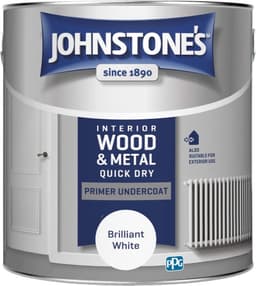
The correct number of coats comes from the specific product. Dulux's retail instructions say two coats of its Primer & Undercoat for Wood on bare wood and one on previously coated wood, with around two hours between coats. That interval should not be transferred automatically to Berger or every Johnstone's size. The Johnstone's 750 ml bullets say dry to the touch in one to two hours, while an attribute says 15 hours. The 2.5 litre listing gives half an hour touch-dry and 24 hours full cure. Follow the tin you receive. Touch-dry is not the same as ready to recoat. If the project is outdoors, see our exterior wood primer guide. Berger's base is unresolved as oil-based or water-based, so its clean-up cannot safely be guessed.

Add the topcoat and know when to stop

Primer is preparation, not the wearing finish. Even a combined primer undercoat still needs the compatible gloss, satin or other topcoat specified for the system. One Johnstone's reviewer returned a tin after discovering it was only primer: undercoat in the name does not mean a finished decorative surface. Before topcoating, ensure the primer has reached the stated recoat stage. Apply thin coats and keep a wet edge. Stop and seek professional help when preparation reveals rotten timber, persistent damp, failed glazing details or extensive unknown old paint. Primer cannot compensate for wet, unsound wood.

Common questions

Do I wash bare wood before priming?
Remove dust, grease and contamination, but do not soak clean bare timber unnecessarily. Existing painted woodwork may benefit from a suitable cleaner such as sugar soap, followed by rinsing as directed and complete drying. Vacuum profiles and wipe away sanding dust immediately before painting.
When should knotting solution be applied?
Treat knots after the timber is clean and prepared but before the full primer coat. Allow the blocker to dry as its own instructions require. Check compatibility carefully, because some traditional shellac knotting products should not sit directly beneath water-based paint.
How many primer coats does bare wood need?
There is no universal count. Dulux specifies two coats of its retail primer undercoat on bare wood and one on previously coated wood. Other tins may differ. Porous end grain can need extra local attention, but use the product label rather than making every coat thicker.
How long should primer dry before gloss?
Wait for the recoat interval stated on the physical tin and ensure the primer is ready for its compatible topcoat. Dulux states about two hours for its retail product, while Johnstone's marketplace fields conflict from half an hour to 15 hours. Conditions and film thickness can extend the wait.
Can I sand old gloss dry?
Not when lead is possible. HSE guidance recommends controlling dust from older coatings, and pre-1980s woodwork deserves particular caution. Avoid aggressive dry sanding, use suitable wet methods and containment, or employ a competent professional if the old paint is deteriorating.
Why did the primer dry before I finished brushing?
Water-based paint can set quickly on warm, absorbent timber or when spread too thinly over a large area. Work in logical sections, maintain a wet edge and avoid brushing back into paint that has begun to set. Follow the temperature and dilution limits on the tin.
Do I need a separate undercoat after primer undercoat?
Not necessarily. A combined product may provide both preparatory roles when applied in the stated number of coats. You still need a compatible topcoat. If the finish manufacturer requires a separate undercoat or the colour change needs additional build, follow that system instead.

Related pages

Sources

Public UK sources used for the VOC, lead-paint and preparation points on this page. Prices, stars and review counts are from the amazon.co.uk listings on 16 October 2026.

  1. VOC in Paints Regulations 2012 (retrieved 16 October 2026)
  2. HSE CIS79 — old lead paint (retrieved 16 October 2026)
  3. GOV.UK — lead information for the public (retrieved 16 October 2026)
  4. Dulux — Primer and undercoat for wood (retrieved 16 October 2026)
  5. Dulux Trade — quick-dry wood primer undercoat sheet (retrieved 16 October 2026)
  6. Johnstone's — primers (retrieved 16 October 2026)
  7. Screwfix — primer and undercoat (retrieved 16 October 2026)
  8. BS EN 927-1:2013 — exterior wood coatings (retrieved 16 October 2026)