Independent comparisons. We may earn from shop links. More info

Wood primer undercoat buying guide

Updated: October 2026

Bare timber, a repaired skirting board and a previously painted door do not necessarily need the same first coat. A wood primer undercoat can simplify the system, but only when its label covers the surface, location and finish you have in mind. Our [wood primer comparison](/hub/paints-and-varnishes/wood-primer) lines up six amazon.co.uk tins; this guide helps you decide which type of coating belongs underneath your paint before you compare brands. For most indoor doors and trim, a water-based combined primer undercoat is the practical starting point. Knotted pine, tannin-rich oak and exposed softwood need separate decisions, because an ordinary white primer is not automatically a knot blocker, stain sealer or preservative.

Bare timber, a repaired skirting board and a previously painted door do not necessarily need the same first coat.

Our top picks

On this page

Primer, undercoat, or both

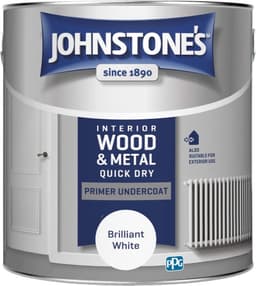
Primer bonds to bare material and controls how quickly a porous surface absorbs the next coat. Undercoat builds an even, opaque base beneath the finish. On a new bare door, the traditional sequence may be primer, undercoat and topcoat; on sound previously painted wood, you may only need to clean, key and undercoat before refinishing. A combined primer undercoat can replace two separate products when the manufacturer explicitly allows it. Dulux says its retail Primer & Undercoat for Wood needs two coats on bare wood and one coat on previously coated wood, with a topcoat still required. The Dulux listing names wood, whereas the Johnstone's 750 ml listing names wood and metal. Our guide to how to prime bare wood covers the order from cleaning to topcoat.

Knots, tannin and exterior softwood

White primer can make timber look uniform without stopping material inside the wood from migrating through it. Resin in softwood knots can form yellow or brown spots, while tannins in oak can discolour pale water-based coatings. None of the six amazon.co.uk listings claims to be a dedicated knot or tannin blocker. One Dulux reviewer reported yellow-brown bleed. The Rustins product data sheet says its traditional shellac knotting should not sit directly beneath water-based paint unless an oil-based primer seals it first. The knots bleeding through paint guide explains the choices. A decorating primer is not a preservative merely because an online bullet says exterior.

How the amazon.co.uk tins differ

The Dulux 750 ml acrylic tin was listed at £17.24, with its own 4.6 rating from 1,944 reviews and stated coverage of 12 m² per 750 ml per coat. Its marketplace weight of 408 g looks implausibly low for 750 ml of paint. The Johnstone's 750 ml option was listed at £9.92. Its rating of 4.6 from 6,050 reviews is shared with the larger listings, rather than being independent evidence for each size. Its bullets say touch-dry in one to two hours, while an attribute says 15 hours. The 2.5 litre tin had the lowest listed price per litre at £23.99, but it repeats 13 m² per tin, the same wording used for the 750 ml size.

What to leave on the shelf

Avoid buying by star score alone. One five-star rating is much less informative than hundreds of reviews. The Johnstone's 250 ml tin was listed at £9.56, only 36p less than the 750 ml tin at £9.92. A 250 ml pack can make sense for a small repair, but it is difficult to justify for a door. Its coverage attribute says 3 m² while the bullets repeat 13 m² per tin. Leave Berger unless you can confirm the binder on the tin. The listing was £11.04, described as oil-based or water-based, with one rating and no review text.

Common questions

Do I need both a primer and an undercoat?
On bare wood, you need a system that seals the timber and provides a suitable base for the finish. That may be separate primer and undercoat products or enough coats of a combined primer undercoat, if its label says so. Previously painted wood in sound condition may need only cleaning, keying and undercoat before the topcoat.
Is a primer undercoat enough on bare wood?
It can perform both preparatory roles, but it is not the final finish. Dulux specifies two coats of its retail combined product on bare wood, followed by a topcoat. Coat counts vary, so follow the tin you bought rather than applying a universal one-coat rule.
Should I choose water-based or oil-based primer?
Water-based primer undercoat usually offers easier water clean-up and faster recoating for indoor woodwork. An oil-based or specialist stain-blocking system may be needed for compatibility or difficult stains. Start with the required topcoat and blocker, then choose a primer that their technical instructions permit.
Will any white primer stop knots?
No. Colour and opacity do not prove that a coating blocks resin or tannin. None of these six listings makes a knot-blocking claim, and one Dulux review reports bleed-through. Treat knots with a compatible dedicated product before the full primer coat.
Which pack size is sensible for one door?
A 750 ml tin is a practical comparison point, though the actual requirement depends on door area, edges, porosity and coat count. One UK Dulux reviewer found 750 ml about enough for an external door. Use the manufacturer's on-pack coverage and include both faces and edges in your calculation.
Can I use the same tin on a radiator?
Only if the label includes the radiator's material and your chosen finish system. The Johnstone's 750 ml listing names wood and metal, and reviews mention radiators. The Dulux listing here names wood, so it should not be extended to metal without manufacturer confirmation.
What if the listing says indoor but the bullets say exterior?
Treat that as unresolved marketplace data, not permission for exterior use. Check the delivered tin and the manufacturer's current UK technical information. If neither clearly approves your location and substrate, choose a product whose exterior use is unambiguous.

Related pages

Sources

Public UK sources used for the VOC, lead-paint and preparation points on this page. Prices, stars and review counts are from the amazon.co.uk listings on 16 October 2026.

  1. VOC in Paints Regulations 2012 (retrieved 16 October 2026)
  2. HSE CIS79 — old lead paint (retrieved 16 October 2026)
  3. GOV.UK — lead information for the public (retrieved 16 October 2026)
  4. Dulux — Primer and undercoat for wood (retrieved 16 October 2026)
  5. Dulux Trade — quick-dry wood primer undercoat sheet (retrieved 16 October 2026)
  6. Johnstone's — primers (retrieved 16 October 2026)
  7. Screwfix — primer and undercoat (retrieved 16 October 2026)
  8. BS EN 927-1:2013 — exterior wood coatings (retrieved 16 October 2026)