Independent comparisons. We may earn from shop links. More info

Wood lubricant buying guide for wooden runners

Updated: October 2026

A stiff drawer can send you towards wax sticks, paste jars, silicone sprays and even tool oils that share similar search terms but do different jobs. This wood lubricant buying guide starts with the surfaces that actually touch, because a dry wooden runner needs a different product from a ball-bearing metal slide. You can compare the five current products and their GBP prices in the [main wood lubricant comparison](/hub/paints-and-varnishes/wood-lubricant). By the end, you should know whether to buy a compact stick, a jar of paste or nothing from this category at all.

A stiff drawer can send you towards wax sticks, paste jars, silicone sprays and even tool oils that share similar search terms but do different jobs.

Our top picks

On this page

Wood on wood, or metal underneath

First remove the drawer and identify the contact points. Traditional furniture often has a wooden rail, groove or side rubbing directly against another wooden surface. That is the straightforward wax job: a thin, dry film reduces friction without turning the runner into an oily track. UK furniture guidance from Neptune recommends paraffin or unscented candle wax on wooden drawer contact points, while Libéron and Rustins also sell beeswax for drawer runners. A modern kitchen drawer may look wooden from above but travel on concealed metal runners underneath. If you see small wheels, bearings or telescoping metal channels, do not buy a drawer wax merely because the drawer box is timber. Cleaning, alignment, loose screws or a lubricant specified by the runner maker is the relevant route.

The visible finish is not the runner

The third surface is the visible finish. A drawer front, polished antique side or varnished cabinet is not the rubbing face and should not be coated simply because the label mentions wood. On historic furniture, keep treatment local to the runner and stop if the finish is flaking or lifting. Conservation guidance from Icon advises against silicone-containing spray polishes on historic furniture. If your object may be valuable, a conservator should assess the finish before you experiment.

Stick or paste

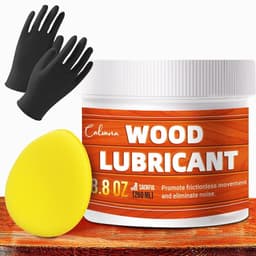
A hard wax stick is the simplest default for one or two indoor drawers. You rub it along the shiny contact line rather than coating the whole drawer, so it is easier to keep the film thin. In the current amazon.co.uk comparison, the Atkinson Oil Co. pack contains two 4 g lipstick-style sticks at £6.99. Its listing explicitly names drawers, sashes and antiques, although its 5.0 rating is based on only one review. AGS Door-Ease costs £10.30 and has a much larger review count, but its listing is broader and conflicts over whether the form is liquid or a stick. Paste serves the same friction-reducing purpose but comes in a jar and is spread with a cloth or, where supplied, a brush. It makes sense when you have broad runners or several pieces of furniture, provided you wipe away excess. The kept jars range from ninesung at £18.95 to Calvana at £26.97 and AstraVox at £28.11. Those prices do not demonstrate better performance, and none of the listings publishes a coverage test. A larger jar is therefore a format decision, not proof of longer life.

What not to buy for this job

Search results around wood lubricant include products that should not be treated as substitutes. Chainsaw oil is designed for a moving chain and bar. Cutting fluid cools and lubricates machining operations. Furniture polish blocks may be intended to build a sheen on a visible finish rather than ease a hidden runner. None becomes suitable for a drawer merely because wax or lubrication appears in the title. Silicone aerosol is a more plausible source of confusion because some cans list wood among many compatible surfaces. It can be useful for a product-specified metal, rubber or uPVC track, but that is a different decision from waxing bare wooden runners. An aerosol also introduces overspray, ventilation and flammability precautions that a solid stick avoids. For the full conditional comparison, read wax or silicone lubricant for wood.

Common questions

Do I need a stick or a jar?
Choose a stick for local, occasional work on one or two wooden runners. Choose paste when you have several broad contact surfaces and are prepared to apply it sparingly with a cloth. Neither form has a proven performance advantage in this comparison; control, pack size and the stated use are the meaningful differences.
Is beeswax better than paraffin?
Both are recommended or sold by UK furniture and woodworking sources for drawer runners. No comparative laboratory evidence in the research establishes a universal winner. Paraffin, beeswax or an unscented candle can all suit clean wood-on-wood contact when applied as a thin film.
Will a small stick do one chest of drawers?
It may, because only the narrow rubbing faces need treatment, but the listings publish no coverage figures. Do not calculate capacity from pack weight alone. Apply sparingly to one drawer first, cycle it, then judge how much product your particular runners require.
What if the drawer has metal runners?
Wax from this comparison is not the automatic choice. Clean the slide, check screws and alignment, and follow the runner maker’s lubrication instructions. Ball-bearing channels and plastic wheels have different requirements from a timber rail, even when they support a wooden drawer box.
Is candle wax acceptable?
Neptune recommends paraffin or unscented candle wax for wooden drawer contact points. Rub a little on the runner rather than melting it. Unscented, uncoloured wax is the cautious household option because fragrance and dye offer no benefit to the sliding surface.
Should I pay more because a jar is larger?
Only if the jar format suits the amount and width of work you have. The kept listings provide weights or volumes but no comparable coverage or wear tests. A £3 trade stick may be sufficient for a drawer, while a £20-plus paste can leave unused product.
What if the listing says non-toxic?
Look for support on the actual label or manufacturer documentation. A marketplace bullet alone is not enough to establish toxicology, food contact or environmental performance. Keep any product away from children, follow its instructions and avoid making safety assumptions that the seller has not substantiated.

Related pages

Sources

Public UK sources used for the labelling and care points on this page. Prices, stars and review counts are from the amazon.co.uk listings on 15 October 2026.

  1. HSE — The GB CLP Regulation (retrieved 15 October 2026)
  2. GOV.UK — Aerosol Dispensers Regulations 2009 (retrieved 15 October 2026)
  3. RoSPA — Aerosol safety advice (retrieved 15 October 2026)
  4. SPAB — Sash window maintenance (retrieved 15 October 2026)
  5. Icon — Furniture (retrieved 15 October 2026)
  6. Neptune — Care guides, timber (retrieved 15 October 2026)
  7. CAP Code section 11 (retrieved 15 October 2026)
  8. Consumer Rights Act 2015, section 22 (retrieved 15 October 2026)