Independent comparisons. We may earn from shop links. More info

Silicone roof coating vs bitumen: which suits the job?

Updated: October 2026

The choice between silicone roof coating vs bitumen often begins with standing water and ends with two very different tins. Black bitumen is the cheaper, solvent-based option in this set for a sound felt surface where water drains; a specified silicone system can be more suitable for ponding, but only when its manufacturer documents the substrate, film build and conditions. The listings in our [roof coating comparison](/hub/paints-and-varnishes/roof-coating) do not make that second choice straightforward. COATERA uses silicone and ponding language but has conflicting pack data, while Thompson’s appears under an amazon “Silicone” style despite manufacturer information that points elsewhere. Compare the actual technical case, not the menu label.

The choice between silicone roof coating vs bitumen often begins with standing water and ends with two very different tins.

Our top picks

On this page

What bitumen is for

Bitumen coatings provide a familiar black film over compatible roofing felt and other named surfaces. They tend to sit at the less expensive end and can be practical for sheds or garages with a firm deck and working drainage. In this set, Bond It Bitubond costs £24.99 for the listed 5 L pack and publishes about 4–10 m²/L, with at least two coats. Nassboards costs £28.99 for 5 L but gives no dependable coverage rate in the captured listing. Both are solvent products, which changes the job. HSE notes that construction solvents can create health and fire risks, so “brushable” does not mean consequence-free household paint. Calculate tins from the applicable end of Bond It’s range rather than automatically using the most generous figure. Bitumen is the honest buy when the existing felt is sound, the area drains and you accept that finish and handling. It becomes a weaker choice when persistent ponding is the central issue, or where a later pale membrane could suffer bitumen bleed. Do not assume a new coating can always go directly over bitumen either.

What a silicone claim is for

Silicone roof systems are commonly considered where water can sit because suitable formulations can retain water resistance under ponding. That is a family-level reason to investigate them, not proof that every marketplace product labelled silicone is appropriate. A credible system normally identifies compatible substrates, preparation and primer, wet or dry film thickness, coverage, curing conditions and any warranty limitations. COATERA is the apparent silicone option in this set at £65.98. Its bullets mention felt and ponding, yet the title says 4.7 kg while component information says 1 kg; the material cell says rubber. Until the seller or manufacturer confirms the exact tub and supplies matching technical information, you cannot calculate cost per kilogram, likely coverage or the specified film. A documented product such as Gaco, described by its UK supplier as 100% silicone with a defined ponding warranty, shows what a traceable system can look like. Those Gaco details cannot be transferred to COATERA. MS-COAT is a third category rather than another silicone: a solvent-free MS-polymer listing at £68.99, with 3.8 stars from 32 captured reviews.

Thompson’s is not the silicone column

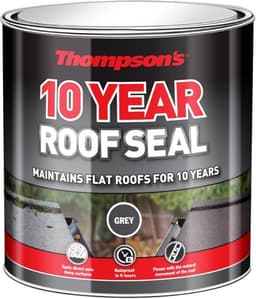
The Thompson’s amazon style cell says “Silicone”, but the manufacturer’s technical sheet describes acrylic-type odour and warm-water clean-up. Its product page gives 2 m²/L, a dry day above 10 °C and a six-hour interval before the second coat. Those are useful, concrete instructions, but they support treating Thompson’s as its documented elastomeric roof seal rather than as a conventional silicone system. This distinction matters most when ponding drives the purchase. Follow the maker’s sheet and ask for clarification if chemistry determines compatibility with an existing roof. Marketplace navigation is not a material certificate. Thompson’s can still make sense for a small felt patch where the substrate is sound and water drains. Compare the job and required coverage in our roof coating buying guide, not the fact that two products appeared beside the same search term.

When to choose which

Choose black bitumen when you have a compatible, sound felt or named surface, working drainage, a suitable weather window and willingness to handle solvent and accept a black film. Bond It is easier to budget because it publishes a rate; Nassboards remains uncertain on quantity because it does not. Choose silicone for ponding only when the actual product forms part of a documented system for your substrate and the supplied pack matches the specification. On the evidence available here, COATERA’s listing clashes stop it being that confident recommendation. If the felt is brittle, laps are moving or the deck is soft, choose neither. Use the felt roof coating guide to decide whether re-covering is needed.

Common questions

Is silicone better than bitumen on a flat roof?
Silicone can be the better family where water ponds, but only as a documented system compatible with the substrate. Bitumen is often the cheaper choice for sound felt where water drains and a black solvent film is acceptable. Neither is better when the deck is soft or the roof needs new falls.
Which bitumen options are in this set?
Bond It Bitubond and Nassboards are the main 5 L black options. Bond It publishes roughly 4–10 m²/L and costs £24.99 in the captured listing; Nassboards costs £28.99 but gives no reliable rate. Both require product-specific solvent precautions, and another brand’s coverage must not be applied to them.
What is wrong with the COATERA listing?
Its title and component data conflict over whether the pack is 4.7 kg or 1 kg, while the material field says rubber despite silicone wording. That prevents dependable coverage and value calculations. Ask for the precise pack and technical sheet before considering it for ponding or a broad roof area.
Does a ponding claim meet flat-roof drainage guidance?
No. Ponding tolerance is a material claim, while roof falls concern design and drainage. LRWA guidance says recoating does not remove a hollow, and UK flat-roof practice still expects drainage unless a system is designed for the condition. Investigate why water sits rather than relying on one product bullet.
Can you apply silicone over bitumen without primer?
Only when the chosen silicone system explicitly permits that build-up after assessing the existing surface. Bitumen oils can bleed through later membranes, and some systems require a bleed-blocking primer. COATERA’s “no primer” bullet must not be generalised to another product or used in place of a full specification.

Related pages

Sources

Public UK sources used for the coverage, drainage and safety points on this page. Prices, stars and review counts are from the amazon.co.uk listings on 16 October 2026.

  1. Thompson's — 10 Year Roof Seal (retrieved 16 October 2026)
  2. Sika — Black Jack 905 product data sheet (retrieved 16 October 2026)
  3. Bond It — bitumen paint technical data sheet (retrieved 16 October 2026)
  4. HSE — Asbestos cement (a16) (retrieved 16 October 2026)
  5. HSE — Paints and solvents (retrieved 16 October 2026)
  6. LRWA — Guidance Note 7 (retrieved 16 October 2026)
  7. Manual to the Building Regulations (retrieved 16 October 2026)
  8. amazon.co.uk — Thompson's 10 Year Roof Seal listing (retrieved 16 October 2026)