Independent comparisons. We may earn from shop links. More info

Roof coating buying guide: six checks before you buy

Updated: October 2026

A leaking shed or garage roof can make any tin marked “waterproof” look tempting. This roof coating buying guide helps you check whether the chemistry, pack size and claims actually match the roof in front of you before money changes hands. Start with the full [roof coating comparison](/hub/paints-and-varnishes/roof-coating) if you want to see all ten amazon.co.uk listings together. The decisive point is not the largest review count or the boldest lifetime in a product name: it is whether the existing covering is sound, the pack is accurately described and the maker gives usable coverage and application information. A small clear repair pot, a black bitumen coating and a specified liquid membrane are not interchangeable purchases.

A leaking shed or garage roof can make any tin marked “waterproof” look tempting.

Our top picks

On this page

A coating is not a new roof

A roof coating can renew or seal a suitable surface, but it cannot turn a rotten deck or a failed covering into a sound roof. A liquid sold in a tin may be useful over torch-on felt, EPDM or GRP, yet that does not make it a replacement for those coverings. Inspect the roof before comparing prices. Firm, bonded felt with a local crack is a plausible coating job; widespread brittleness, lifted laps or boards that feel soft point towards repair or re-covering instead. Liquid Roofing and Waterproofing Association guidance is clear that a coating does not create the falls needed to drain a roof. The Health and Safety Executive treats fragile roof surfaces as a serious fall risk, and buying a brushable coating does not make a garage roof safe to walk on. For a felt-specific coat-or-replace decision, use our felt roof coating guide.

Six checks before you add a tin to the basket

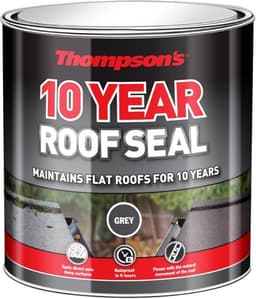
First, match the named substrate. Look for your actual surface—such as roofing felt, asphalt, metal or a particular membrane—in the maker’s instructions, rather than assuming that “roof seal” covers everything. Second, verify the pack. The product title, selected size, technical details and basket line should agree on litres or kilograms; if one says 4.7 kg and another says 1 kg, the value calculation is not dependable. Third, find a printed coverage rate and work from the number of coats specified. As a rule of thumb, divide the roof area by the maker’s square metres per litre, then multiply for additional coats and allow for a porous or rough surface. Thompson’s publishes 2 m² per litre for its 10 Year Roof Seal. Do not copy another brand’s rate onto a different amazon.co.uk listing. Fourth, separate waterproofing language from a documented ponding-water system. A product bullet that says it tolerates standing water is not the same as a system specification that names the substrate, primer, film build and warranty conditions. Fifth, check whether the product is solvent-based. That affects ventilation, gloves, fire precautions, odour and brush cleaning. Sixth, read reviews for the same use you have planned. A sealant with thousands of reviews may have earned them on gutters, shoes, planters or household repairs rather than as a roof membrane. If water sits on the roof, compare the underlying claims in silicone roof coating vs bitumen before treating a category label as proof.

What the listing clashes in this set look like

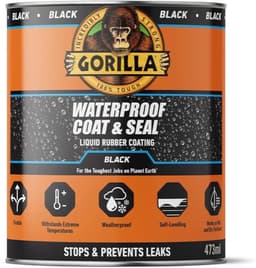
Several products in this set show why the checks need to happen in order. A COATERA silicone listing is priced at £65.98, but its title and component information conflict over whether the pack is 4.7 kg or 1 kg. Until the seller confirms what will arrive, neither cost per kilogram nor likely roof coverage can be calculated responsibly. Thompson’s creates a different clash. An amazon style cell says “Silicone”, while the manufacturer’s sheet describes acrylic-type odour and warm-water clean-up. Treat it according to the maker’s technical information, not the marketplace menu label. Gorilla Waterproof Coat & Seal has 2,378 reviews in the captured listing, but the surface field points to gutter use and the colour information conflicts between black and clear. That makes it a local repair candidate, not evidence for covering an entire flat roof. Entry tins sit at roughly £8–£22, 5 L bitumen products at about £25–£29, and the COATERA or MS-polymer tubs around £66–£69.

Who should stop before buying

Do not buy another coating to disguise movement, wet insulation, a soft deck or widespread cracking. A professional roofer can determine whether a local repair, new felt or a designed liquid system is appropriate.

Common questions

What should you check before buying a roof coating?
Check that the deck is firm, the existing covering is bonded, and the maker names your substrate. Then confirm the delivered pack size, printed coverage, number of coats, ponding-water limits, solvent or water clean-up, and whether reviews concern roof use. If any of those are missing, do not let the star rating substitute for the technical information.
Is a clear 300 g or 1 kg pot a roof coating?
It may be a useful local sealant, but its scale makes it a poor default for coating a roof. In this set, the 300 g DBTW pot and 1 kg BSCPAM pot fit details and small repairs better than broad coverage. Check the stated area and compatible substrates before treating “waterproof” as a membrane specification.
How do you calculate how many tins you need?
Use the manufacturer’s coverage for your substrate and the required number of coats. Divide roof area by square metres per litre, multiply by the coat count, then allow for texture and waste. This is only a planning calculation: do not borrow another brand’s rate when your chosen listing publishes none.
Does “waterproof” mean a coating can hold a permanent pond?
No. Waterproofing and resistance to persistent ponding are separate claims, and a coating does not correct a hollow or inadequate fall. For standing water, look for a documented system that covers your substrate, preparation, primer and film thickness. A marketplace bullet on its own is not equivalent to that specification.
What conflicts with the Thompson’s “Silicone” style cell?
The manufacturer’s technical sheet describes acrylic-type odour and warm-water clean-up, which does not support treating it as a conventional silicone roof system. The practical response is to follow the maker’s sheet for substrate, coverage and application, rather than using an amazon menu label to classify the chemistry.

Related pages

Sources

Public UK sources used for the coverage, drainage and safety points on this page. Prices, stars and review counts are from the amazon.co.uk listings on 16 October 2026.

  1. Thompson's — 10 Year Roof Seal (retrieved 16 October 2026)
  2. Sika — Black Jack 905 product data sheet (retrieved 16 October 2026)
  3. Bond It — bitumen paint technical data sheet (retrieved 16 October 2026)
  4. HSE — Asbestos cement (a16) (retrieved 16 October 2026)
  5. HSE — Paints and solvents (retrieved 16 October 2026)
  6. LRWA — Guidance Note 7 (retrieved 16 October 2026)
  7. Manual to the Building Regulations (retrieved 16 October 2026)
  8. amazon.co.uk — Thompson's 10 Year Roof Seal listing (retrieved 16 October 2026)