Decking oil or varnish: choose the right finish

Decking oil or varnish? Why penetrating oil suits horizontal timber, when an old film must come off, and how to choose a finish for a UK deck.
On this page

You have cleaned the boards, found a dry weekend and reached the shelf where exterior oils sit beside glossy wood finishes. Choosing decking oil or varnish is not simply a choice between a matt and shiny appearance. A flat deck takes rain, standing water, foot traffic and seasonal timber movement, so a finish that works neatly on a window can fail when spread across boards underfoot.
For most bare or previously oiled timber decks, the practical default is a product specifically labelled as a penetrating finish for exterior decking. A window, yacht or general exterior varnish is not automatically suitable merely because the label mentions weather protection. The intended surface and orientation matter as much as the word exterior.
In short
Use a penetrating decking oil that the manufacturer approves for horizontal deck boards. Choose some pigment if retaining the timber's colour matters, because clear does not mean the wood will keep its fresh-cut shade. Avoid putting oil over an old film: identify and remove varnish or paint first, then test your chosen system on an inconspicuous area or offcut.
Why varnish struggles on a flat deck
Traditional varnish protects by forming a continuous film. On a sheltered door or window, water runs off and the coating sees little foot abrasion. A deck reverses that: the upper face catches water, shoes grind in grit, and boards expand and contract as their moisture content changes.
Once a film cracks, water can reach the timber through a small break and dry slowly beneath the intact coating. Whitening, lifting or flakes often appear around joints and board ends. Another coat does not repair trapped moisture, and it can make the later stripping job larger.
The Timber Decking and Cladding Association advises using penetrating products on horizontal decking rather than coatings that create a film and are liable to crack and flake. That is a general principle, not an endorsement of every deck oil. You still need to check the maker's preparation and recoat conditions.
Product names can mislead. Yacht, marine, UV or exterior does not by itself confirm suitability for a walked-on horizontal surface. If the instructions do not say deck or horizontal timber, leave that product for its intended job and compare a dedicated window varnish separately.
What a penetrating decking oil does
A penetrating deck finish soaks into prepared wood rather than building a thick, rigid shell on top. Microporous decking oils are made for outdoor exposure and timber movement, and makers commonly describe them as finishes that do not crack, peel or flake. Later maintenance is then cleaning and a maintenance coat, rather than stripping a hard film.
Penetrating does not mean bottomless. Dense hardwood can accept relatively little product if it is new, naturally oily or already saturated. A heavy coat can leave excess oil that stays glossy, tacky or slow to dry. The number of coats and the drying interval belong to the particular tin.
Oil does not turn timber into waterproof plastic. Drainage, ventilation beneath the deck and clear gaps still matter, and high-wear routes may lose their finish sooner than quiet edges.
For hardwood such as yellow balau or bangkirai, compare products formulated for dense decking and follow any weathering period stated by the manufacturer. Our hardwood decking oil comparison is the useful starting point once you have confirmed that the existing surface is suitable for oil.
Clear, coloured and anti-slip finishes
Clear, coloured and varnished are not interchangeable. Clear means little or no pigment; it does not say whether the finish penetrates the grain or forms a film. A clear decking oil can be a legitimate deck product, while a clear window finish can still be the wrong choice for horizontal boards.
Pigment matters because sunlight changes timber colour. A completely clear coat is not a promise that fresh colour will never grey. A suitably pigmented penetrating oil normally slows visible colour change more, although the shade depends on species, weathering and previous treatment. Test it on an offcut and let it dry before you judge it, because wet oil looks deeper than the cured finish.
Anti-slip oil is not a generic substitute for ordinary deck oil, and it is not automatically a varnish. Some systems apply a coloured decking oil first and a separate anti-slip product as the second coat. Osmo Anti-Slip Decking Oil 430 is described in that second-coat role. Do not mix brands or change the order unless both manufacturers confirm compatibility.
How to choose for your deck
Start with the surface you have, not the sheen you want. Bare, clean and suitably weathered decking is a candidate for a penetrating oil. Previously oiled decking may take a compatible maintenance coat after cleaning and preparation. A peeling, glossy or unknown film needs investigation and normally removal before you move to oil.
Then read beyond the front label. Look for decking or horizontal exterior timber, the wood species, preparation, spreading rate and minimum drying conditions. BS EN 927-1 classifies exterior wood coatings by end use; a description for exterior wood does not turn a window system into a deck system.
- Is the product approved for horizontal decking? Exterior wood on its own is too broad.
- Does it suit your timber species? Dense hardwood and softwood absorb a finish differently.
- Do you want to slow greying? Consider a compatible pigmented oil rather than a fully clear finish.
- Is grip a particular concern? Check the stated anti-slip system, not the marketing language.
- Can you maintain it as specified? You need to be able to clean, inspect and recoat it.
A low shelf price means little if poor coverage requires another container. Do not thin the product or substitute teak oil unless the decking product's instructions expressly permit that.
What to do with an existing coating
An unknown old finish is the point at which a quick weekend recoat can become a restoration job. Inspect dry boards in several places, including under furniture and along exposed edges. Glossy islands, peeling rims, pale moisture marks or material that lifts as a sheet all suggest a film rather than a penetrating oil.
Do not oil over that film. Oil cannot soak evenly through varnish, and apparently bare cracks will absorb differently from sealed areas. The result can be patchy colour and poor drying without solving the failure underneath. If water appears to sit below cracked coating, stripping and drying are required before any new system is considered.
Removal may involve a compatible coating remover followed by scraping and sanding, or mechanical sanding alone, depending on the old product and the timber. Work cautiously around screw heads, grooves and board edges. Collect residues rather than washing flakes into soil or drains, and follow the remover's safety instructions.
After stripping, the aim is uniformly clean, sound and dry timber. Residual film in low areas can still block oil, so check that the boards absorb a finish evenly before you coat the whole deck.
If you cannot identify the coating, cannot remove it without damaging the boards, or suspect decay beneath it, bring in an experienced decking contractor. Oil cannot repair soft timber, failed fixings or trapped-moisture damage.
Apply decking oil without building a film
Choose a settled period that meets the product's temperature and rain-free requirements, and let cleaned boards dry as directed. Stir pigmented oil thoroughly so colour and solids are evenly distributed. Mask adjacent surfaces, protect plants, and plan an exit route so you do not have to cross wet boards.
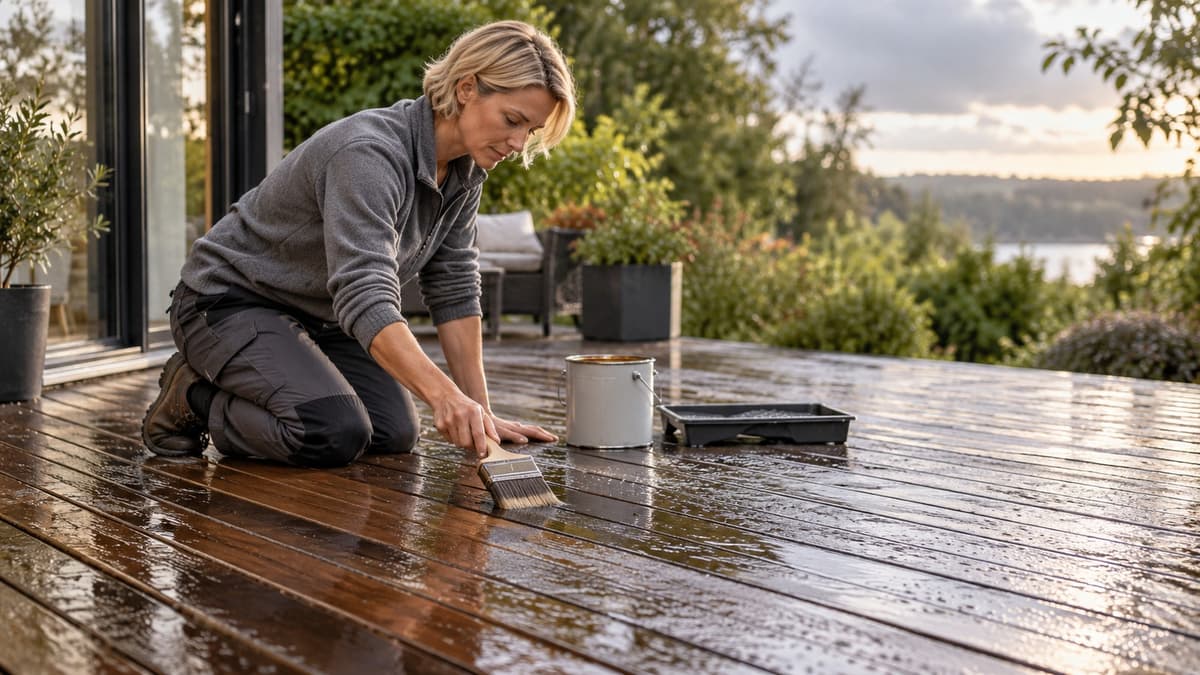
Apply thinly in the direction of the grain, working along complete boards to reduce lap marks. Deal with excess exactly when the instructions say; leaving puddles in grooves, around fixings or at board ends defeats the purpose of a penetrating coat. More material is not more protection when the wood cannot absorb it.
Let the first coat dry for the stated time before any specified second coat. Cool, damp conditions can extend drying, so judge the surface rather than the shortest label time. Keep people, pets and furniture off until the finish is dry, and handle oily cloths as the label requires, because some drying oils can heat up in crumpled rags.
Keep the product name, colour and batch details with a dated photograph of the finished deck. Inspect wear routes and board ends, clean without an incompatible chemical, and recoat when the specified system and the surface call for it.
Common questions
Can I use window varnish on deck boards?
What does penetrating deck finish mean?
Is a clear decking finish always varnish?
Can I apply decking oil over old varnish?
Does decking oil need recoating every year?
Does the TDCA test the oils sold online?
Is anti-slip decking oil a varnish?

Peter F. is the editor for DIY & tools at productscompared.co.uk. Comparisons in this category are checked against amazon.co.uk listings, review evidence and public UK sources.
Related articles

How long to wait before oiling new decking
Find out why new boards may need to weather before their first coat and what to check before you start.

When to recoat a hardwood deck
Use the condition of the finish, rather than a fixed calendar date, to decide when another coat is due.
Decking oil and slip resistance
Understand what a finish can and cannot do about slippery boards before choosing an anti-slip product.