Does decking oil make decking less slippery when wet?
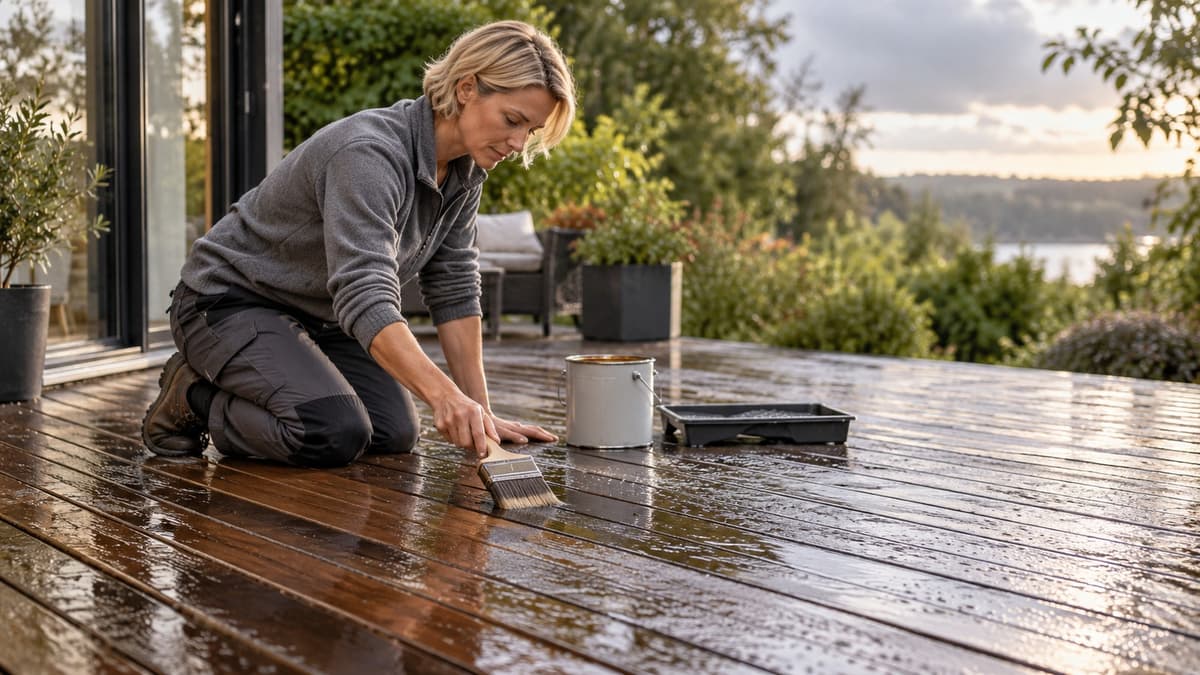
Find out what decking oil can and cannot do for grip, why grooves are not a slip test, and when an anti-slip finish or tested boards are the right call.
On this page

Rain has stopped, the boards look dark, and the first step outside feels less certain than it did in summer. It is tempting to assume that a fresh coat of oil will solve the problem as well as improving the colour. But does decking oil make decking less slippery? Standard decking oil should not be treated as a grip treatment unless the exact product carries relevant evidence. Oiling can protect timber and change its appearance. Neither result proves safer footing in wet conditions.
In short
Ordinary coloured decking oil is not the same thing as anti-slip decking oil, and a freshly oiled surface is not a tested surface. Clean away the causes of avoidable slipperiness, keep water routes open, and use a purpose-made anti-slip finish or tested enhanced-grip boards where reliable wet grip matters.
What standard decking oil does
A penetrating decking oil is a timber finish. It is chosen to help weathered boards resist moisture and to refresh or alter their colour. Those jobs do not answer a slip-resistance question. None of the captured ASINs in the underlying comparison supplied a slip-resistance bullet or pendulum value, so there is no sound basis for presenting one of those coloured oils as a non-slip treatment.
The distinction matters when you compare oils by shade or timber type. A product may be sold for dark hardwood, softwood or a colour effect without any measurable claim about grip. The word decking tells you where the finish is meant to be used. It does not mean the coating has been tested as anti-slip. Our Bangkirai oil comparison can help you judge timber and appearance. It is not a slip specification.
Penetrating does not mean grippy. Timber Decking and Cladding Association guidance favours suitable penetrating oils rather than varnish-like films for normal deck finishing, and it identifies anti-slip coatings as a separate option. Choose an ordinary oil for its stated finish performance. If the aim is to reduce a known slipping risk, ask what evidence supports the complete surface when wet. Whether you use decking oil or varnish is a film question, not a pendulum result.
Why decking becomes slippery
Treat the deck as a surface and drainage problem first. Organic growth can form a slick layer on damp timber, particularly in shade that dries slowly. Leaves, soil and other debris hold moisture and can block the gaps or grooves that should move water away. Standing water then keeps the surface wet for longer. A new coating applied over those conditions may improve the colour and leave the hazard largely unchanged.
Note whether the slippery patch appears only after rain, stays damp for hours, sits beneath planting, or lines up with clogged channels. Check steps, door thresholds and changes of level rather than judging the whole deck from one dry board. That observation is not a laboratory test. It separates a maintenance defect from a wider specification problem.
Clean with a method that suits the timber and the finish you plan to apply. Remove contamination and let the boards dry. Do not roughen the surface aggressively. Jet washing is poor preparation for oil, because excessive pressure can damage timber fibres and leave an uneven, furry surface. Follow the oil maker's preparation and drying instructions, especially if an earlier coating is present.
Cleaning can remove a slippery layer and restore drainage. It does not turn an ordinary board into an enhanced-grip board. On steep steps or a ramp, better housekeeping may still not be enough.
Grooves are drainage, not a slip test
Grooved deck boards are often called non-slip, and that description overpromises. According to the TDCA, grooves channel water. They are not an extra slip-resistance feature in themselves. They work only as well as the route the water can take, so dirt packed into a groove defeats much of the drainage. Orientation and construction matter, because water needs somewhere to go after it enters the channel.
A grooved board can still feel slippery. The foot meets the raised parts of the board, and algae or a wet film can remain there. Grooves do not supply a pendulum value, and they say nothing about how that product performed in a standardised wet test. More texture is not the same as verified grip.
Enhanced-grip boards are a different product. Where a supplier reports PTV 36 under BS 7976-3, the figure belongs to the tested board, not to a guess based on grooves. Check what was tested, whether the figure is for wet conditions, and whether installation or maintenance limits the claim. Keep grooves clear on a domestic deck. On a new ramp or shared route, tested boards are a more dependable start than an unspecified oil.
When anti-slip decking oil helps
Anti-slip decking oil is a separate product. It is formulated and sold for added surface grip. Standard coloured decking oils are chosen mainly for protection and appearance. That difference should show in the product name, the technical information and the application system. Do not infer it from a retailer category, a timber colour, or grooves under the coating.
Osmo Anti-Slip Decking Oil 430 shows the distinction. Osmo UK describes 430 as a second coat over a coloured decking oil. It is not one of the seven captured ASINs in the comparison, and it is not the same as coloured variants such as 006 or 016. Buying a coloured tin for anti-slip performance solves the wrong part of the job.
Osmo says 430 may be used on its own, or over clear Decking-Oil 007, but those clear arrangements provide limited UV protection. A coloured first coat, then the anti-slip second coat, is the relevant configuration when colour and weathering matter. Follow the current maker's instructions for preparation, coverage, drying and any existing finish.
A purpose-made anti-slip oil can add grip. Dirt, growth and blocked drainage can still leave the surface wet, and the coating wears on steps and walking lines. A later coat is upkeep, not a safety certificate. See how often to oil hardwood decking when you are judging wear, not grip.
PTV 36 and BS 7976-3
PTV means pendulum test value. The pendulum test uses a standardised rubber slider on the surface and produces a number that helps assess slip potential. In UK decking guidance, PTV 36 is a reference point for enhanced-grip boards tested to BS 7976-3, particularly for wet performance.
The number does not travel by association. A PTV for one board, coating system or set of conditions does not apply to another timber, or to a deck after a different oil goes on. An ordinary decking oil with no published pendulum result does not acquire PTV 36 because it is brushed onto grooved boards. The claim belongs to the tested configuration.
Confirm that the method is BS 7976-3, that the condition matches your wet deck, and that the named product is the one you will install. A mention of standards without the result and the test conditions is not enough. For a domestic seating area, the evidence can inform a choice. For a workplace or public route, it belongs in a competent risk assessment. Even a tested board can pick up contamination or wear. The result describes a sample under defined conditions.
Choose the right response
On a level domestic deck that turns slippery after leaves and algae, start with maintenance. Remove debris, clear drainage, clean by a timber-appropriate method and let the boards dry. Then decide whether the timber needs a normal oil for protection and colour, or a compatible anti-slip finish. Keep those decisions apart so a colour choice is not mistaken for a grip claim.
On steps and wet thresholds, inspect more often and watch local wear. An anti-slip second coat can help when it matches the first coat and is applied as the manufacturer specifies. Do not promise non-slip performance. Conditions vary, coatings wear and contamination returns. If the area stays hazardous, stop adding another maintenance coat and look for a more suitable surface specification.
For a new ramp, public deck, workplace route or shared access, involve a competent designer, installer or slip-resistance specialist. Ask for wet pendulum evidence and for the board or system that achieved it. Tested enhanced-grip boards may be a better start than standard timber plus a remedial finish. Note when a higher-risk area was cleaned, finished and inspected, and where it stays wet.
Common questions
Does decking oil make decking less slippery?
Will Osmo Decking-Oil 006 or 016 make a deck non-slip?
Are grooved deck boards non-slip?
What does PTV 36 mean for decking?
Is anti-slip decking oil the same as coloured decking oil?
Can Osmo 430 be used on its own?
Should I treat a public walkway myself?

Peter F. is the editor for DIY & tools at productscompared.co.uk. Comparisons in this category are checked against amazon.co.uk listings, review evidence and public UK sources.
Related articles

Decking oil or varnish: choose the right finish
Penetrating oil suits horizontal timber. A varnish-like film is a different finish, and an old film has to come off first.
Oil over grey decking: restore the wood first
The grey layer is weathered fibre, not a clean base. Restore the surface and let the boards dry before a pigmented oil.
How often to oil hardwood decking: check wear first
Recoat when wear, water resistance and traffic show the finish is declining, not because the calendar says so.