Independent comparisons. We may earn from shop links. More info

Yellow balau decking oil and bangkirai explained

Updated: October 2026

Your UK timber invoice says yellow balau, while the oil tin and online listings say bangkirai. That does not necessarily mean you have bought the wrong finish. In this market, yellow balau decking oil and bangkirai oil often describe the same practical timber-and-finish pairing, but the trade names, durability claims and weathering advice still need care. Our [bangkirai oil comparison](/hub/paints-and-varnishes/bangkirai-oil) covers the captured tins. This guide explains the species name, the published class 2 figure, why boards turn silver and why new decking should wait before oiling.

Your UK timber invoice says yellow balau, while the oil tin and online listings say bangkirai. That does not necessarily mean you have bought the wrong finish.

Our top picks

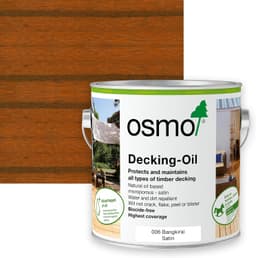
Osmo Osmo 006 Bangkirai Satin 2.5 L

Best overall

Osmo Osmo 006 Bangkirai Satin 2.5 L
9.4/10about £72.31
Osmo Osmo 006 Bangkirai Oil 0.75 L

Alternative

Osmo Osmo 006 Bangkirai Oil 0.75 L
7.4/10about £23.82
On this page

The name on the invoice

Yellow balau is the common name used by many UK timber merchants for dense tropical hardwood decking. Brooks Timber's decking sheet identifies it as Shorea laevis and notes that the timber is known as bangkirai in Indonesia and Malaysia. CIRAD makes the regional naming more precise: yellow balau is usual for Malaysian imports, while bangkirai is often used for Indonesian imports. Check documentation rather than relying on colour because balau can be used broadly. Your invoice and supplier's technical sheet are better evidence than a marketplace keyword. If they identify yellow balau or Shorea laevis, Osmo's balau and bangkirai guidance is relevant. Osmo lists colour 006 as optically suitable for bangkirai and balau and offers 016 as the darker alternative. That does not mean every product containing the word teak, hardwood or tropical is interchangeable. A pigmented exterior decking oil has a different job from chopping-board oil, clear teak oil or a film-forming window varnish. The bangkirai oil buying guide explains how to exclude those wrong product types.

What durability class 2 does and does not mean

The Brooks decking sheet describes yellow balau as very durable, class 2, with a density of about 980 kg/m³ that can vary by 20%. Those figures are useful for understanding why the boards feel dense and why they are selected for exterior decking. They do not mean the surface will retain its colour without maintenance, and they do not provide a guaranteed service life for your particular deck. Design, drainage, ventilation, fixings and installation quality all affect performance. Durability classification is not proof that decay is impossible. Boards can fail where water is trapped, ventilation is poor or construction details are wrong. Oil manages appearance and surface water repellency but cannot repair internal decay.

Silver boards are a colour change

Untreated yellow balau changes under sunlight and weather, gradually losing its fresh brown tone and becoming silver-grey. Greying is a surface colour process and is not, on its own, evidence that the board has rotted. That distinction matters when an otherwise firm deck looks old sooner than expected. Inspect the structure and surface condition separately instead of diagnosing failure from colour alone. If you want to retain a warm bangkirai appearance, use a pigmented penetrating decking oil after the required weathering period. Osmo 006 follows the natural colour direction, while 016 produces a darker result. Osmo says darker pigment slows greying more than a light or clear coating, but neither shade stops weathering permanently. The Osmo 006 or 016 comparison helps you choose between those visual outcomes. New yellow balau needs patience too. Osmo UK states that balau should weather for 12 weeks and elsewhere on the same page says tropical species including bangkirai need at least three months. Treat that as a roughly three-month waiting period. Dense, extractive-rich boards may not accept oil properly when coated immediately after installation, so a first-week application can create the very unevenness you were trying to prevent.

Use penetrating deck oil, not varnish

The Timber Decking and Cladding Association advises using a penetrating product designed for decking rather than a film-forming varnish. A penetrating oil moves and wears differently from a hard surface film exposed to foot traffic and British weather. A coating sold for windows or indoor floors is not automatically suitable because it happens to adhere to wood. Check the stated end use, application system and maintenance route. Preparation still determines whether the oil can work. New boards need weathering, dirty boards need cleaning, and grey fibres need reviving if colour restoration is the goal. Osmo UK uses a maximum 20% moisture, two thin coats and about 12 hours' drying under stated conditions.

Common questions

Is yellow balau the same as bangkirai?
The names are commonly used for closely related trade material: yellow balau is usual for Malaysian imports and bangkirai for Indonesian imports. Brooks identifies its yellow-balau decking as Shorea laevis and says it is known as bangkirai in Indonesia and Malaysia.
What durability class should I quote?
The Brooks UK decking sheet gives yellow balau as very durable, class 2, and about 980 kg/m³ with density varying by 20%. Other sheets conflict, so do not convert this into a universal class 1 claim or guaranteed lifespan.
Does yellow balau need oil to avoid rot?
Oil is not a structural preservative claim. Yellow balau is naturally durable, while good design, drainage and ventilation remain important. Decking oil is mainly used to manage appearance and surface water repellency, not to repair decay.
Why does yellow balau turn grey?
Sunlight and weather alter the exposed surface colour, producing a silver-grey patina. Greying alone does not prove decay. If you want to restore colour before oiling, use an appropriate wood reviver and prepare the timber correctly.
How long should new balau wait before oiling?
Osmo UK states 12 weeks for balau and at least three months for tropical species including bangkirai. Plan for roughly three months, then clean the boards and verify that moisture is at or below the UK sheet's 20% limit.
Do grooves make yellow-balau decking non-slip?
No. TDCA says grooves are not proven to make boards less slippery by themselves. Enhanced-grip performance and PTV 36 under BS 7976-3 concern tested board systems, not an unsupported claim for ordinary grooved decking or oil.

Related pages

Sources

Public UK sources for the timber, the coating class and the solvent points. Prices, stars and review counts are the captured amazon.co.uk lines, not a live check on 15 October 2026.

  1. Osmo UK — Decking-Oil (retrieved 15 October 2026)
  2. Osmo UK — Decking oils product information (retrieved 15 October 2026)
  3. The Volatile Organic Compounds in Paints, Varnishes and Vehicle Refinishing Products Regulations 2012, Schedule 2 (retrieved 15 October 2026)
  4. HSE — Solvents (retrieved 15 October 2026)
  5. TDCA — Deck finishes (retrieved 15 October 2026)
  6. Brooks Timber — decking sheet (retrieved 15 October 2026)
  7. Southgate Timber — Osmo 006 bangkirai decking oil (retrieved 15 October 2026)
  8. Consumer Rights Act 2015, section 9 (retrieved 15 October 2026)