Isocyanate paint spraying UK: when home use must stop
Isocyanate paint spraying UK belongs in a booth with air-fed breathing kit. A hobby airbrush and a paper mask are the wrong setup for two-pack paint at home.
On this page

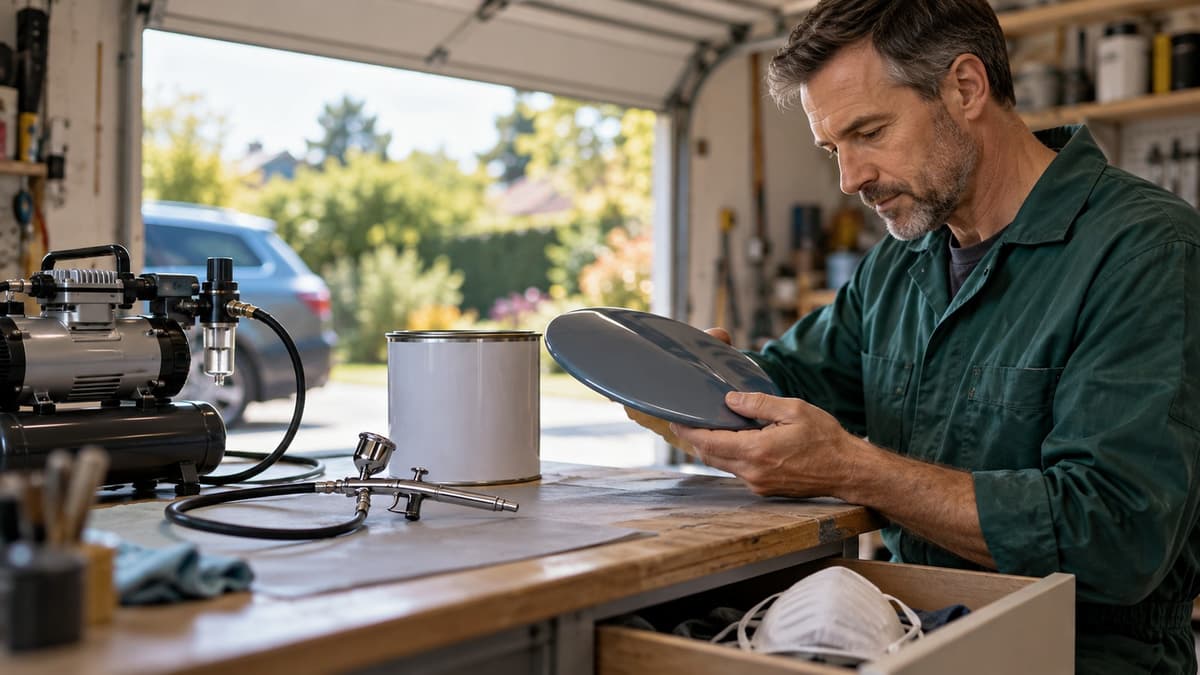
The panel is the size of a dinner plate, the garage door is up, and the gun on the bench is the hobby kit you bought for models. The tin says two-pack. A paper mask is in the drawer. Isocyanate paint spraying UK guidance from the Health and Safety Executive treats the mist from that tin as a workplace asthma risk. Spraying belongs in a booth, or in a room held at a slight negative pressure, with air-fed breathing apparatus worn through a measured clearance time.
Peter F. edits DIY & tools at productscompared.co.uk. Kit figures come from the amazon.co.uk files behind our airbrush set comparison. The stop-lines come from HSE’s public pages on 2-pack paints, SMART spraying, booth controls and lead paint. We did not open your tin, measure a garage, or run an exposure test. A qualifying purchase through our links can earn a commission at no extra cost to you.
In short
Isocyanate paint spraying in the UK belongs in a ventilated booth with air-fed breathing apparatus and a measured clearance time. An airbrush, a mini gun or an aerosol still makes a fine invisible mist, and a P3 filter does not stop the vapour. Water-based model paint in a ventilated room can stay on a hobby kit. Two-pack spraying, a scorched plug, and lead paint that has to come off are the points where you stop.
What a hobby airbrush is for
The top pick in that comparison is the Timbertech ABPST05, amazon.co.uk ASIN B00LO4PKY2, at £69.99 with 4.5 from 6,320 reviews in the snapshot we scored. The listing bullets name autostart at 3 bar and autostop at 4 bar. A 0.30 mm head is described as mounted, with 0.20 mm and 0.50 mm heads to swap. The spec block prints a tank volume of 7 ml and 220 V. That is a bench compressor and a small gun for water-based model or craft paint in a room you can ventilate.
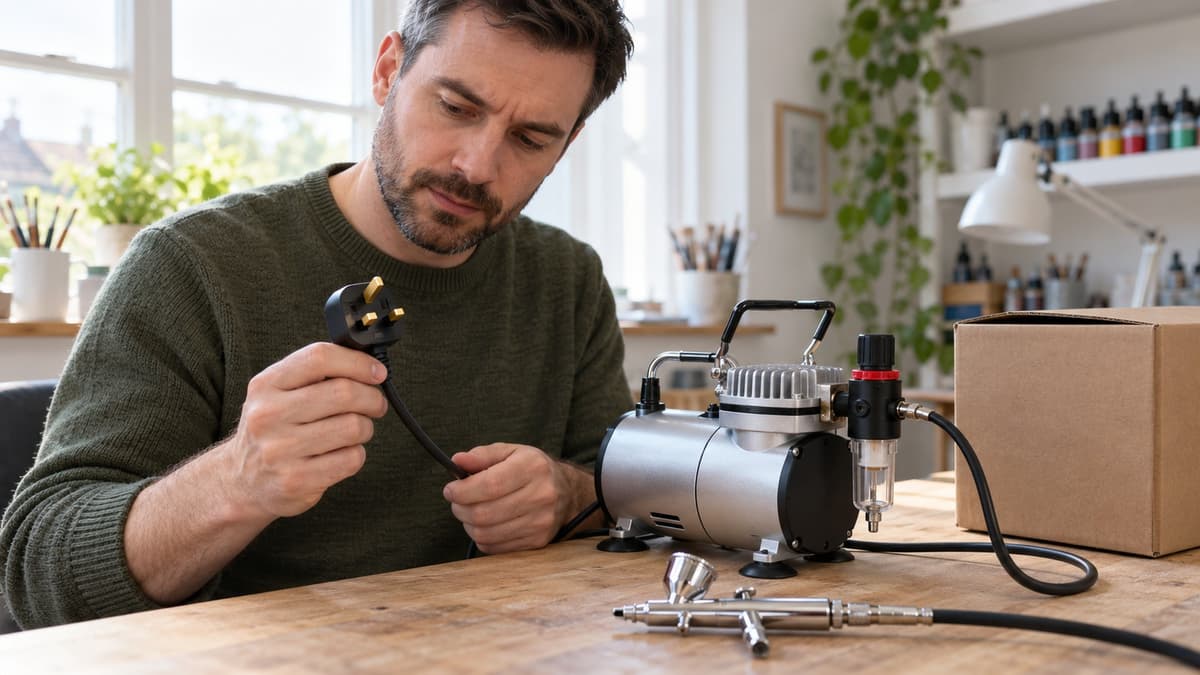
A 7 ml figure is the compressor’s own tank line, not breathing air and not a spray booth. Autostart at 3 bar is when the motor kicks in for the gun, not a room’s clearance time. One review on the file reports a Euro two-pin plug. The spec says 220 V and does not say BS 1363. UK mains are 230 V, and a UK socket wants a BS 1363 plug. If the colour and a hardener have to be mixed, put the gun down and read both labels. If the tin is emulsion for a wall, leave this kit in the drawer. An open window for acrylic is not the slight negative pressure HSE describes for isocyanate spraying.
Two-pack isocyanate paint
Stop if either pack shows isocyanate, 2K, a polyurethane hardener, or prepolymer. Those are the markers HSE uses for paints, coatings, foams and glues that carry isocyanates. On a two-pack system the colour pack can look like a normal topcoat. The hardener is often the smaller tin, and it commonly carries the isocyanate words. Two-pack paint home spraying starts when those words meet a gun.
The motor vehicle repair page says the main exposure from 2-pack isocyanate paint is an invisible spray mist, and that the mist is a cause of occupational asthma. Spraying indoors means a ventilated booth or a room at slight negative pressure, with air-fed breathing apparatus on while you spray and while the booth clears. A garage with the door cracked is the usual picture for 2K paint garage work. The door changes the draught. It does not give you a measured clearance time or a supply of breathing air. Spraying sits at the high end of exposure on HSE’s construction page, and brushing or trowelling lower, because less of the product becomes mist you inhale.
Why a small gun is not a small risk
HSE guidance sheet MR5 covers SMART repair isocyanate spraying with an airbrush, a mini spray gun or an aerosol. A small 2K repair still produces high levels of invisible isocyanate mist. You should not spray that paint in an occupied workshop, and you should not spray it without airline breathing apparatus. The motor vehicle repair page allows outdoor spraying only for these SMART repairs, and it still calls for airline breathing apparatus. A breeze is not a measured clearance time.
A cordless craft gun and the Timbertech bench kit fail together on this paint. Neither is a booth at slight negative pressure, and neither supplies breathable air to a mask. If the work is a car panel in two-pack, the next call is a bodyshop that sprays inside those controls. Keep the hobby kit for the water-based paint it was compared for.
Masks, booths and clearance time
A paper mask is a dust mask. HSE’s construction page says a P3 filter stops mist and does not stop isocyanate vapour. Air-fed breathing apparatus in guidance sheet MR2 is airline-fed respiratory protective equipment with an assigned protection factor of at least 20, worn while you spray and through the clearance time. The hose that feeds the gun is not that airline. A hobby compressor atomises paint. It is not a source of breathing air.
Spray booth clearance time is the wait after you stop spraying before anyone enters without the air-fed kit, and the kit stays on during the wait. These pages do not give a single minute figure you can copy onto a domestic garage, because the measurement belongs to the booth. An open door or a fan in the window is not that measurement. If the label shows isocyanate and you do not have the booth and the air-fed kit, you stop.
Other reasons to stop: the plug, and lead paint
A damaged mains lead or a scorched plug is a separate stop. Unplug it and leave it unplugged. Do not tape the lead, and do not open the plug to rewire it so the session can finish. Goods that will not go into a UK socket, or a lead that arrives damaged or heat-marked, fall under the short-term right to reject in the Consumer Rights Act 2015. You have 30 days for that right when the goods are faulty. A travel adapter left in the wall is not the fix. Reject the goods instead.
Lead paint is the other line, and an airbrush does not remove it. HSE’s lead FAQs say you strip old paint only when it is flaking, chipping, or a risk to children, and they say not to use blow lamps. Sound paint that is not flaking can stay. If flakes are where a child can reach them, removal is a specialist task. Sanding and heat turn old lead into dust. A steam wallpaper stripper is for wallpaper, not a milder way to heat paint. If you are unsure the layer is lead, stop sanding and get advice.
Jobs that can stay as DIY
Water-based model paint or craft acrylic, in a room you can ventilate, is the job a hobby kit is for. You still read the label, keep other people out of the mist, and clean the gun before the paint sets. You do need a BS 1363 plug and a lead that is not scorched.
Emulsion on a wall is DIY with a different tool. A roller from the paint roller comparison is the straightforward way to cover a room. If you want the wall sprayed, use a cordless paint spray gun or an airless paint sprayer, or ask a decorator to do the masking. Ordinary emulsion does not become an isocyanate job because a sprayer is involved. A 0.3 mm airbrush head will not cover a room.
If you are paid to spray isocyanate products, those home exceptions do not travel with you. Training duties sit with the employer on the motor vehicle repair page, and the booth, the negative pressure and the air-fed kit sit in MR2 and MR5. A customer’s driveway and a paper mask do not replace them. If you cannot tell whether the tin contains isocyanate, ask the supplier for the safety data sheet and get specialist help. The public pages behind these lines are HSE’s note on 2-pack isocyanate paints, the construction note on isocyanates, guidance sheets MR2 and MR5, and the lead FAQs. Prices and the plug review are from the amazon.co.uk snapshot in our airbrush comparison, not a live check on the day you read this.
Common questions
Can I spray two-pack car paint in the garage with an airbrush?
Is a paper mask or a P3 filter enough for isocyanate paint?
What is SMART spraying, and does a small airbrush make it safe?
Do I need a professional for ordinary emulsion?
The compressor plug is scorched. Do I keep using it?
Old paint might be lead. Can the airbrush remove it?
I am being paid to spray. Does that change the rules?
Who do I call if I am not sure the tin contains isocyanate?

Peter F. is the editor for DIY & tools at productscompared.co.uk. Comparisons in this category are checked against amazon.co.uk listings, review evidence and public UK sources.
Related articles

Paint sprayer or roller for walls: one-room choice
A hobby airbrush is the wrong tool for a wall. A roller, a cordless wall gun or an airless sprayer is the comparison that fits the room.
Airbrush compressor UK plug: pins before decibels
A printed decibel figure was not measured here, and 220 V on the spec does not prove a BS 1363 plug.

Lead paint UK decorating: leave sound paint
Flaking paint a child can reach is a lead-paint decision. An airbrush does not take it off, and sound paint can stay.