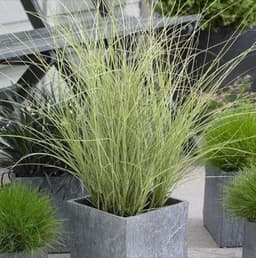
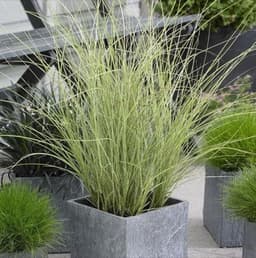
Miscanthus in pots on a patio or balcony
You have a sunny patio or a balcony and no border to spare, so miscanthus has to live in a container that can dry out by afternoon and still give you movement and winter structure. Miscanthus in pots works when you choose a cultivar size honestly, build drainage into the tub, and water through summer in a way you would never need for an established bed. The [miscanthus comparison](/hub/ornamental-plants/miscanthus) shows which amazon.co.uk lines ship. This page is container culture only. Peter F. matched the pot advice to the stored listings and public UK sources. A qualifying purchase through our amazon.co.uk links can earn a commission at no extra cost to you.
You have a sunny patio or a balcony and no border to spare, so miscanthus has to live in a container that can dry out by afternoon and still give you movement and winter structure.
You have a sunny patio or a balcony and no border to spare, so miscanthus has to live in a container that can dry out by afternoon and still give you movement and winter structure. Miscanthus in pots works when you choose a cultivar size honestly, build drainage into the tub, and water through summer in a way you would never need for an established bed. The miscanthus comparison shows which amazon.co.uk lines ship. This page is container culture only. Peter F. matched the pot advice to the stored listings and public UK sources. A qualifying purchase through our amazon.co.uk links can earn a commission at no extra cost to you.
Our top picks
| Badge | Product | Form | Size to plan for | Sun | Note | Price | Offer |
|---|---|---|---|---|---|---|---|
| Best overall |  Carbeth Plants Carbeth Morning Light, three 9 cm pots | Three 9 cm pots | RHS 1–1.5 m once mature | Full sun | 9.3 | about £24.99 | View offer |
| Best value |  Carbeth Plants Carbeth Chinese silver grass, one 9 cm pot | One 9 cm pot | RHS 1–1.5 m once mature | Full sun | 8.2 | about £10.99 | View offer |
 n/a Kleine Fontäne, three plugs | Three plugs | 150 cm (seller) | Partial shade | 8.1 | about £11.95 | View offer |

On this page
Which miscanthus belongs in a pot
Pot, compost and drainage
Water and feed
What this batch can start you with
Common questions
Will Morning Light live in a pot?
How big a pot, as a rule of thumb?
How often do I water?
Do I feed a potted plant?
Which listing in this set is the wrong size for a balcony?
What happens if the pot has no drainage?
Related pages
Sources
Public sources from the research digest, last checked on 22 October 2026. Shelf prices are the stored amazon.co.uk figures for this comparison. The price band is this set, not a market average. No listing was trialled in a garden.
- RHS: Miscanthus sinensis (retrieved 22 October 2026)
- RHS: Miscanthus sinensis Morning Light (retrieved 22 October 2026)
- RHS: cutting back ornamental grasses (retrieved 22 October 2026)
- RHS: dividing ornamental grasses (retrieved 22 October 2026)
- BBC Gardeners' World: how to grow miscanthus (retrieved 22 October 2026)
- GOV.UK: plant passports for trade (retrieved 22 October 2026)
- Wildlife and Countryside Act 1981 Schedule 9 (retrieved 22 October 2026)
- Invasive Alien Species Order 2019, Schedule 2 Part 2 (retrieved 22 October 2026)
- Biomass Connect: miscanthus as a crop (retrieved 22 October 2026)