Independent comparisons. We may earn from shop links. More info

Clematis pruning groups

Updated: 22 October 2026

February is on the calendar, the secateurs are out, and the label says group 1, group 3, or nothing at all. Clematis pruning groups exist so that a hard winter cut does not remove the shoots that would have flowered. Products Compared matched the RHS pruning guides to the six offers in the [clematis plants comparison](/hub/ornamental-plants/clematis-plants), as stored on 20 October 2026. We did not trial the plants. A qualifying purchase through our amazon.co.uk links can earn a commission at no extra cost to you. Only one listing prints a group. A montana cut to the base in February is the mistake this page is here to stop.

February is on the calendar, the secateurs are out, and the label says group 1, group 3, or nothing at all. Clematis pruning groups exist so that a hard winter cut does not remove the shoots that would have flowered.

Our top picks

On this page

The three groups in one pass

Group 1 flowers on stems that grew last year. You prune after flowering, once the frost risk has passed, and you take off faded flowers and tidy wayward shoots. You do not start a routine February cut. Clematis montana sits in this group, and the only amazon listing here that prints a number prints group 1, on the Growtanical plugs. Group 2 is a light February cut back to a healthy bud, then a tidy after the first flush. Large-flowered hybrids are the usual members. None of the six listings is identified as a group 2 hybrid. A cut to 15 cm is not that pattern. Group 3 flowers on growth made this year. The RHS guide puts the cut in February, back to the lowest pair of healthy buds, about 15–30 cm above the soil. Herbaceous clematis, such as Clematis integrifolia, can be cut near ground level in early spring or late autumn. 'Rooguchi' is group 3 on the RHS profile, though the amazon title does not print the number.

Group 1, including a montana

If the plant is group 1, wait until it has flowered, then remove spent flowers and shorten wayward shoots. A montana can be sheared then if it has outgrown the wires. Renovation, back to about 15 cm, is done after flowering and should not be repeated within three years. The Growtanical listing prints group 1, names a pink montana in the title, and names Montana Rubens in a bullet, so you still confirm the cultivar that arrives. The RHS 'Mayleen' page, if that is the plant, is also group 1 and 8–12 m tall. A hard February cut takes off the shoots that would have carried the late-spring flowers. A newly planted climber with fewer than three or four stems from the base can be cut to about 30 cm in its first spring. That is one establishment cut, not the yearly group 1 method. Which habit you planted is on Clematis Mayleen vs Rooguchi. The hole and the wires were settled on how to plant clematis.

Group 3 and a missing label

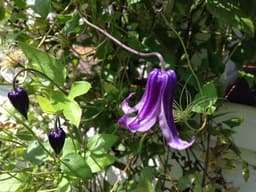
A confirmed group 3 plant is cut in February or early March, down to a pair of healthy buds about 15–30 cm above the soil. If it is herbaceous and dies back, the same guides allow a cut near the ground in early spring or late autumn. 'Rooguchi', on the RHS profile, is herbaceous, about 1.5–2.5 m, and group 3. Use that cut only when you are satisfied the parcel is that plant. The amazon title does not print the group, and the count disagrees with itself. When the label is blank, use flowers, not the word perennial. Flowers before June mean you do not prune as group 3. Flowers from late June mean a February prune. A root that has never flowered cannot use that test, so you leave it uncut. The unnamed bulbs and rhizomes print no group. Colour codes B and D are seller codes. Hardy perennial on those pages is not group 3.

Before you cut

Wear gloves. Sap can irritate skin. Stop if the stems are blackened, or if a montana is already out of reach on a house wall. Wilt is a disease of a plant that has grown. A mouldy root in the delivery bag never grew, and the Consumer Rights Act 2015 is the route for goods that were not of satisfactory quality. Group 1: tidy after flowering. Group 3, if you have confirmed the plant: February, down to healthy buds around 15–30 cm. A blank label and no flowers yet: wait.

Common questions

What are clematis pruning groups 1, 2, and 3?
Group 1 flowers on last year’s stems and is tidied after flowering. Group 2 is a light February cut, then a tidy after the first flush. Group 3 flowers on new wood and is cut in February to about 15–30 cm. In this comparison only the plug listing prints a group, and that group is 1.
When do you prune a Clematis montana?
After flowering, once the frost risk has passed. Take faded flowers and shorten shoots that have overgrown the support. A renovation back to about 15 cm is also done after flowering, and the RHS says not to repeat it within three years. A winter cut removes the flowers, which sit on last year’s wood.
When do you cut a group 3 clematis, and how low?
Cut in February or early March, down to a pair of healthy buds about 15–30 cm above the soil. Herbaceous types may be taken near ground level in early spring or late autumn. 'Rooguchi' is group 3 on the RHS profile, and the amazon title does not print that group. An unnamed perennial pack does not inherit the cut.
What do you do if the amazon label has no group?
Wait for flowers, then use the RHS shortcut. Flowers before June mean you do not prune as group 3. Flowers from late June mean a February prune. A root that has never flowered cannot use that test, so leave it uncut. Colour code B or D, and a hardy-perennial bullet, are not a group.
Can you hard-prune a montana to renovate it?
You can, once, after it has flowered, taking old growth down to about 15 cm, and you then leave it alone for at least three years. The RHS treats that as renovation, not as the regular prune. Doing the same cut every February stops the late-spring flowers. At the top of a wall, that job needs someone who can work at height.
Are the unnamed bulb packs group 3 because the seller says perennial?
No. Hardy perennial on those listings does not name a pruning group, a cultivar, or an RHS H rating. The four unnamed packs stay unassigned until you have seen when they flower, or until a label states a group. A February hard cut can remove group 1 flower buds if the root was a spring climber.
Who should you call instead of cutting at height?
Call a professional when a montana is already out of reach, or when stems are blackened and you cannot tell winter dieback from clematis wilt. Wilt is a disease of a plant that has grown. A mouldy root in the bag never became a pruning problem.

Related pages

Sources

Public sources from the research digest, last checked on 21 October 2026. Shelf prices and star lines are the stored amazon.co.uk figures. The price band is this set, not a market average. The score is not a lab trial.

  1. RHS: growing clematis (retrieved 21 October 2026)
  2. RHS: pruning clematis (retrieved 21 October 2026)
  3. RHS: Clematis 'Mayleen' (retrieved 21 October 2026)
  4. RHS: Clematis 'Rooguchi' (retrieved 21 October 2026)
  5. RHS: clematis wilt (retrieved 21 October 2026)
  6. RHS: hardiness ratings (retrieved 21 October 2026)
  7. GOV.UK: plant passports in Great Britain (retrieved 21 October 2026)
  8. Consumer Rights Act 2015, section 9 (retrieved 21 October 2026)