Independent comparisons. We may earn from shop links. More info

Half face or full face gas mask

Updated: October 2026

You are choosing a half face or full face gas mask because something in the job bothers your eyes, or because a visor looks more serious than goggles in a box. By the end you should know what each shape covers, what happens to ordinary glasses, and why a heavier full face title in this set is not a higher protection factor. The seven prices are on the [gas mask comparison](/hub/occupational-safety/gas-mask). Peter F., editor for DIY & tools, updated this page on 20 October 2026. Weights and box lists come from the amazon.co.uk files captured on that date. HSE's HSG53 is the source for spectacles and wear time. A qualifying purchase can earn a commission at no extra cost to you.

You are choosing a half face or full face gas mask because something in the job bothers your eyes, or because a visor looks more serious than goggles in a box.

Our top picks

On this page

What each shape covers

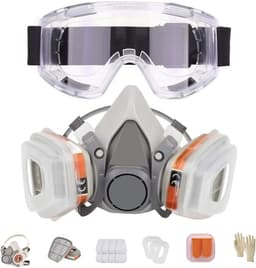
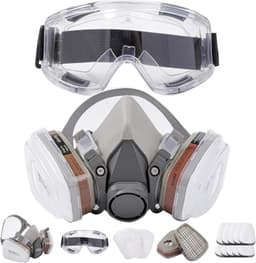
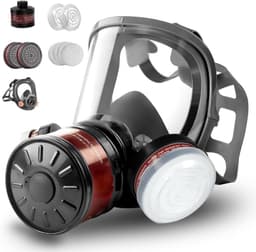
A half mask seals around the nose and mouth. Your eyes stay in the room. A full facepiece adds a visor, so splashes and irritating vapour meet plastic instead of your eyes, if the visor is actually there and the seal holds. That is the shape decision. It is not a filter decision. Dust that only threatens the lungs can be a half mask job. Solvent that stings, or a brush that flicks, is why people look at a visor or at goggles. In this set the specification or the title says half face for Wytcyic and LAMANICE, and both boxes include goggles. TYAKRI is a full face mask with a polycarbonate cover. Bryze's title says full face. SGIXBE says full face and anti-fog in the title, and the specification does not name a visor material. Facemoon's specification does not say half or full. Reviews describe a nose-and-mouth seal and separate goggles, which is how a half mask behaves. Do not turn Facemoon into a visor because a review felt enclosed. Filter letters stay on the gas mask buying guide.

Glasses, goggles, and the seal

Spectacles with side arms break the seal of a full facepiece. HSG53 treats that as a wearer limit. The work fix on a marked mask is the maker's own in-mask frame, not your everyday glasses pushed under the visor. If you cannot get a seal with the arms in place, a full face mask is the wrong shape for you, even when the visor looks the part. Contact lenses are something to raise with a competent person. They are not a workaround for a failed seal. Goggles are a second item on a half mask. Side arms and goggle straps can spoil the fit, so wear them during the seal check. Wytcyic and LAMANICE include that pair. Facemoon reviews mention goggles the specification does not list. A beard still rules out both shapes. HSE's alternative is loose-fitting powered protection, which how to use a gas mask covers, not a heavier visor.

Weight and fittings in this set

The half face files are the lighter ones. Wytcyic is 580 g and LAMANICE is 550 g, each with separate goggles and a stack of 5N11 cottons, ten and eight. Facemoon is 548.85 g, and the specification is silent on the fitting. TYAKRI's full face mask is 1.18 kg, with a polycarbonate cover, one 40 mm activated carbon filter, two filter boxes, two caps, and four cottons. Bryze's package line is 1.1 kg, with 40 mm in the title and no piece count. SGIXBE prints dimensions of 15 x 18.5 x 30 cm and no weight, on a page whose details ASIN does not match the URL. A 40 mm canister is a different fitting from twin cheek cartridges. TYAKRI prints 40 mm. It does not print EN 148-1 or Rd40, so do not assume that standard thread. The 5N11 cottons are not inserts for that canister. At 1.18 kg, and with HSE's guide of under an hour for an unpowered tight mask, TYAKRI is the one you will notice first. Early visor notes mention fogging, the weight, a clip that snapped, and a scratched lens.

What a full face title does not prove

On a standard device, HSE's examples give a full face gas filter a higher assigned protection factor than a half mask gas filter, 20 against 10, and a full face P3 can reach 40. Those numbers stay with BS EN 136 and the matching filter standard. They do not move across to a full face title that prints no standard. TYAKRI's nuclear wording, and Bryze's 5.0 from one review, do not upgrade the shape. SGIXBE's anti-fog line does not either. A visor can be the right cover for your eyes and still be a poor listing for the air you breathe. If you need the factor, you need a marked device and a seal it can hold, including a plan for your glasses. The best gas mask page does not pick these full face files as the lead. If you have a beard, side-arm glasses you will not take off, or a two-pack spray, neither shape in this table is the answer.

Common questions

When do your eyes need a visor rather than goggles?
When the eyes need to be inside the same seal as the nose and mouth, a visor is the shape to look at. Splashes and vapour that irritates the eyes are the usual reason. Goggles can cover the eyes on a half mask if they fit with the harness and you check the seal while wearing them. They do not stop vapour that leaks at the cheek. If your glasses have side arms, a visor often loses, because the arms break that seal.
Can you wear your normal glasses under a full face mask?
Not if the side arms cross the seal. HSG53 treats spectacles as a wearer limit, and a full facepiece that will not seal over the arms is the wrong mask that day. Inserts made for a specific certified facepiece exist on proper kit. Everyday glasses are not that insert. If you must keep those glasses, test a half mask and a separate plan for your eyes, and still pass a seal check. Do not bend the arms and hope the rubber copes.
Do goggles in the box solve eye protection?
They help only if they fit your face, sit with the respirator straps, and you wear them. Wytcyic and LAMANICE include a pair. The listing does not print an eye-protection standard for those goggles. A pair that fogs, or that will not go over large glasses, is packaging rather than cover. One Facemoon review raises that glasses problem for the goggles reviewers describe. Check the pair on, with the mask, before you open the tin.
Why are some of these masks much heavier?
TYAKRI is 1.18 kg because the listing is a full facepiece with a polycarbonate cover and a 40 mm canister. The half face kits sit around 550 g to 580 g before you notice the goggles. Bryze's 1.1 kg figure is the package line, not a weighed facepiece on its own. HSE's guidance of under an hour for unpowered tight masks matters more as the weight rises. Heavier, in this set, is not the same as better sealed.
What is a 40 mm filter doing on a full face mask?
It is a single canister on a large round fitting, rather than two cartridges on the cheeks. TYAKRI includes one 40 mm activated carbon filter. Bryze names 40 mm in the title. Neither page says the thread is EN 148-1. Carbon in a canister is aimed at vapour, and dust still needs a particle stage the page may not print. Do not take a loose 40 mm filter from another box and assume the letters match this facepiece.
Are 5N11 cottons the same fitting as a 40 mm canister?
No. The cottons with Wytcyic and LAMANICE sit with cheek filter boxes and covers. A 40 mm canister is a different part. Pressing a pad into the canister, or leaving the cottons out because you bought a full face mask, does not build a combined filter. TYAKRI also lists four cottons, still without a P class in the table. Match the spare to the port you can see, or do not use the mask for that job.
Does a full face title mean a higher protection factor here?
No. The higher factors in HSG53 belong to standard full facepieces used properly, such as a gas filter at 20 or P3 at 40. TYAKRI, Bryze, and SGIXBE do not print BS EN 136 or a four-digit body number. A visor changes what can reach your eyes. It does not print a factor on the listing. The word nuclear does not either. If you need the number, you need a marked device and a fit test, not only a heavier carton.

Related pages

Sources

Public UK sources from the research digest, last checked on 20 October 2026. Shelf prices and star lines are the amazon.co.uk figures in the display file. The price bands are this set, not a market average. Assigned protection factors in the buying guide belong to standard devices, not to these seven ASINs.

  1. HSE HSG53: respiratory protective equipment (retrieved 20 October 2026)
  2. HSE: how to choose respiratory protective equipment (retrieved 20 October 2026)
  3. HSE: filter advice for employers (retrieved 20 October 2026)
  4. HSE INDG479: fit testing of respiratory protective equipment (retrieved 20 October 2026)
  5. HSE: fit testing basics (retrieved 20 October 2026)
  6. HSE: bodyshop respiratory protective equipment (retrieved 20 October 2026)
  7. HSE COSHH essentials R3 (retrieved 20 October 2026)
  8. BSIF: ensuring effective respiratory protection (retrieved 20 October 2026)