Independent comparisons. We may earn from shop links. More info

Gas mask buying guide

Updated: October 2026

You have a tin of solvent paint, a pile of MDF, or a resin kit, and the amazon.co.uk title says gas mask. That word does not name the substance, the filter, or a printed standard. This gas mask buying guide puts the decisions in order: name the hazard, match the filter letters, decide whether your eyes need a visor, then read what the listing prints. The seven masks in our [gas mask comparison](/hub/occupational-safety/gas-mask) cost £13.59 to £24.99 on 20 October 2026. Peter F., editor for DIY & tools, updated this page from HSE's HSG53 and those files. We did not fit-test these masks. A qualifying purchase can earn a commission at no extra cost to you.

You have a tin of solvent paint, a pile of MDF, or a resin kit, and the amazon.co.uk title says gas mask. That word does not name the substance, the filter, or a printed standard.

Our top picks

On this page

Start with the hazard, not the title

A reusable filtering respirator cleans air you breathe in. It does not supply oxygen. HSE's HSG53 splits the job by what is in the air. Dust and mist need a particle filter. Organic vapour needs a gas filter. One element does not do both, which is why combined marks exist on standard devices. If the air may be short of oxygen, or the space is confined, these products are the wrong tool. A title that says gas mask, nuclear, or spray does not change that. Start with the safety data sheet or the tin, not the star rating. Solvent paint that you brush is a different problem from two-pack spray that contains isocyanate. Wood dust from sanding is a particle problem, even when the same afternoon involves resin. If you cannot name the substance, you cannot choose a letter. The gas mask for painting page takes that split further. An employer still needs a COSHH decision and a fit test. A marketplace title is not that assessment.

Match the filter letters

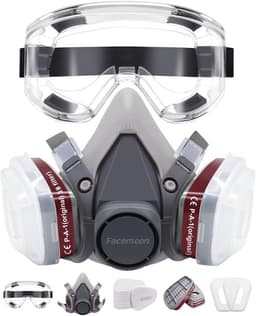
Type A is the organic-vapour family. The colour code used on standard filters is brown, and the boiling point is above 65°C. Class 1 and class 2 describe capacity and how often a standard device's filter is changed, not a star count. P-class filters are for particles. A cotton pad in the box is not a P class unless the class is printed. Combined marks such as A1P2 exist because a particle layer does not stop vapour and a gas filter does not stop dust. Inside this set, only the Wytcyic file prints A1P2. A bullet says the gas filter is for organic gases and vapours with a boiling point above 65°C, and CE (EN 140:1998). There is no four-digit body number. Facemoon's 4.5 from 1,718 reviews does not fill an empty specification block. LAMANICE lists eight 5N11 cottons and claims 97% in a bullet, with no A or P class. A 40 mm canister is a different fitting from twin cheek cartridges. Do not assume the pads fit the canister. HSE's example factor of 10 for a standard half mask gas filter belongs to that device used properly. It is not a score for any of these seven files.

Facepiece, eyes, and a seal

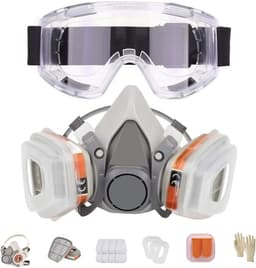
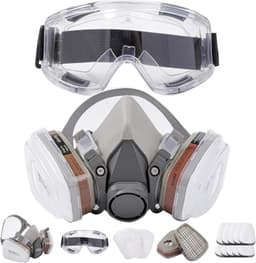
A half mask covers the nose and mouth and leaves the eyes outside. A full facepiece includes a visor. Wytcyic and LAMANICE are half face kits with goggles in the box. TYAKRI, Bryze, and the SGIXBE title are full face. Facemoon's specification does not say which shape it is. Goggles in the box are a separate item. They do not turn a half mask into a visor, and the goggle strap can fight the head harness. The seal has to sit on clean skin. A beard or stubble on the seal makes a tight mask unreliable, and HSE points to loose-fitting powered protection instead. Spectacles with side arms break a full-face seal. Weight, goggles, and the 40 mm fitting are on half face or full face. If you cannot get a seal, stop. A better filter does not close a gap at the cheek.

What the listing must show

Category III respiratory protection should show CE or UKCA and a four-digit body number. BSIF's guide treats a missing mark, especially on a very cheap copy, as a reason to be suspicious. A sentence in a bullet is not that mark. Wytcyic is the only file here that names both A1P2 and CE (EN 140:1998), and it still has no body number, so this guide does not call it certified. The other six files do not print BS EN 140, BS EN 136, BS EN 143, BS EN 14387, CE, or UKCA in the specification table. SGIXBE adds a second problem. The URL is B0G6Z4QCGG at £19.99 and the specification line prints ASIN B0G6Z1ZGSZ. You cannot treat a mask as known when the page disagrees about which product it is. ANUNU at £16.59 has no review line at all. Stars, a rank in Reusable Respirators, and the word nuclear are not substitutes. If the listing is silent, treat the filter as unknown.

When this guide stops

Use the main table when you want the seven prices, the box lists, and the review limits side by side. Use the best page when you want a top pick inside that set only, with the caveat that a bullet is not a certificate. Put the mask on using how to use a gas mask, including the point where a broken clip means you stop. Painting, resin, and isocyanate spray stay on the painting page, because a filtering mask is the wrong tool for isocyanate spraying. Leave this set for asbestos, confined spaces, oxygen-deficient air, and any employed job that needs a marked device and a fit test. If you cannot name the hazard, get competent advice rather than a cheaper title.

Common questions

What should you decide before you look at the price?
Name the substance first, then the filter letters, then whether your eyes are inside the facepiece. Price is the last step. In this set the shelf prices run from £13.59 to £24.99, and the cheapest file is also the only one that prints A1P2. A low price does not create a class on the six listings that leave the filter field empty. If you cannot name the hazard, neither figure helps.
Does a particle filter stop solvent vapour?
No. HSE states that particle filters do not stop gas or vapour, and gas filters do not stop particles. Solvent vapour from paint needs a type A filter, the organic-vapour family with a boiling point above 65°C. A 5N11 cotton in the box is a pad, not that letter, unless the listing prints a combined mark. Only the Wytcyic file in this set prints A1P2.
What does A1 mean, and what does P2 add?
On a standard filter, A is organic vapour and 1 is the lower gas class. P2 is a particle class. Together, A1P2 means one combined filter is meant to face both, within the limits of that standard device. It does not mean every mask titled gas mask has those letters. This guide does not attach an assigned protection factor of 10 to the Wytcyic bullet, because the page has no four-digit body number.
Why is a printed standard not the same as a certificate you can rely on at work?
A bullet that says CE (EN 140:1998) is a sentence on a listing. A mark you could rely on at work shows CE or UKCA and a four-digit body number on the device, and the employer still fit-tests that exact model. None of these seven files prints the body number. At work, that gap means you do not select from this table. The stars do not close it.
How often should a class 1 gas filter be changed on a standard device?
HSE's advice for employers is at least every two days for a class 1 gas filter, and daily when the substance is a carcinogen or a respiratory sensitiser. A class 2 filter is at least weekly. Those intervals belong to standard devices, not to a cotton that looks clean. Waiting until you smell the solvent is not the plan. Particle filters are changed when they are damaged, past the packet date, or harder to breathe through.

Related pages

Sources

Public UK sources from the research digest, last checked on 20 October 2026. Shelf prices and star lines are the amazon.co.uk figures in the display file. The price bands are this set, not a market average. Assigned protection factors in the buying guide belong to standard devices, not to these seven ASINs.

  1. HSE HSG53: respiratory protective equipment (retrieved 20 October 2026)
  2. HSE: how to choose respiratory protective equipment (retrieved 20 October 2026)
  3. HSE: filter advice for employers (retrieved 20 October 2026)
  4. HSE INDG479: fit testing of respiratory protective equipment (retrieved 20 October 2026)
  5. HSE: fit testing basics (retrieved 20 October 2026)
  6. HSE: bodyshop respiratory protective equipment (retrieved 20 October 2026)
  7. HSE COSHH essentials R3 (retrieved 20 October 2026)
  8. BSIF: ensuring effective respiratory protection (retrieved 20 October 2026)