Independent comparisons. We may earn from shop links. More info

Gas mask for painting

Updated: October 2026

You are about to brush a solvent enamel, pour epoxy, or you are wondering whether a spray gun changes the mask. A gas mask for painting is not one answer, because solvent vapour and isocyanate mist are different hazards. By the end you should know when an organic-vapour filter and a seal are the DIY question, and when a filtering mask is the wrong tool. The seven listings are compared on the [gas mask](/hub/occupational-safety/gas-mask) page. Peter F., editor for DIY & tools, updated this page on 20 October 2026 from HSE's bodyshop guidance, HSG53, and the words printed on these amazon.co.uk files. We did not sample the air in a workshop. A qualifying purchase can earn a commission at no extra cost to you.

You are about to brush a solvent enamel, pour epoxy, or you are wondering whether a spray gun changes the mask. A gas mask for painting is not one answer, because solvent vapour and isocyanate mist are different hazards.

Our top picks

On this page

Solvent vapour is not paint mist

Brushing or rolling a conventional solvent paint puts organic vapour in the air. Droplets and sanding dust are particles. HSE is plain that a particle filter does not stop gas or vapour, and a gas filter does not stop particles. Type A, brown on a standard filter, is the organic-vapour family with a boiling point above 65°C. A combined filter exists because one layer is not both jobs. A dust mask, or a cotton pad on its own, misses the vapour even when it catches some dust. Read the tin before you trust a title that says painting. If the sheet stays with ordinary solvent and you are clean-shaven, you need type A plus a particle class for the dust. If the sheet says isocyanate, stop and read the next section. Only Wytcyic prints A1P2 and a bullet about vapours above 65°C. That line does not clear you to spray. Letters and standards are on the gas mask buying guide. The other files mostly leave the class blank.

Two-pack spray is a different tool

HSE's bodyshop page says filtering respirators are not suitable for spraying isocyanate paints. The control is air-fed breathing apparatus, and you do not lift the visor while mist is still in the air. Two-pack isocyanate is a common cause of occupational asthma in vehicle spraying. The mist can be present when you cannot see it. INDG388 talks about clearance time and about staying on air-fed apparatus until you are out of that air. None of that is a half mask with cottons from this comparison. A spray-paint title, including TYAKRI's nuclear line, does not override that rule. Bryze's one review and Facemoon's comments about smell are not permission to spray two-pack. If the tin is two-pack, including a hobby aerosol, get advice rather than shopping this table. Come back to brush and roller work only for a conventional solvent you can ventilate.

What these seven listings say about paint

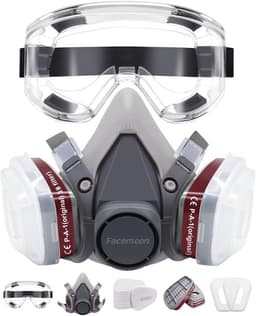
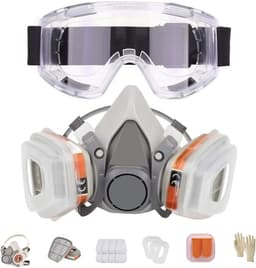
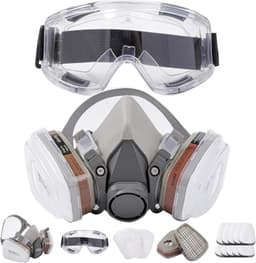
Shopping titles in the set lean on paint, spray, or resin. The specification is thinner. Wytcyic at £13.59 prints A1P2, includes ten 5N11 cottons and goggles, and shows 4.3 from 412 reviews. The CE (EN 140:1998) wording is a bullet without a body number. LAMANICE at £17.90 claims the dual system blocks 97% of organic vapours and dust, with eight cottons and no class. That 97% is a marketing bullet. It is not A1P2, and two UK reviews describe a neck clip that failed, which ends the session whatever the bullet says. Facemoon at £19.99 has 4.5 from 1,718 reviews and no class in the spec. Reviewers say they could not smell paint or resin until the mask came off. That is a comment about that hour, not a test of the filter. TYAKRI at £24.99 puts spray paint and nuclear in the title, with a 40 mm carbon filter and no EN line in the table. Bryze at £23.99 has one review that used the mask for painting and sanding. ANUNU and SGIXBE name the theme in the title and have no review line. The best gas mask page keeps the ranking inside that limit. Outside this set, a 3M 4251+ is sold as a maintenance-free mask for solvent paint, around £30 to £32. We do not paste it into this table.

Resin, sanding, and eyes

Epoxy vapour and epoxy dust are not the same afternoon. Wessex Resins tells users to ventilate, and to use an approved respirator with an organic-vapour cartridge when ventilation is not enough. Sanding partly cured epoxy is a dust problem and can still be a sensitiser. A cotton that helps with dust does not answer the vapour, and a vapour cartridge does not answer the dust unless the filter is combined. If you sand in the morning and mix resin after lunch, you need both answers, or you need to keep the jobs apart and clean up between them. A half mask leaves the eyes outside, so goggles in the Wytcyic or LAMANICE box are a second item and can clash with the straps. A visor covers the eyes and brings the spectacle problem with it. If you smell the resin with the mask on, or the clip will not hold, stop and ventilate. The seal check is in how to use a gas mask. Get advice when the product is a sensitiser, when someone is employed, or when you are about to spray.

Common questions

Is a dust mask enough for solvent paint?
No. A dust mask or a particle cotton does not stop solvent vapour. HSE separates particle filters from gas filters. Brushing solvent paint needs a type A organic-vapour filter, and dust from sanding needs a particle class as well. One 5N11 pad does not print either letter. If the tin is water-based and you are only sanding filler, the vapour question changes. Read the tin before you skip the gas filter.
What filter letters do solvent fumes need?
Type A, for organic vapour with a boiling point above 65°C. On standard filters the colour is brown. A1 is the lower gas class. P2 adds a particle class when dust or mist is part of the same job. Combined marks such as A1P2 are how one filter states both. In this set only Wytcyic prints A1P2. This page does not treat that bullet as a certificate, and it does not give the mask an assigned protection factor.
Can you spray two-pack paint in a filtering gas mask?
No. HSE says filtering respirators are not suitable for spraying isocyanate paints. You need air-fed breathing apparatus, and you keep the air supply on while mist remains. Occupational asthma is the harm, and the mist is not always obvious. A full face title, a 40 mm carbon filter, or a review that mentions spray paint does not replace that equipment. If the tin is two-pack, this set is the wrong shelf.
What do the seven listings actually say about painting?
They say it in the title more often than in the specification. Wytcyic prints A1P2 and a 65°C bullet. LAMANICE claims 97% with no class. Facemoon's reviews mention paint smell and the spec does not. TYAKRI's title says spray paint and nuclear, with no EN line. Bryze has one painting-and-sanding review. ANUNU and SGIXBE have no reviews. None of them prints a four-digit body number you could use at work.
Does a review that says you could not smell the paint prove the filter class?
No. It shows that one person did not notice a smell during that job. Smell is a late signal, and some harmful substances do not warn you that way. Facemoon's large review file includes that comment and still has no class in the specification. Use the comment as a note about comfort, not as A1 or P2. If you can smell the solvent through the mask, stop and leave the room.
Are your eyes covered while you paint?
Only if the facepiece has a visor or you wear separate eye protection that actually fits. Wytcyic and LAMANICE include goggles with a half mask. TYAKRI has a polycarbonate cover. A half mask on its own leaves the eyes in the vapour and the splash. Goggles can spoil the respirator seal if the straps fight, so run the seal check while wearing them. Ordinary glasses under a full face visor break the seal at the arms.
How is resin sanding different from resin vapour?
Sanding throws dust, including from partly cured epoxy, and that dust can still sensitise you. The vapour from mixing or from an open tin is an organic-vapour problem. Wessex Resins splits them: ventilate, use an organic-vapour cartridge when the air is not enough, and treat sanding as its own control. A single cotton does not cover both. If you cannot ventilate a small room, a filtering mask from this set is a weak plan for either job.

Related pages

Sources

Public UK sources from the research digest, last checked on 20 October 2026. Shelf prices and star lines are the amazon.co.uk figures in the display file. The price bands are this set, not a market average. Assigned protection factors in the buying guide belong to standard devices, not to these seven ASINs.

  1. HSE HSG53: respiratory protective equipment (retrieved 20 October 2026)
  2. HSE: how to choose respiratory protective equipment (retrieved 20 October 2026)
  3. HSE: filter advice for employers (retrieved 20 October 2026)
  4. HSE INDG479: fit testing of respiratory protective equipment (retrieved 20 October 2026)
  5. HSE: fit testing basics (retrieved 20 October 2026)
  6. HSE: bodyshop respiratory protective equipment (retrieved 20 October 2026)
  7. HSE COSHH essentials R3 (retrieved 20 October 2026)
  8. BSIF: ensuring effective respiratory protection (retrieved 20 October 2026)