Steel toe or composite toe: same test, different clues

Steel toe or composite toe can both meet the 200 joule safety-footwear test. A dent shows on steel. A smooth composite cap can still be finished after a blow.
On this page
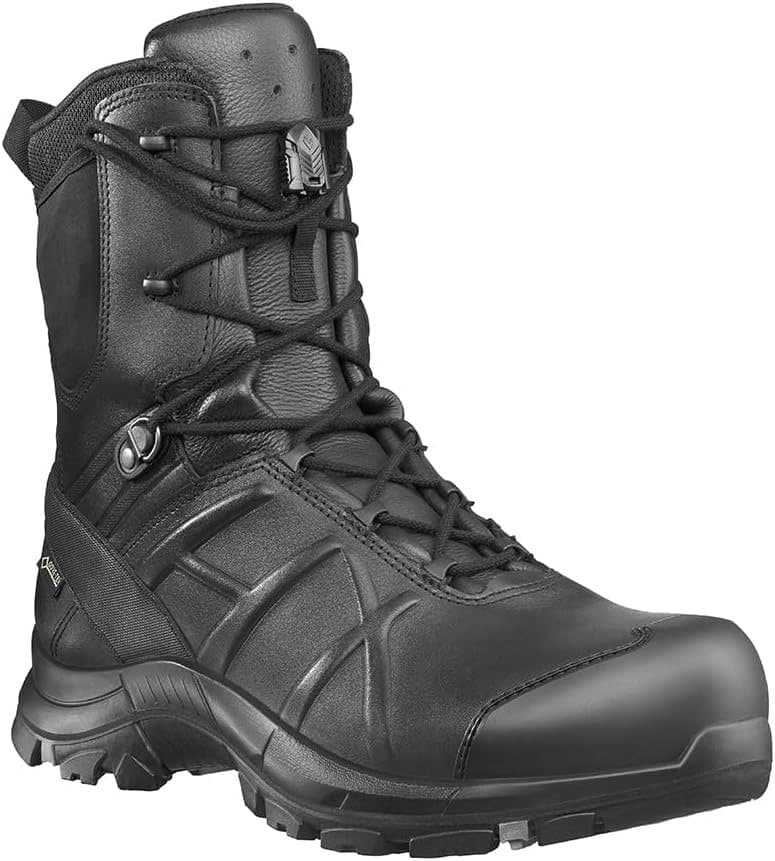
You are choosing between a steel toe and a composite toe because someone said fibreglass is tougher, or because someone else said it is the weak option that only exists to feel light. Steel toe or composite toe, inside safety footwear, can meet the same toe test. The finished shoe is what gets certified. A loose cap on a bench is not the product.
The difference you can use is practical. Steel that stays dented shows you the blow. A composite cap can be finished and still look smooth. In this Albatros set, only two titles actually say fibreglass and metal-free. The other five leave the material off the page.
In short
Steel and composite toes can both meet the safety-footwear test of 200 joules of impact and 15 kN of compression on the finished shoe. Composite is the metal-free option people choose at detectors, and that is not a promise your gate will agree. After a blow, a dented steel cap is an obvious retire signal. A smooth composite cap is not proof the shoe is fine.
One toe test, two materials
The Wise Safety UK marking sheet for EN ISO 20345 puts safety footwear at 200 joules of impact and 15 kN of compression. Those figures belong to the class of shoe, not to a race between steel and fibreglass. Anbu’s guide says the complete shoe is what gets certified. A cap tested on its own, then fitted to a soft upper, is not the test you are buying.
Arco’s risks page says steel and composite can both comply with BS EN ISO 20345, and that composite is the metal-free choice at detectors. A shoe built and tested to the standard can pass in either material. That does not make every hard-toed trainer a pass, and it does not make composite the safer buy.
BSI’s record for BS EN ISO 20345 describes general-purpose safety footwear, not foundry footwear and not chain-saw footwear. Anbu cites EN ISO 20349 for foundry and welding risks. A 200 joule toe, steel or composite, is the wrong product when the hazard is molten metal or a saw. Use the standard the assessment names.
A composite cap can be built with less mass than a steel cap. These listings do not let you rank that. A 1 kg field is repeated across the shoes, including the ones that never name the cap. Steel toecap weight needs two weighed shoes, and this file does not contain them. Leave lightness out until a listing states a figure you can compare.
The toes still have to sit under the cap. A longer size, bought to get width, moves the foot back. The fitting guide covers that, and it applies whichever material the title names.
What metal-free does, and what it does not
Metal free safety boots, when the title says so, are the pair you look at for a detector lane or a workplace that has asked for no metal in the cap. Arco’s wording is the metal-free choice at detectors. It is not a result. An eyelet, a lace tag, or a shank can still alarm a cap that is itself non-metal.
Two titles make the claim. Clifton Low, B08XN4CB9Y, at £55.14, prints a fibreglass toe, puncture protection and metal-free, with S3 SRC, rated 4.4 from 130 ratings. The £31.25 shoe, B09QCT342M, prints fibreglass, penetration protection, metal-free, S1P, ESD, HRO and SRC, rated 2.4 from two ratings, with no review text. Those two titles are the fibreglass claim. It does not spread to a shoe that only shares the brand.
Clifton Low’s brand page says S3L ESD and FAP, a flexible metal-free anti-penetration midsole. The amazon.co.uk title says S3 SRC and does not use FAP. You pay for the title. The metal-free subpage sets out that clash model by model.
Metal conducts heat more readily than a fibreglass shell, so a steel cap can feel colder in winter. None of the seven listings measures that. Socks and how long you stand still change the feeling. Do not pick a blank title because you hope the hidden cap is the warmer one.
The midsole is a separate question
A nail through the sole is not the toe test. Anbu treats P as the metallic puncture test, and PL and PS as the non-metallic ones. This article does not follow the shorthand that S means metal and L means non-metal. The midsole letter does not tell you the toe, and a metal-free toe does not tell you the midsole.
Clifton Low prints S3, not S3L, beside puncture protection and metal-free. The £31.25 title prints S1P, not PL or PS. Do not attach letters the title omits. Clifton Mid prints S3 SRC with no toe or insert. The Ultratrail mid boot prints S3 and ESD and names neither.
If the hazard is a nail in a timber, the assessment wants a puncture claim, whatever the toe is made of. If the hazard is a detector, the assessment wants the metal-free claim, and a metal insert would defeat it. S1P or S3 is the package around those letters. The toe material is the column this page is for.
On the Haix comparison the top pick is the Black Eagle Safety 50 High at about £183.09, with 4.6 from 211 reviews. The best value is the Haix Eagle at about £145.47, with 4.5 from 612 reviews. Neither title prints a toe material. Do not assume either card has Clifton Low’s midsole letters.
After something heavy lands on the toe
Arco says replace the footwear after an incident, including when the damage is not obvious, and treat exposed protective parts as the end of the shoe. A dented steel cap is the easy case: stop wearing it. A composite or fibreglass cap may not dent, so a smooth shell after a block, a drum, or a pallet foot is not a pass.
A scuff on the upper, of the kind a Clifton Low review describes on screed, is surface wear, not a failed cap. If an impact reached the toes, retire the pair. When to replace safety shoes keeps the other faults. There is no fixed number of months.
Antistatic soles permanently fouled with paint are another retire case Arco names. That is a sole problem, and wiping may not restore it. If the boots are required PPE, the employer replaces them. You should not fund a new pair because a composite toe hid the damage.
Titles that never mention the cap
Five titles leave the toe unstated. Ultratrail Olive CTX Mid at £61.72 prints S3 and ESD. Clifton Mid at £68.60 prints S3 SRC. Ultimate Impulse Olive Low at £51.52 prints S1P and ESD. Aer55 Impulse Low at £80.32 and Ultratrail Low at £77.37 print no class and no toe. Ultratrail Low’s 488 ratings still do not name the cap. Do not upgrade a silent amazon title from a catalogue photo.
A two-rating sample, even with a long list of letters, is a weak place to decide a detector lane. A blank cell on the Albatros comparison stays blank. Price does not fill in the toe.
Choose steel when you want a dent you can see, and when the site has not asked for a metal-free shoe. Choose a composite or fibreglass claim when the title prints it and the assessment wants that claim, then retire the pair after a blow even if the toe looks untouched. Choose neither from a title that never mentions the cap.
These points come from the Wise marking sheet, Anbu’s guide, Arco’s risks page, the BSI record for BS EN ISO 20345, and the amazon.co.uk titles in this comparison. Products Compared did not drop a weight on any toe and did not walk a detector. A qualifying purchase through a comparison link can earn a commission at no extra cost to you.
Common questions
Is a composite toe weaker than steel?
Will composite boots go through a metal detector?
Are fibreglass and composite the same idea?
Does metal-free also mean the midsole has no metal?
How do I know a composite toe is damaged?
Are composite boots always lighter?
Does a fibreglass toe feel colder in winter?
Is a metal-free boot enough for welding or foundry work?

Products Compared publishes British-English buying guides based on amazon.co.uk listings and public UK sources. We do not run a lab and we do not invent test scores.
Related articles

How to fit safety footwear
Measure both feet and keep the toes under the cap. Extra length is not a way to buy width.

When to replace safety shoes
Retire a pair after a blow to the toe, even when a composite cap still looks smooth.
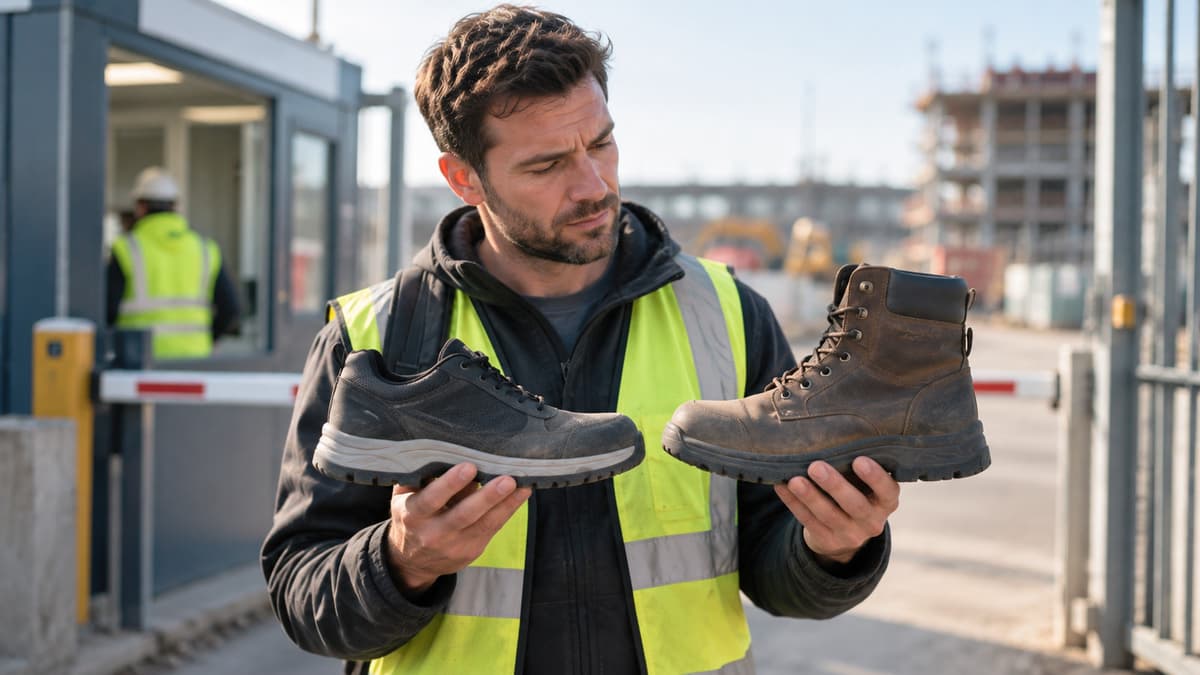
S1P or S3 on a UK site
The toe test is shared. S3 adds a water-resistant upper and a cleated outsole.