Safety glasses with a hard hat: stop the lift

Thick temples lift a hard hat or pinch your nose. Wear safety glasses with a hard hat so the shell, the muffs and any visor still do their job on site.
On this page

You slide the clear pair on, drop the helmet, and the shell sits proud of your head. The temples are the spacer. Safety glasses with a hard hat fail in that gap, or they fail on the nose when the shell pushes the frame down. The Health and Safety Executive says equipment worn together has to work together, and a hard hat that will not seat is not being worn properly.
Peter F., editor for DIY & tools at productscompared.co.uk, checked HSE's PPE pages, JSP's notes on helmet and muff combinations, a Health and Safety Matters piece on sidearms, and the amazon.co.uk listings named below, plus the construction helmet and safety glasses files in this hub. We did not run a lab fit test. Shelf prices are the figures in those files or on the amazon.co.uk pages read on 20 October 2026. Links use the tag pcuk26-21. A qualifying purchase can earn us a commission at no extra cost to you.
In short
Put the eyewear on, then the helmet, and nod. If the shell lifts, the arms are holding it off the harness, and bending them is not the repair. Thin temples, a strap the maker fits to that hat, or a lens that lives in the shell are the three ways through, and ear defenders still have to seal after the arms are in place.
Seat the glasses, then the shell
Start with the eyewear for the task, including ordinary prescription glasses if they stay on. Seat the helmet harness low on the brow, as the leaflet shows, and close the ratchet until the cradle is snug. The shell should be carried by that harness, clear of the temples. Nod, and look up as you would under a scaffold board. If the peak rises, change the eyewear. Tape in the gap, or an arm heated over a kettle, is a modification. The Health and Safety Executive says modifying PPE to make it fit is not a solution.
Where more than one item is worn, HSE says you make sure they can be used together. The example is safety glasses disturbing a respirator seal. A hat that rocks on two arms is the same kind of failure, and you can see it. Suitable head protection fits, is worn properly, is in good condition, and does not stop you wearing hearing protectors when they are needed. On most sites that duty sits under the Personal Protective Equipment at Work Regulations 1992.
The construction helmet comparison is the shell side of the stack. The top pick is the JSP EVO2, a vented HDPE hat at £6.99 with a slip ratchet, a claimed EN 397 mark, and 4.6 from 4,743 amazon.co.uk reviews. The listing has no chin strap and no lens, so treat it as a ground-work hat unless the assessment says otherwise. For Great Britain it still needs a UKCA or CE mark and instructions in English.
When temples lift the hat
A temple hooks the ear on a bare head. Under a helmet it shares space with the headband and often a muff. Anything proud of your skull becomes a fulcrum. Metal-core arms, thick tips and wrap frames that bow outward hold the shell up. The harness feels loose, and the frame slides until the nose pads bite. That pinch is the lift seen from the front. The hat is loading the frame because the arms cannot get out of the way.
Three-position temples change length. They do not make a thick arm thin. The Riley Flux on amazon.co.uk is 24 g, with that adjuster, a title citing EN 166:2001 and ANSI/ISEA Z87.1, CE and UKCA, £10.99, and 4.8 from 38 reviews on 20 October 2026. Thirty-eight reviews is a thin record, and the listing names no helmet. Try the shortest position and the nod test. A Z87.1 line is a US mark.
The safety glasses comparison ranks wraps for chips. The top pick is the NoCry EyeArmor+, 28 g, adjustable arms and a nose pad, £13.99, with 4.4 from 61,350 reviews shared with the red colourway. The specification table prints no EN 166, and reviewers say the curve will not sit over prescription glasses. If those arms hold the EVO2 off the cradle, that top pick is the wrong shape here.
Ear defenders and the cushion
Hearing protection fails quietly. HSE tells you to choose the hard hat and the ear defenders so both stay effective. A headband muff fights the helmet for the crown. A mounted muff hangs on the shell. Either way, a spectacle arm can break the foam around the ear.
Health and Safety Matters describes that seal and gives no decibel figure. The cushion has to meet the head so sound goes through the cup. A sidearm under the cushion can cut attenuation. This page will not invent a loss. After the muffs are on, run a finger around the cushion. A gap beside the arm is a path for noise. Thin temples, or spectacles on a strap, leave a better chance of a seal. The strap still has to clear the harness.
EN 352-3 covers ear defenders attached to head or face protection, tested with named helmets. JSP's support page says an untested combination can sit too loose or too tight, and the leaflet names the approved hats. A universal slot accepts many arms. The British Safety Industry Federation's line is the same: just because it fits, it has not been shown to protect. If the site issues JSP muffs, the leaflet has to name your hat. Parking the cups on the shell while you grind is the short-job failure HSE warns about.
A strap, a visor or a lens in the shell
When arms and cups cannot share your head, leave the spectacle shape.
A strap goggle deletes the temple. The JSP EVO goggle on amazon.co.uk, ASIN B0HGFCNB4B, was £16.89 on 20 October 2026, with 4.4 from 648 reviews. The bullets cite EN 166 and EN 170, an elastic strap, and a fit to JSP PPE. Care is mild soap, a rinse and air drying. It is not in our comparison file, so match the helmet in the leaflet. Goggles mist more. An N mark is the anti-mist test, and a coating sentence is not that mark.
A visor protects the face. L25 says a faceshield does not fully enclose the eyes, so the assessment may keep spectacles on. In the helmet file the HEARMOR Voltek is £29.99 with a clear visor and a smoky visor, claimed EN 397 and EN 166, and 4.8 from 50 reviews. ANSI Class C with vents is not an insulation claim. A separate browguard sits in the face protection comparison. The EVO2 remains the top pick for a plain EN 397 shell.
A lens in the shell removes a lost pair. 3M's UK page describes glasses that slide between shell and headband, tested to EN 166:2001, with no pound price there. The JSP VISTALens, ASIN B0HGRMTH8B, was £46.25 the same day, with 4.5 from 262 reviews, EN 397, EN 166 and a retractable optical class 1 lens. It is not in our comparison file. Keep the lens down when the task needs cover. Mesh lets dust through, and chainsaw work still lists EN 166 glasses on their own line.
The check before you start
Do this when the kit is issued, and again when any piece changes.
- Confirm the eye hazard matches the mark, using the assessment and the leaflet.
- Put the glasses on first, and set any temple length the maker provides.
- Fit the helmet and nod. The shell stays seated, and the nose piece does not dig in.
- Fit the hearing protection, and check the cushion all round. Mounted muffs need the helmet named in the instructions.
- With a respirator, check the face seal with the glasses on. A leak at the nose is HSE's example of a failed combination.
- Look through the lens at a tape mark. Deep scratches or a bent frame mean a replacement.
L25 says clean with what the manufacturer names. Mild soap and air drying is the care line on the JSP goggle and the NoCry wrap. If the shell, the cushion and any respirator seal cannot all be true together, hand the stack back. A supervisor can change the issue. A slot is not a certificate, and a feel-check is not a respirator fit test.
Common questions
Can I wear safety glasses with a hard hat?
Why do safety glasses lift my hard hat?
Should the temples go under the ear defenders?
If the muffs clip on, are they compatible?
Are goggles better than glasses under a helmet?
Does a helmet visor replace safety glasses?
Can I wear prescription glasses under the stack?

Peter F. is the editor for DIY & tools at productscompared.co.uk. Comparisons in this category are checked against amazon.co.uk listings, review evidence and public UK sources.
Related articles

Safety glasses or goggles for the hazard
Temples and a gap are spectacles. A strap and a rim that meet the face are a goggle. The hazard picks the shape.
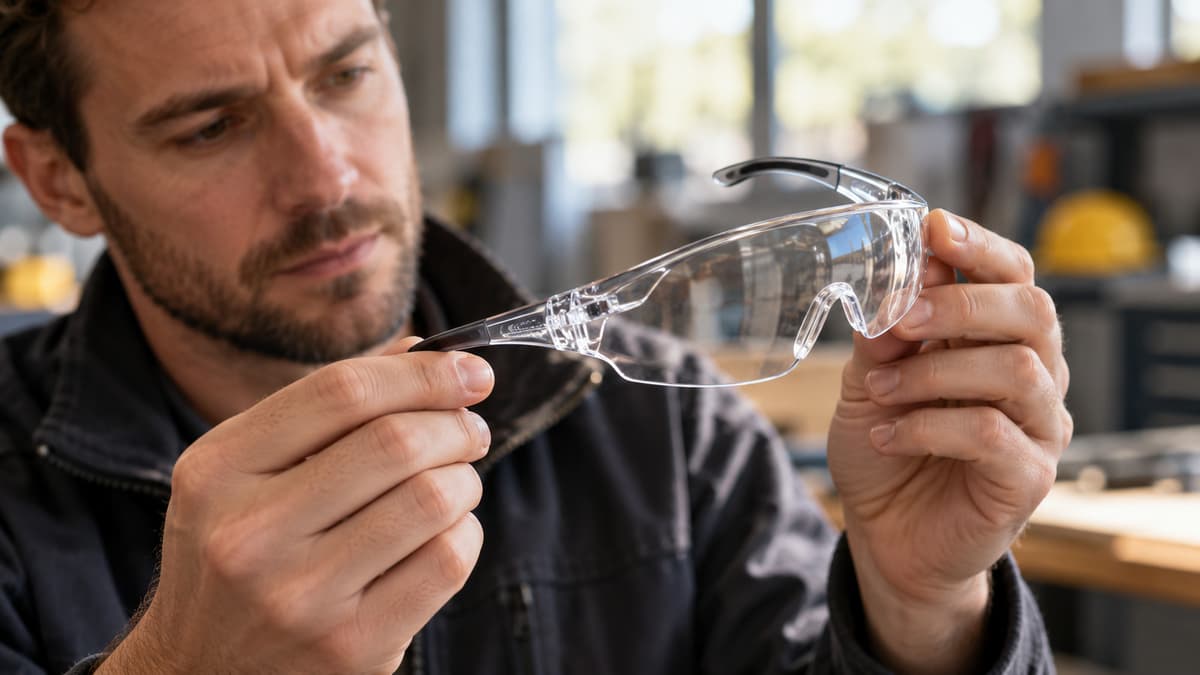
How to read EN 166 markings
Optical class, F and N sit on the lens and the frame. A blank specification table still leaves that stamp unread.
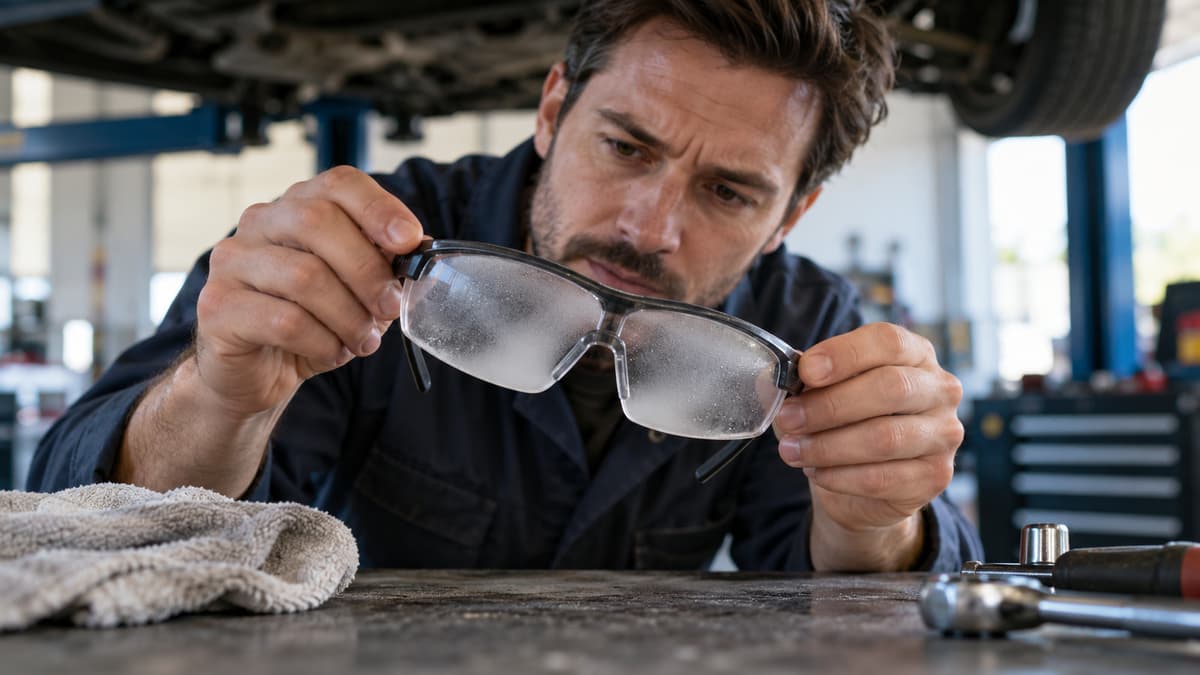
Why safety glasses fog
Warm breath on a cool lens mists the pair. Anti-fog in a title is a coating claim, and an N mark is the fog test.