Independent comparisons. We may earn from shop links. More info

Stop renovation dust spreading

Updated: 16 October 2026

You are sleeping in the spare room while one room is being taken back to the brick. To stop renovation dust spreading, you seal the doorway you still walk through, and you still control the dust at the tool. A zip sheet is one enclosure step. It does not replace extraction, a suitable mask in the work room, or a competent person if the dust may be asbestos or lead. The sheets themselves are in our [dust protection door comparison](/hub/occupational-safety-accessories/dust-protection-door). The Products Compared editorial team set this order from Health and Safety Executive guidance on 15 October 2026. A qualifying purchase through our links can earn a commission at no extra cost to you.

You are sleeping in the spare room while one room is being taken back to the brick. To stop renovation dust spreading, you seal the doorway you still walk through, and you still control the dust at the tool.

Our top picks

On this page

What one zip sheet changes in an occupied house

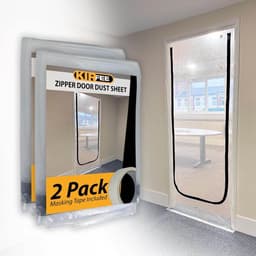
A zip sheet changes where the dust can drift. It does not make the work room dust-tight. The Health and Safety Executive treats construction dust as a health risk, and COSHH applies when the work is employment. CIS36 tells you to enclose the work with sheeting or temporary screens. Respiratory protection comes last. A normal internal door still leaks, and a dust door is the extra seal. A clear zip sheet such as the brackit door, with the limits on the best dust protection door page, is only the panel on the opening you walk through.

The doorway, the vents, and the clean room

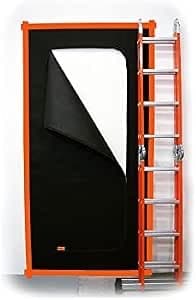
Zip the sheet every time you leave the work room. An open zip is just the doorway again. Seal the floor gap when you fit it. The sequence for tape, the zip, and that floor edge is how to fit a dust protection door. Cover or close the vents in the work room so dust is not drawn into the rooms you are still using. Keep one room's door shut. Clear plastic keeps the landing light. Fabric blocks it. That material limit is the plastic or fabric dust protection door page.

Extraction, the mask, and the brush

Control the dust at the source, then enclose what escapes, and treat a mask as the last line. That is the order in CIS36. A zip sheet is the enclosure. It is not local exhaust. The Considerate Constructors' Scheme supervisor note says polythene and zip walls contain spread, and that you use class M or H extraction rather than dry sweeping. Do not dry-brush what the sheet has caught. Dry brushing puts dust back into the air. If you are on the sander, you still need a suitable mask in that room.

When to stop taping and get a competent person

Stop and get a competent person if the material might be asbestos or lead, or if you do not know what the old coating is. A zip sheet does not license you to sand it. Employers need a COSHH assessment. Stop if the opening is a fire door or an escape route that has to stay clear. Article 14 of the Regulatory Reform (Fire Safety) Order 2005 requires emergency routes and exits to be kept clear where that duty applies. None of the seven listings states a flame-retardant grade.

The sheet is one step

Pair the zip sheet with extraction, a shut clean room, no dry sweeping, and a mask in the dusty room. If the opening is protected, or the dust is unknown, stop taping and bring in someone who is competent to judge it. People in the rest of the house are why you enclose.

Common questions

Will a zip sheet keep the rest of the house clean?
It reduces what drifts through the opening you walk through. It does not keep the house clean by itself. A normal door already leaks, and a dust door is an extra seal, not a dust-tight room. Tape gaps, an open zip, and a floor hem still pass dust. Vacuum and damp-wipe beyond the sheet. Treat a grey landing as a sign the enclosure or the cleaning slipped.
Do you still need extraction and a mask if the doorway is sealed?
Yes, in the room where the tool is running. CIS36 puts enclosure in the plan and respiratory protection last, at APF 20 as the general level when a mask is still needed. The zip sheet is not on-tool extraction, and it is not a mask. You, beside the sander, still need the source control and a suitable mask. APF 20 describes a level of protection. It is not an item packed with the sheet.
What should you do with vents while you sand?
Cover or close the vents in the work room so dust is not pulled into the rooms you are living in. Keep the clean room's own door shut, with belongings and the floor protected. Zip the dust sheet whenever you are not walking through it. Those steps sit beside extraction at the tool. They do not replace it. Open the vents again when the air has settled and you have cleaned.
Why is dry sweeping a bad idea?
Dry brushing throws the dust the sheet has caught straight back into the air. The Health and Safety Executive says to damp it or to use an M or H class extractor, with RPE where it is still needed. Sweeping the landing because the sheet caught it all undoes the enclosure. Damp-wipe after you have vacuumed. The silica 0.1 mg/m³ figure on that HSE page is an eight-hour workplace limit, not a reading you can take from a zip door.
When is a taped sheet the wrong tool?
When the opening is a fire door or an escape route that must stay clear where the fire-safety duty applies, and when the dust may be asbestos, lead, or another material you cannot identify. None of these sheets states a flame-retardant grade. Employers need a COSHH assessment rather than a sheet used as the whole plan. In those cases, stop and get a competent person.

Related pages

Sources

Public UK sources used for this comparison, last checked on 16 October 2026.

  1. HSE, Construction dust (retrieved 16 October 2026)
  2. HSE, CIS36 Construction dust (retrieved 16 October 2026)
  3. HSE, Principles of good control practice (retrieved 16 October 2026)
  4. HSE, Wood dust (retrieved 16 October 2026)
  5. Regulatory Reform (Fire Safety) Order 2005, article 14 (retrieved 16 October 2026)
  6. Door Superstore, UK door sizes (retrieved 16 October 2026)
  7. CCS dust-control supervisor note (retrieved 16 October 2026)
  8. Homebuilding, ways to make sanding less dusty (retrieved 16 October 2026)