ESD wrist strap how to ground: use the common point
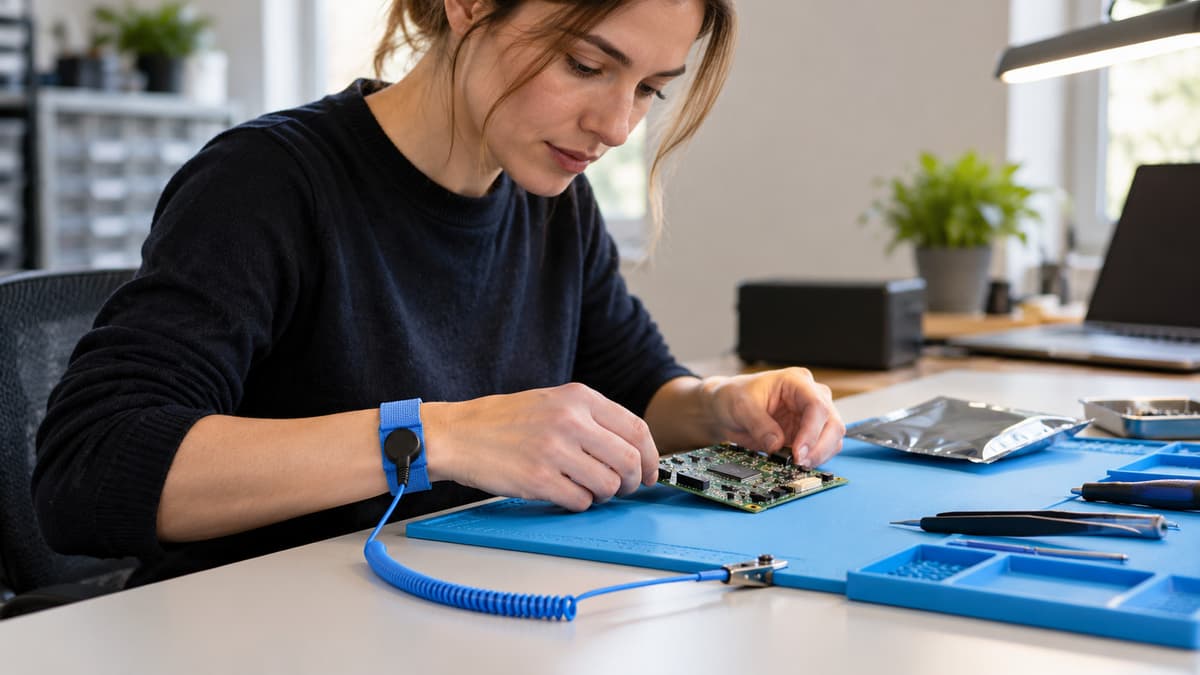
ESD wrist strap grounding means a common point, not the mat edge. Test the strap you are wearing daily. It is not for mains, and spray is not a substitute.
On this page

The cuff is on, the cord is clipped to the nearest bit of the mat, and the board is already out of the bag. That clip is the usual way a wrist strap fails while looking as if it is in use. ESD wrist strap how to ground is a bond from your skin to a common point, in parallel with the mat, checked while you are wearing it.
A bracelet in a drawer is not that bond. Antistatic spray is not that bond either.
In short
Seated work on parts that static can damage uses a wrist strap to a common point ground, not a crocodile clip on the mat edge. EN 61340-5-1 is the standard Desco cites for that seated person. Test the strap on your wrist. A resistor in a proper coil cord is a current limit, not a licence to work on mains. Above 250 VAC, Charleswater says this product is the wrong tool.
What the strap is equalising
Static on a person is a voltage relative to the bench and the part. The strap brings your skin to the same potential as the common point, through a resistance high enough to limit current and low enough that charge does not sit on you. The ESDA fundamentals series puts a wrist strap on seated people handling sensitive parts, and a separate resistance on the worksurface to that same ground. You are not earthed by wrapping a green-and-yellow wire around your wrist. You are equalised through a defined path.
A mat alone is incomplete for seated work. It can hold the board's resting place at a controlled resistance. Your hand is a second object, and if you pick the board up, you are the path. Desco Europe's TB-7504 points at EN 61340-5-1: seated personnel wear the strap. This article does not paste the standard. Standing work is often footwear and a floor, and a wrist strap is a poor match once you walk out of its cord length.
The wrist-strap comparison is a set of amazon.co.uk listings, not a certificate that any of them meets EN 61340-5-1. The top pick is the ECO-FUSED pack of three, B017164JHA, at £5.99. The bullets state a coiled cord up to 180 cm, a wrist up to 23.5 cm, an alligator clip, and a warning never to connect yourself or the hardware to mains. They do not print a resistor. The material line says alloy steel and cast iron, a poor description of a fabric band. The score is 4.5 out of 5 from 4,890 reviews. UK reviews report about 1 megohm, one reports 10 megohm, and one reports an open circuit. Measure the cord you are about to wear.
The how to ground a wrist strap and the PC-repair notes stay with that bench. The buying guide is the listing comparison. None of them is a mains-safety procedure.
Common ground, not the mat edge
The mat's ground cord and your wrist-strap cord should arrive at one common point. From that point the bench scheme goes to earth, or to the ground the facility has defined. Your cord does not travel through the mat. Desco's TB-7505 says not to ground the strap through the mat. TB-7504 says not to clip to the mat edge and not to daisy-chain mats from one cord. A clip on the corner looks tidy and is the wrong circuit.
Do not clip the strap to the mat edge, and do not daisy-chain mats. If the corner of the mat is the only place the clip will reach, the ground point is still missing.
Clipping to the mat edge puts the mat's resistance in your path. That resistance is for the surface, not a substitute for the resistor in a coil cord, and a crocodile clip on a smooth vinyl hem is a poor contact. Reviews in this set already say small clips slip on smooth metal. Daisy-chaining asks the first mat's cord to carry the second mat and anyone clipped to it. When that cord is unplugged, everything upstream goes with it.
A PC chassis is not automatically the common point. Some cases meet mains earth only while the lead is plugged in, which is a bad moment to add your body. Some are painted, anodised, or isolated. A water pipe, a radiator, or a random rack screw is the same kind of guess. Use the ground point the bench was given. A £5.99 strap does not include the earth bonding of the room.
The coil length on the ECO-FUSED listing, up to 180 cm, is long enough for a seated reach and short of a reason to wander. If you unclip to fetch a tool, clip again before the part is touched. A cuff with the cord draped over a chair back is decorative. A shorter cord that stays plugged in beats a long one clipped to the wrong place.
Test the strap you are wearing
An empty cuff can show a resistance the worn cuff will not, because skin contact is what fails: a dirty band, a loose adjustment, a cord that only conducts on the bench. Desco's TB-7504 says to test the strap as worn. Roscan's UK protocol calls for a daily test and resistance under 35 megohm including the person, the same order of figure often cited around EN 61340-5-1. This page is not quoting the standard's tables. Use a wrist-strap tester, not a continuity beep.
A continuity beep is the wrong tool. A beep can mean a near short, and silence can mean either a megohm-range cord or a broken one. ECO-FUSED does not print the resistor, so a beep cannot confirm a value the listing never stated. Measure in megohms, with the strap on your wrist, against the common point. If one strap in a three-pack is open, the other two are not a certificate for the bad one.
Daily is the Roscan interval, and the same check applies before you trust the cord if it has been tugged, the clip has been bent, or the band was washed. These listings do not state a life in months. A strap that fails the worn test is finished even if the fabric looks new. Do not bypass a failed tester because the board is waiting.
Desco's install note describes a 1 megohm resistor, plus or minus 20 percent, on that path. That is Desco's check for Desco's cord, not a value printed on every budget strap. If your reading is far from that and the listing never stated a value, do not add resistors of your own. Home repair of a coil is how open circuits and shorts get built.
Mains equipment is outside this product
Charleswater's UK note is the hard stop: straps of this class are not for equipment above 250 VAC, and wearing one does not reduce electric-shock risk. The resistor that limits a static spark is not insulation rated for mains. ECO-FUSED prints the warning. A cheaper cuff that omits it is not permission. For live mains, the strap comes off and the circuit is isolated and proved dead. This product stays in the drawer.
Antistatic spray is the neighbouring mistake. Those liquids are for surfaces and for cling on fabrics. A mist on a shelf does not bond a person. A mist on a circuit board is also a contamination risk the board maker may forbid. Use a spray only for the surface job, never as the control that TB-7504 assigns to a worn strap. The two categories share a hub. They do not share a function.
Gloves, hand cream, and a cuff worn over a sleeve break the skin contact the test is measuring. The band has to meet skin. A written programme that names a coordinator or a forbidden spray outranks a marketplace bullet.
Products Compared did not certify a strap to EN 61340-5-1 and did not measure the ECO-FUSED resistor. The 1 megohm line is Desco's. The 35 megohm daily check is Roscan's and the figure often cited for the system. The 250 VAC stop is Charleswater's. Price and the missing resistor line are the amazon.co.uk listing. A qualifying purchase can earn a commission at no extra cost to you.
Common questions
Do I need a wrist strap if I already have a mat?
Where does the cord plug in?
Can I clip the strap to the mat?
How often do I test it?
What is the resistor for?
Can I wear it while working on mains?
Is antistatic spray the same control?
Did you test these straps?

Products Compared publishes British-English buying guides based on amazon.co.uk listings and public UK sources. We do not run a lab and we do not invent test scores.
Related articles

Zinc spray on galvanised steel
A different bench job. A light mist is not a 100 micrometre repair, and weld fume is separate.

When to replace scratched safety glasses
Eye protection fails when you cannot see. A wrist strap fails when it is not grounded or not tested.

Oven gloves and contact heat
Another mark people skip. EN 407 is a glove claim. A wrist strap is not heat protection.