Independent comparisons. We may earn from shop links. More info

Pin vs pinless moisture meter

Updated: October 2026

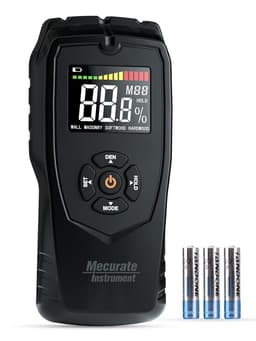
You are choosing between a two-pin pen and a pad that never leaves a hole. A pin vs pinless moisture meter decision is about the surface: a freshly split log that can take two small marks, or plaster, a floor or a caravan panel that must stay clean. In this set most meters are pins. Mecurate PDM-01 is pinless. Proster PST326 is the only listing that claims both. The sensor column is on the [wood moisture meter comparison](/hub/measuring-equipment/wood-moisture-meter). Products Compared compared those listings with HETAS, Historic England and Forest Research on 16 October 2026, without a lab test. A qualifying purchase can earn a commission.

You are choosing between a two-pin pen and a pad that never leaves a hole.

Our top picks

TopTes TopTes TS-630

Best overall

TopTes TopTes TS-630
9.2/10about £25.99
Mecurate Mecurate PDM-01

Alternative

Mecurate Mecurate PDM-01
9.0/10about £24.99
GERUI GERUI WT660-1

Preis-Tipp

GERUI GERUI WT660-1
8.6/10about £10.99
On this page

What each sensor is doing

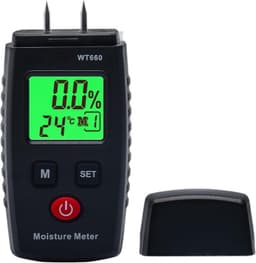
A pin meter measures electrical resistance between two electrodes. You push the tips into the face you care about. That is why a fresh split matters for logs: the pins are in the wood you will burn, not in the bark. The tips are sharp. On plaster or a finished board they leave marks, and on hardwood they can snap. A pinless meter uses a pad. Mecurate’s listing is non-destructive, with softwood, hardwood, wall and masonry modes. A round, rough log is a bad seat. Forest Research’s 2010 portable-meter summary did not recommend a simple protocol for accurate roundwood. That limit is not a test of the Mecurate, and it is still a reason to refuse the claim that pins are always more accurate. Historic England says salts confuse both resistance meters and capacitance meters. A pad is not immune because it leaves no hole.

Logs and rough timber

For firewood, use a pin. HETAS demonstrates the check on a freshly split face, in the centre, promptly. The Wood Burner makes the same consumer argument: a pad needs a flat face and reads nearer the surface, while pins tolerate a rough split. Buying a pad solely for a log pile is the skip. Valiant FIR421, Dryzone and TopTes TS-630 are the pin examples. Any of them will mark what you push them into. That is acceptable on a log you are about to burn. It is a poor trade on a finished oak floor. The 20% burner target, and the England sales rule that a pin does not certify, is the firewood page. Where to put the pins is the how to use page.
TopTes TopTes TS-630

Testsieger

TopTes TopTes TS-630
9.2/10about £25.99

Plaster, floors and caravan panels

When the surface must stay unmarked, the Mecurate PDM-01 is the pinless listing. It is about £24.99, with 4.5 from 1,871 amazon.co.uk ratings. UK reviewers cite plaster, cupboards and caravans because there are no prongs. No numeric moisture span and no ± accuracy figure are printed. The gift bullet lists a bag and three AAA cells, and the included-components field says the meter only. One reviewer was not sure the readings matched a house survey. Treat a wall mode as a comparison across several points. Do not inject a damp-proof course because the LED went red. On a caravan, UK reviews use the unmarked check while buying, including walking away from a damp van. A cheaper pin is not a bargain if the plaster is the thing you are trying to preserve.

One meter with both

Proster PST326, at about £24.99 with 4.4 from 201 ratings, is the only listing here that claims a pin and a pinless sensor together. The pinless bullet states 0–100% relative humidity, a depth of no more than 20 mm, and only if the piece is thicker than 20 mm. That depth is what the listing states. It is not a depth we measured. A 40% on the pad is not a log at 40% moisture. Buy a pin meter if the only job is logs. Buy the Mecurate if the only job is an unmarked panel. Buy the PST326 if you will do both and you will not pretend the pad’s relative humidity is timber moisture content. Wider criteria, including batteries and the unit of the percent, are in the buying guide.

Common questions

Which is better for firewood?
A pin meter is the better fit for firewood, because the method is a fresh split and the tips can reach that face. HETAS demonstrates a pin, not a pad. A pinless meter can still be useful on flat, planed boards. It is the wrong only-tool if the wood is round and still in the bark. Better here means suited to the split, not proven more accurate in a lab.
Which is better for plaster, a floor, or a caravan wall?
A pinless pad is the better fit when you must not leave holes and the face is flat enough to sit on. Mecurate PDM-01 is the pinless model in this set, and UK reviews use that approach on plaster and caravans. Pins will mark those surfaces. A dual meter such as the Proster PST326 lets you choose the pad for that job and the pins for a log, if you read the pad as relative humidity.
Do pins damage the log?
They leave small holes where the tips enter. On a log you are about to burn, that is usually acceptable. On a finished floor, a door or a plaster skim, the same holes are the damage people buy a pad to avoid. One Dryzone review describes a probe that snapped in hardwood floorboards. Seat the pins without levering them, and do not force a stiff cap.
How deep does pinless read?
On the Proster PST326 the listing states no more than 20 mm, and only if the piece is thicker than 20 mm. That is a stated depth, not a figure from this comparison. Mecurate does not print a scan depth in the extract used here. A pad that cannot sit flat will not deliver even that stated zone. Do not assume every pinless meter reaches 20 mm.
Why did a pinless reading jump around?
Poor contact is a common reason: the pad is rocking on a round or rough face, or you are sliding it while you watch the number. Average several settled spots on a flat area instead of recording the spike. A jump is a reason to repeat the point, not a diagnosis.

Related pages

Sources

Public UK sources on wood fuel moisture in England, meter limits, and damp in buildings. Prices, stars, and review counts are the amazon.co.uk listing figures in this set. Prices move. There was no laboratory test and no oven-dry calibration. Last checked 17 October 2026.

  1. GOV.UK, selling wood for domestic use in England (retrieved 16 October 2026)
  2. SI 2020/1095, Air Quality (Domestic Solid Fuels Standards) (England) Regulations 2020 (retrieved 16 October 2026)
  3. GOV.UK, customer notice for wood sold in volumes of 2 cubic metres or more in England (retrieved 16 October 2026)
  4. HETAS, how to check firewood moisture content (retrieved 16 October 2026)
  5. Forest Research, a simple method for testing moisture content (retrieved 16 October 2026)
  6. Historic England, assessing damp in historic buildings (retrieved 16 October 2026)
  7. Historic England, measuring moisture content in historic building materials (retrieved 16 October 2026)
  8. Woodsure, Scotland and the burning report on fuel quality (retrieved 16 October 2026)