Independent comparisons. We may earn from shop links. More info

Wood moisture meter buying guide

Updated: October 2026

You are standing in front of a log pile, a damp skirting board, or a caravan wall, and you want a number before you burn the wood or call anyone in. On amazon.co.uk these wood moisture meters sit between about £8.99 and about £25.99, and the percent signs do not all mean the same thing. This wood moisture meter buying guide puts the job and the sensor first, then the unit of the percent, then what is in the box. The twelve listings are on the [wood moisture meter comparison](/hub/measuring-equipment/wood-moisture-meter). Products Compared used those extracts on 16 October 2026 and did not run a lab test. A qualifying purchase can earn a commission at no extra cost to you.

You are standing in front of a log pile, a damp skirting board, or a caravan wall, and you want a number before you burn the wood or call anyone in.

Our top picks

TopTes TopTes TS-630

Best overall

TopTes TopTes TS-630
9.2/10about £25.99
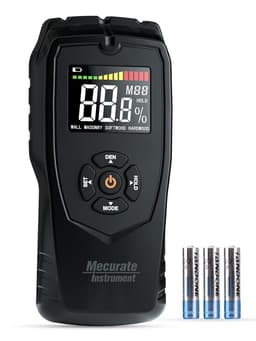
Mecurate Mecurate PDM-01

Alternative

Mecurate Mecurate PDM-01
9.0/10about £24.99
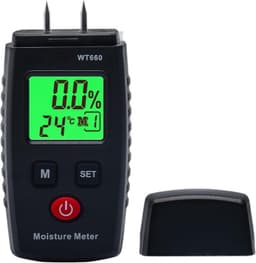
GERUI GERUI WT660-1

Preis-Tipp

GERUI GERUI WT660-1
8.6/10about £10.99
On this page

Pin, pinless, or both

Start with the surface you are allowed to mark. Most of this set is a pin meter: two electrodes, a resistance reading, and a small hole if the tips go into plaster, flooring or a finished board. That is the right shape for a freshly split log, because HETAS shows the check on the new face, not on the bark. Mecurate PDM-01, at about £24.99, is the pinless listing here. UK reviewers use that style on plaster, cupboards and caravan panels. A round log is a poor fit if the pad cannot sit flat. Proster PST326, also about £24.99, is the only listing that claims both sensors, with a pinless depth of no more than 20 mm on a 0–100% relative humidity scale. If the job is logs, leave the pad argument on the pin versus pinless page. If the face must stay clean, stop looking at pens.

What the percent is claiming

Wood fuel in the HETAS guidance is quoted on a wet basis, and the aim they give for burning is 20% or lower, with the stove manual still in charge. Some construction meters read a dry basis, which prints a higher number for the same piece of wood. The England sales rule sits on the firewood page. Inside this set the printed spans are claims, not results. Dryzone states wood 6–60% and building materials 0–40%. GERUI WT660-1 states wood 6–70% and building materials 0–15.2%. Kiprim WM02 prints accuracy as ±4% RH, which is relative humidity, not wood moisture content. Valiant FIR421 prints no numeric range at all. Forest Research treats a resistance reading as an approximation and points to oven drying when the figure has to support a specification.
TopTes TopTes TS-630

Testsieger

TopTes TopTes TS-630
9.2/10about £25.99

Modes, batteries and pins

A confident percent on the wrong mode is still the wrong percent. GERUI, Dryzone, TopTes TS-630, BOBOVAV and Proster PST290 name more than one material path. Kiprim names softwood, hardwood, building and packing, and one UK review got 0% on a plastered wall. GERUI’s UK file includes a review that the meter does not explain which setting to use. If the booklet will not name your timber, the star rating will not fill that gap. TopTes includes three AAA cells, a pouch and a spare pair of probes. Dryzone, GERUI and VivaStride say cells are not included. HAVENWARE’s technical table says batteries are not required, while UK reviews say the buyer had to purchase 2×AAA cells. Spare pins are listed for TopTes, Kiprim and Proster PST290.

What you still should not decide with it

A log and a wall are different decisions. For stove wood you want a pin, a fresh split, and a reading you can compare with 20% as a burner target. Named fits are on the best wood moisture meter page. For a wall, Historic England puts comfortable indoor timber near 8–12% moisture and treats that as ordinary, not a defect. A few high readings do not justify injected damp proofing. Salts near the base of a wall can look wet on both a pin and a pad. If the pattern is high at depth and you are about to open the plaster, that is surveyor work. A green backlight does not make a log legal to sell.

Common questions

Is a 0–99.9% meter more accurate than a 6–60% meter?
No. S8603 and VivaStride print 0–99.9% with ±0.5%, and Dryzone prints 6–60% with ±2% on wood. Those figures are listing claims. Historic England’s measurement work treats this kind of meter as reasonably accurate up to about 22%, so the wider span is not evidence of a tighter instrument. A missing range, as on the Valiant and the HAVENWARE, is also not evidence of a better one.
What does ±2% or ±0.5% on the listing actually prove?
It proves the seller printed a tolerance. This comparison did not check those lines against oven-dry samples. Forest Research treats a resistance meter as an approximation. Kiprim’s ±4% RH is a different unit again, relative humidity, and you should not read it as wood moisture content plus or minus four points.
Do I need a wood mode and a building mode?
You need the mode that matches the material in front of you. A wood scale on plaster, or a building scale on a log, still prints a percent. Dryzone, GERUI and Proster PST290 state both kinds of range. If you only burn logs, a building mode is spare capacity, not a reason to pay more. If you also chase a leak, a meter with no building path leaves you guessing.
Is a colour screen a pass or fail for burning?
No. Green, yellow or red is a prompt on that model’s own thresholds. It is not the Ready to Burn mark, and it is not a certificate that the log is at or below 20%. HETAS still wants a fresh split and a wet-basis reading you can compare with the stove manual. Use the colour as a glance, then read the number if the meter has one.
When is a surveyor the right call instead?
Call a surveyor, or a damp specialist you trust, when the readings form a pattern you are about to treat with drilling or injection, or when a house survey has already flagged the wall and your meter does not agree. One high spot, or one 0% on plaster, is a reason to change mode and repeat the points. It is not a diagnosis of rising damp, and salts can inflate the figure on both sensor types.

Related pages

Sources

Public UK sources on wood fuel moisture in England, meter limits, and damp in buildings. Prices, stars, and review counts are the amazon.co.uk listing figures in this set. Prices move. There was no laboratory test and no oven-dry calibration. Last checked 17 October 2026.

  1. GOV.UK, selling wood for domestic use in England (retrieved 16 October 2026)
  2. SI 2020/1095, Air Quality (Domestic Solid Fuels Standards) (England) Regulations 2020 (retrieved 16 October 2026)
  3. GOV.UK, customer notice for wood sold in volumes of 2 cubic metres or more in England (retrieved 16 October 2026)
  4. HETAS, how to check firewood moisture content (retrieved 16 October 2026)
  5. Forest Research, a simple method for testing moisture content (retrieved 16 October 2026)
  6. Historic England, assessing damp in historic buildings (retrieved 16 October 2026)
  7. Historic England, measuring moisture content in historic building materials (retrieved 16 October 2026)
  8. Woodsure, Scotland and the burning report on fuel quality (retrieved 16 October 2026)