Independent comparisons. We may earn from shop links. More info

How to use a wood moisture meter

Updated: October 2026

You already have the meter, or you are about to borrow one, and the first instinct is to stab the bark or the dried end of a log and trust the percent. That number moves with the mode, the face you touch, the battery and the salts in a wall. This is how to use a wood moisture meter so the reading is something you can compare later. The models in the [wood moisture meter comparison](/hub/measuring-equipment/wood-moisture-meter) are the ones these steps refer to. Products Compared drew the method from HETAS, the GOV.UK seller notice and Forest Research on 16 October 2026. We did not run the meters in a lab. A qualifying purchase can earn a commission.

You already have the meter, or you are about to borrow one, and the first instinct is to stab the bark or the dried end of a log and trust the percent.

Our top picks

TopTes TopTes TS-630

Best overall

TopTes TopTes TS-630
9.2/10about £25.99
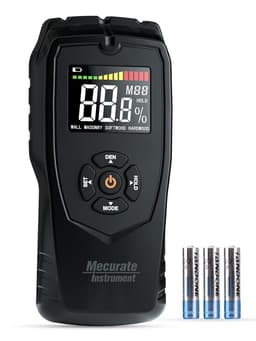
Mecurate Mecurate PDM-01

Alternative

Mecurate Mecurate PDM-01
9.0/10about £24.99
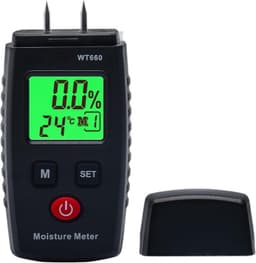
GERUI GERUI WT660-1

Preis-Tipp

GERUI GERUI WT660-1
8.6/10about £10.99
On this page

Set the meter before you touch the wood

Fit a battery you know is fresh, then set the material before the tips or the pad touch anything. A wood scale and a building scale are different instruments inside the same case. If the meter offers a wet-basis reading for fuel, use that for logs. HETAS warns that a construction meter may be on a dry basis, which prints a higher number for the same piece, and that a low battery is a reason to stop. Where the manual asks for an open-air check, do it. Hold the reading if you need both hands, and ignore a colour bar until the mode is right. If a live-circuit warning label is stuck on the back, as one UK reviewer found on a Proster PST290, do not treat the meter as a voltage tester.

On a log

Split the log and measure the centre of the new face straight away. Bark and the dried end grain will flatter a stack that is wet in the middle. HETAS says to sample the middle of the pile as well as the outside, because the front row dries first. The aim they give for burning is 20% or lower, on a wet basis. What that 20% means in England is on the firewood page. For a bag on the drive, take logs from the outside and from inside the pile, each on a fresh face, and write the mean down. One dry face-log does not clear a load whose centre is wet. Seat the pins firmly, and do not lever the meter if the cap was stiff. A mean is still an approximation.
TopTes TopTes TS-630

Testsieger

TopTes TopTes TS-630
9.2/10about £25.99

On a wall or a panel

A wall is a map, not a certificate. Pick one mode and take a run of points: low, middle and high on the same patch, then a drier-looking area in the same room. Historic England treats a few high readings as a reason to look harder, not as proof that you should inject a damp-proof course. Salts at the base of a wall can look wet. Comfortable indoor timber sits near 8–12% moisture in their guidance, and that range is ordinary. If the surface must stay clean, use a pad and keep it flat. On a caravan panel, compare seams, windows and the floor, and do not drill because one point looks high. The choice between pins and a pad is the pin versus pinless page.

When the number is nonsense

On the Valiant FIR421, warm wood produced no reading. Let the log cool and split a fresh face. BOBOVAV’s file includes one buyer who got a lit display and no material reading. Dryzone and HAVENWARE reviews both describe a stiff cap. Forcing that cap is how tips bend. If the display will not settle, stop and check the open-air zero where the manual has one. What to buy, if you are still choosing, is the buying guide.

Common questions

How many logs should I check?
For a household bag, check several logs, including some from inside the pile, and take the mean. Forest Research’s method for a supplier’s 2 metre batch is at least five logs. One dry face on the front row does not describe the centres. If you are in a dispute about a large sale, their oven-dry route is the one that can support a specification, not a second pin reading.
What if the meter has a wood mode and a wall mode?
Use the wood mode on timber and the building or wall mode on plaster and masonry. The two scales are not interchangeable. A wood setting on a plastered wall can print a number that looks precise and means very little, including the 0% one UK reviewer saw on a Kiprim. Set the mode before you record anything you intend to compare later.
How do I zero it?
Follow that meter’s manual. Kiprim’s bullet says the open-air reading should be 0, and you recalibrate if it is not. Other listings in this set do not all print that check, so do not force a zero on a model that uses a different start-up. A flat battery will undo the check. HETAS says not to trust a low battery.
Why is the reading zero on plaster?
It may be the wrong mode, a reading that only sees the dry surface, or a meter that is not reaching the damp you can feel. One Kiprim review reported 0% on a normal plastered wall and rejected the result. Switch to the building mode if you were on wood, compare with a patch you already know is wet, and do not buy a treatment because a single zero surprised you.
When do I stop and call someone?
Stop when you are about to drill, inject or strip a wall because of a handful of high readings, especially if salts are visible at the base. Historic England treats that pattern as a prompt for proper diagnosis, not as a shopping list for damp cream. Stop on the stove side when the meter and the fire disagree and the flue or the appliance may be the problem. A surveyor or a stove installer is the next instrument, not a different colour screen.

Related pages

Sources

Public UK sources on wood fuel moisture in England, meter limits, and damp in buildings. Prices, stars, and review counts are the amazon.co.uk listing figures in this set. Prices move. There was no laboratory test and no oven-dry calibration. Last checked 17 October 2026.

  1. GOV.UK, selling wood for domestic use in England (retrieved 16 October 2026)
  2. SI 2020/1095, Air Quality (Domestic Solid Fuels Standards) (England) Regulations 2020 (retrieved 16 October 2026)
  3. GOV.UK, customer notice for wood sold in volumes of 2 cubic metres or more in England (retrieved 16 October 2026)
  4. HETAS, how to check firewood moisture content (retrieved 16 October 2026)
  5. Forest Research, a simple method for testing moisture content (retrieved 16 October 2026)
  6. Historic England, assessing damp in historic buildings (retrieved 16 October 2026)
  7. Historic England, measuring moisture content in historic building materials (retrieved 16 October 2026)
  8. Woodsure, Scotland and the burning report on fuel quality (retrieved 16 October 2026)