Independent comparisons. We may earn from shop links. More info

Sound level meter for noise at work

Updated: 22 October 2026

You run a workshop, a warehouse corner, or a small firm, and someone has quoted 80 and 85 dB at you. Those figures are exposure and peak action values under the Control of Noise at Work Regulations 2005, not a household comfort cap and not a coloured face on a classroom board. None of the twelve amazon.co.uk listings states LAeq or LCpeak. The product cards remain on the [sound level meter comparison](/hub/measuring-equipment/sound-level-meter). Snapshot claims are from the 21 October 2026 capture. Products Compared is not your competent person. A qualifying purchase can earn a commission at no extra cost to you.

You run a workshop, a warehouse corner, or a small firm, and someone has quoted 80 and 85 dB at you.

Our top picks

LATNEX LATNEX SM-130DB

Best overall

LATNEX LATNEX SM-130DB
7.2/10about £113.99
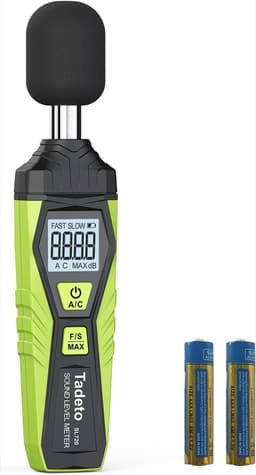
Tadeto Tadeto SL720

Rank 2

Tadeto Tadeto SL720
8.4/10about £29.99
On this page

The action values and the limit

Regulation 4 sets three pairs. The lower exposure action values are 80 dB(A) daily or weekly personal noise exposure and 135 dB(C) peak. The upper exposure action values are 85 dB(A) and 137 dB(C) peak. The exposure limit values are 87 dB(A) and 140 dB(C) peak. Hearing protection may be taken into account only when you compare with the exposure limit values, not when you decide whether the lower or upper action values are reached. HSE's INDG362 tells employers to estimate the dose and the peak without subtracting protectors first, then act at 80 dB and put a programme in place at 85 dB. Weekly averaging is for days that truly vary. It is not cover for one unprotected very loud day, which L108 also stresses. Those six numbers are the UK workplace frame, not a glance beside a saw.

What the meter has to measure

A useful workplace estimate needs the quantities those limits use. NoiseMeters' which-meter note and Cirrus Research's integrating-meter explainers describe an integrating Class 2 sound level meter, LAeq, LCpeak, and a calibrator to IEC 60942 Class 2 used before and after the session. IOSH Magazine's March 2022 overview treats Class 2 as the usual workplace minimum and Class 1 as tighter and dearer. That expectation is guidance, not a line in regulation 4. A handheld that only shows the level right now can warn you the room feels loud. It does not, by itself, produce a daily personal exposure. How to choose features without a workplace winner is on the sound level meter buying guide.
LATNEX LATNEX SM-130DB

Testsieger

LATNEX LATNEX SM-130DB
7.2/10about £113.99

What this amazon.co.uk set actually states

The mid handhelds offer live A or A and C readings. None prints LAeq or LCpeak. The Wintact WT1355A and DANOPLUS DP-441 add large USB logs. Logging is not integration unless Leq is stated, and it is not. Wall boards and the Kethvoz Wi-Fi display are room prompts, not personal exposure meters. The LATNEX SM-130DB at about £113.99 states EN 61672 Type 2 and a calibration certificate. That is the closest paperwork on the shelf, and it still omits LAeq and LCpeak. The Institute of Acoustics has separated pattern evaluation of a type from a calibration certificate on a single unit. TECPEL at about £170.00 states almost no acoustical specification. This set is not the integrating Class 2 kit workplace guidance describes. The live-reading pick is a different job, on best sound level meter.

When a screen in the workshop is still useful

A cheap live meter or a red-face wall board can still earn its keep as a cue. If the display sits in the mid-80s dB(A) on slow while someone works unprotected beside a router, you have a reason to commission a proper assessment. DANOPLUS reviewers used a red face as a prompt to put ear defenders on. Treat that as behaviour change, not as proof you have met regulation 4. Write down weighting and place if you keep the cue meter. The steps are on how to use a sound level meter. Do not subtract the assumed attenuation of defenders before you compare with 80 or 85. The cue's job is to trigger the right instrument and the right person.

When a competent person takes over

Bring in competent help when employees work in obvious noise, when hearing-protector decisions need more than a glance, or when a specification cites BS 4142 for industrial neighbour noise rather than a factory dose. A consumer logger's Excel sheet is not that report. Your duty to assess waits for an adequate estimate, not for a perfect meter on amazon.co.uk.

Common questions

What are the UK noise at work decibel limits?
Lower action values are 80 dB(A) and 135 dB(C) peak. Upper action values are 85 dB(A) and 137 dB(C) peak. Exposure limit values are 87 dB(A) and 140 dB(C) peak, under regulation 4 of the Control of Noise at Work Regulations 2005.
What is the difference between 80, 85, and 87 dB?
Eighty triggers lower-action duties such as information and hearing checks, as INDG362 outlines. Eighty-five triggers a fuller programme. Eighty-seven is the limit, where hearing protection may count in the comparison.
Do I need a Class 1 or a Class 2 meter?
Workplace guidance commonly points at integrating Class 2 for many assessments. Class 1 is tighter and dearer. Neither class is established on this consumer shelf by a pattern-evaluated claim plus LAeq.
Can I use a handheld that only shows the level right now?
As a rough cue, yes. As the estimate you compare with 80 or 85 dB, no, unless you have another reliable noise information source HSE accepts.
Does a calibration certificate make the meter legal for a survey?
A certificate shows a check at a reference point. It does not replace integrating functions, peak capture, or pattern evaluation of the type.
Should I subtract ear defenders before I compare with 85 dB?
No. Estimate exposure and peaks without subtracting protectors when you test the action values. Protection counts toward the exposure limits only.
When do I bring in a competent person?
When the work is clearly noisy, when the method needs more than a live consumer meter, or when a standard such as BS 4142 is named in the brief.

Related pages

Sources

Public UK sources from the research digest, last checked on 21 October 2026. Shelf prices and star lines are the amazon.co.uk figures captured with these twelve listings. The price bands are this set, not a market average.

  1. Control of Noise at Work Regulations 2005, regulation 4 (retrieved 21 October 2026)
  2. HSE INDG362: Noise at work (retrieved 21 October 2026)
  3. HSE L108: Controlling noise at work (retrieved 21 October 2026)
  4. NoiseMeters: which meter for noise at work (retrieved 21 October 2026)
  5. Institute of Acoustics: have our standards slipped (retrieved 21 October 2026)
  6. GOV.UK: noise nuisances (retrieved 21 October 2026)
  7. GOV.UK: method implementation document for BS 4142 (retrieved 21 October 2026)
  8. Noise Act 1996, section 5 (retrieved 21 October 2026)