Independent comparisons. We may earn from shop links. More info

Decibel meter for neighbour noise

Updated: 22 October 2026

You are losing sleep to a neighbour's bass, a dog, or late DIY, and amazon.co.uk is offering a meter around £16 that promises to prove it. A household reading can support a diary. It does not decide statutory nuisance, and it is not the approved device a council uses for a night-noise prosecution. The listings stay on the [sound level meter comparison](/hub/measuring-equipment/sound-level-meter). Review notes from 21 October 2026 include buyers who tried meters for neighbour emails. One TOPTES reviewer said the council still did nothing. That is one review, not a national outcome. A qualifying purchase can earn a commission at no extra cost to you.

You are losing sleep to a neighbour's bass, a dog, or late DIY, and amazon.co.uk is offering a meter around £16 that promises to prove it. A household reading can support a diary.

Our top picks

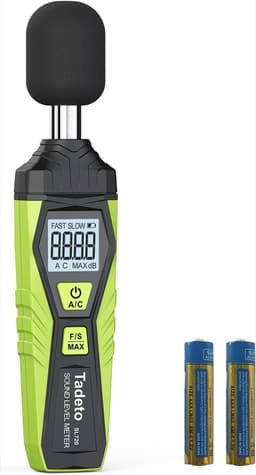
Tadeto Tadeto SL720

Best overall

Tadeto Tadeto SL720
8.4/10about £29.99
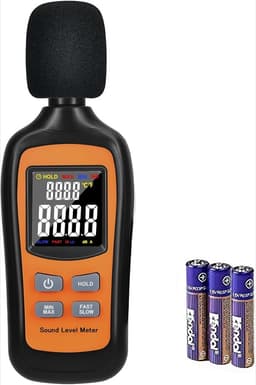
TOPTES TOPTES TS-501B

Alternative

TOPTES TOPTES TS-501B
8.2/10about £29.99
On this page

What the council is actually testing

For most daytime and general neighbour complaints, councils work under statutory nuisance in the Environmental Protection Act 1990 framework that GOV.UK summarises. Officers look at whether the noise is unreasonable and substantial in its interference with your home, or harmful to health, taking account of time of day, duration, and character. GOV.UK's noise-nuisances guidance does not publish a single daytime decibel cap. Somerset Council's public noise page states the same point: there is no specific decibel level that defines statutory nuisance. A screenshot of 72 dB on a consumer meter does not win by itself, and a quiet number on a slow setting does not lose by itself. Impact on sleep, conversation, or work at home matters more than a lone peak. Daytime nuisance does not borrow the workplace 85 dB line. That figure stays on sound level meter for noise at work.

The night permitted levels

Between 11pm and 7am, GOV.UK explains that a warning notice can rest on a permitted level measured inside the complainant's dwelling. If the underlying level is no more than 24 dBA, the permitted level is 34 dBA. Otherwise it is 10 dBA above the underlying level. Those figures are for that night regime. They are not an all-day home limit and not a target for your kitchen meter. Section 5 of the Noise Act 1996 requires the permitted level to be measured with an approved device. A TOPTES, Tadeto, or Wi-Fi classroom board from this shelf is not that device. The council's kit, inside your home, is what a prosecution measurement needs. You do not take the formal night reading by holding a handheld out of the window.
Tadeto Tadeto SL720

Testsieger

Tadeto Tadeto SL720
8.4/10about £29.99

The diary comes first

Council diary pages converge even when the exact length differs. North Kesteven asks for start and finish times to the minute, the type of noise, and the effect in your home, and reminds you that an officer still has to substantiate the problem. Cheshire West and Chester suggests about two weeks or at least six entries, with real start and finish times. Vague all-evening lines get cases closed when monitoring does not match. Treat that length as local practice, not a national form. Write which room you were in, whether windows were open, and what you could not do. Do not invent a continuous eight-hour block if the bass ran in twenty-minute bursts. Talk to the council before you assume a gadget is required. Feature order, if you still buy, is on the sound level meter buying guide.

If you still buy a meter

A meter is optional notes beside that diary, not a replacement for it. Use the same weighting and time response every time, stand in the same room, and write the figure next to the start and stop times. TOPTES and ONE WORLD reviewers used handhelds for neighbour notes and emails. That shows the habit, not a legal shortcut. A slow A reading will not match an officer's approved night measurement, and a max-hold spike may not be the quantity they record. Technique for caps, height, and settings is on how to use a sound level meter. Prefer a simple A-weighted handheld you will actually use. If a case is already open, ask what the council wants before you buy a dearer LATNEX certificate.

What not to expect

Do not expect 34 dBA to police your afternoon, or 85 dB from noise-at-work guidance to be a home legal limit. Do not expect a Kethvoz or DANOPLUS wall display to be an approved night device. Services differ, which is why GOV.UK's national test matters more than one borough's webpage. A meter can make a diary more concrete. It cannot force an abatement notice on its own.

Common questions

Will a decibel meter make the council act?
Not by itself. Officers need a nuisance case they can substantiate, often with their own attendance or monitoring. Your meter is supporting detail for a diary.
Is there a legal decibel limit for neighbour noise in the daytime?
GOV.UK does not give a single daytime decibel cap for statutory nuisance. Time, duration, character, and impact drive the test.
What is the 34 dBA night figure, and who measures it?
It is one permitted level for the 11pm to 7am warning-notice regime when background is at most 24 dBA, measured inside your dwelling with an approved device. The council measures for that purpose, not your consumer meter.
What should a noise diary contain?
Start and finish times, type of noise, where you were, and how it affected you. Local pages often want about two weeks or several dated entries rather than one bad night.
Can I send one screenshot as evidence?
A lone screenshot without settings, times, and impact is weak. Attach figures only as columns beside a proper diary.
Is a Wi-Fi meter an approved night-noise device?
No. The Noise Act route needs an approved device. Consumer Wi-Fi boards in this set are room monitors.
Should I buy a meter before I talk to the council?
Usually start with the council's complaint and diary process. Buy a meter only if you will keep consistent notes and accept that officers may still ignore the number.

Related pages

Sources

Public UK sources from the research digest, last checked on 21 October 2026. Shelf prices and star lines are the amazon.co.uk figures captured with these twelve listings. The price bands are this set, not a market average.

  1. Control of Noise at Work Regulations 2005, regulation 4 (retrieved 21 October 2026)
  2. HSE INDG362: Noise at work (retrieved 21 October 2026)
  3. HSE L108: Controlling noise at work (retrieved 21 October 2026)
  4. NoiseMeters: which meter for noise at work (retrieved 21 October 2026)
  5. Institute of Acoustics: have our standards slipped (retrieved 21 October 2026)
  6. GOV.UK: noise nuisances (retrieved 21 October 2026)
  7. GOV.UK: method implementation document for BS 4142 (retrieved 21 October 2026)
  8. Noise Act 1996, section 5 (retrieved 21 October 2026)