Independent comparisons. We may earn from shop links. More info

How to use a sound level meter

Updated: 22 October 2026

You have a handheld from the amazon.co.uk shelf, or you are about to use one, and you need a number you can compare with the next visit to the same room. Two readings on different weightings, or with the microphone still capped, are not a comparison. This page walks through a repeatable live check: settings first, then position, then what the digits are not, then what to write down. The product table stays on the [sound level meter comparison](/hub/measuring-equipment/sound-level-meter). Products Compared used stored UK review notes and UK retail guidance on 21 October 2026. This is not a survey method statement. A qualifying purchase can earn a commission at no extra cost to you.

You have a handheld from the amazon.co.uk shelf, or you are about to use one, and you need a number you can compare with the next visit to the same room.

Our top picks

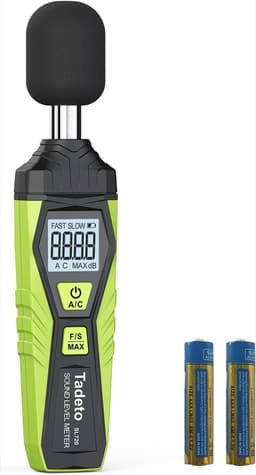
Tadeto Tadeto SL720

Best overall

Tadeto Tadeto SL720
8.4/10about £29.99
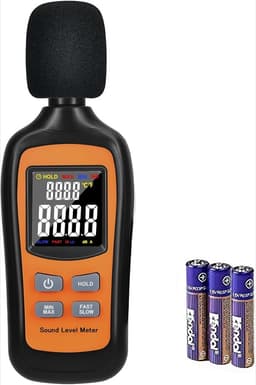
TOPTES TOPTES TS-501B

Alternative

TOPTES TOPTES TS-501B
8.2/10about £29.99
On this page

Set the meter before you trust it

Take the plastic cap off the microphone before you believe a low reading. TOPTES reviewers left the cover on and wondered why the figure sat high or refused to fall. Fit a foam windshield if the box included one and you are near a draught. Choose A or C and leave it for the whole session. Choose fast or slow the same way. Fast follows speech and music. Slow steadies a continuous machine. If the manual demands a 94 dB calibrator and you do not own one, do not invent an offset. V·RESOURCING UK notes describe contradictory 94.0 versus pictured 90.7 instructions that buyers could not resolve. Use fixed settings for a relative check, or borrow a proper calibrator. Wintact reviewers met menus in Chinese, so change the language before you keep a number. If you have not bought yet, feature order is on the sound level meter buying guide.

Where to put the microphone

For a room comparison, retail advice from the RS sound-measurement guide is to keep the meter away from walls, about 1.5 m above the floor, point the microphone at the source, and avoid wind above about 5 m/s. That is their field advice, not an HSE regulation copied into your kitchen. The Association of Noise Consultants' building guideline talks about heights of about 1.2–1.5 m and staying roughly a metre from reflecting surfaces where the room allows. If the room is too small, write down how close you stood. For a workplace spot check, hold the microphone near ear height on the noisy side. A single live reading is not a personal dose. Do not cup the capsule, and do not talk into it while you measure speech levels.
Tadeto Tadeto SL720

Testsieger

Tadeto Tadeto SL720
8.4/10about £29.99

What the number is, and what it is not

A live display is the level now under the settings you chose. It is not LAeq unless the instrument integrates and says so. None of the twelve meters in this comparison states LAeq, so watching the screen and guessing an average does not create a daily exposure figure. It is also not a C-weighted peak just because you pressed hold. Tadeto reviewers missed air-rifle peaks and said max hold behaved on fast only. LATNEX reviewers missed a rifle muzzle. Slow A on a bang will under-read the event you care about. A reading stuck near 40 dB, or a floor around 30–35 dB where the range starts there, is often the instrument's bottom, not proof the room is loud. Employee thresholds are on sound level meter for noise at work, and night permitted levels on sound level meter for neighbour noise.

Write the reading down

A bare screenshot without settings is how neighbour and workplace notes fail later. Write the weighting, fast or slow, place, height or distance, start and end time, what was making the noise, and whether windows were open. If you log on a Wintact or DANOPLUS unit, export the file and keep the same fields beside it. The second visit has to match the first: same corner, same height, same switches. A council or an employer will still prefer their own kit. Your note is a diary aid, not their measurement. When staff work in obvious noise, a brief cites BS 4142, or a council case is already open, stop and bring in a competent person with integrating Class equipment.

Common questions

Where do I hold the meter?
For a room, about chest to head height, away from walls where you can, microphone toward the source. For a person at work, near ear height on the noisy side. Write the place down so the next reading matches.
Should I use A or C, and fast or slow?
Use A for ordinary loudness comparisons. Use C when peaks matter and the meter offers it. Use fast for speech and music, slow for a steady machine. Do not mix settings between two visits you want to compare.
What do I write down with the number?
Weighting, time response, place, duration, source, and date. Without those, the digits are a souvenir.
Why does a quiet room still read about 30 or 40 dB?
Many consumer meters bottom out near 30–35 dB, and some faulty units stick higher. That floor is not a finding that the room is noisy. Rule out a cap still on the microphone before you change place.
The manual says calibrate to 94 dB and I have no calibrator. What now?
Do not invent a correction. Use fixed settings for relative checks, or obtain a calibrator. Contradictory 94 dB pages on cheap manuals are a known buyer complaint on this shelf.
Can I measure a bang or a shot with hold?
Often not reliably on these handhelds. Reviews of Tadeto and LATNEX describe missed short peaks. A peak limit needs the right weighting and a meter that captures it.
When should I stop and get a competent person?
When staff work in obvious noise, when a survey cites BS 4142, when the council is already measuring, or when you need a dose rather than a live cue.

Related pages

Sources

Public UK sources from the research digest, last checked on 21 October 2026. Shelf prices and star lines are the amazon.co.uk figures captured with these twelve listings. The price bands are this set, not a market average.

  1. Control of Noise at Work Regulations 2005, regulation 4 (retrieved 21 October 2026)
  2. HSE INDG362: Noise at work (retrieved 21 October 2026)
  3. HSE L108: Controlling noise at work (retrieved 21 October 2026)
  4. NoiseMeters: which meter for noise at work (retrieved 21 October 2026)
  5. Institute of Acoustics: have our standards slipped (retrieved 21 October 2026)
  6. GOV.UK: noise nuisances (retrieved 21 October 2026)
  7. GOV.UK: method implementation document for BS 4142 (retrieved 21 October 2026)
  8. Noise Act 1996, section 5 (retrieved 21 October 2026)