Independent comparisons. We may earn from shop links. More info

Tyre pressure gauge

Updated: 22 October 2026

You are at the car, the gauge is in the door pocket, and the placard is on the pillar or the fuel flap. A tyre pressure gauge is useful when the tyre is cold, the chuck seals before the digits lock, and you compare the number with the manufacturer’s figure for the load. This page is about the one tyre gauge in our [pressure gauge comparison](/hub/measuring-equipment/pressure-gauge), the AA AADTP, at £8.49. The pipe dials in that grid do not fit a Schrader valve. Peter F. used the Highway Code, the AA guide, and the amazon.co.uk listing on 21 October 2026. There is no lab. A qualifying purchase can earn a commission at no extra cost to you.

You are at the car, the gauge is in the door pocket, and the placard is on the pillar or the fuel flap.

Our top picks

AA AA digital tyre gauge

Best overall

AA AA digital tyre gauge
6.6/10about £8.49
On this page

The figure is the manufacturer’s, checked cold

Highway Code annex 6 tells you to inflate to the manufacturer’s figure for the load, and to check weekly, before the journey, when the tyres are cold. Warm tyres mislead. The Code does not print a universal psi, so a neighbour’s 32 is not your car. The AA’s guide puts the placard in the handbook, the fuel flap, or the driver’s door, with a normal-load figure and a full-load figure. They describe cold as a couple of hours since the car was driven. Use the Code’s week, not the AA’s couple of weeks. The gauge only displays what is in the tyre after the chuck has sealed.

What the AA gauge in this set actually states

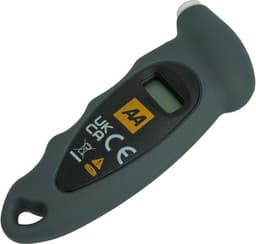
The listing states 0–100 psi and 6.85 bar, a blue back-lit LCD, automatic shut-off, a plastic body, and 76 g. The amazon.co.uk line is 4.3 from 7,312 ratings. The live page mentions a lithium cell and an auto-off of about 30 to 90 seconds. The bullets in the file we compared do not state either, so keep 6.85 bar as the comparison figure. An attribute line says NPT. The reviews use a tyre valve, not a pipe thread. A Bourdon dial has a BSP stem and will not seat on the valve. How that stem seals on a pipe is on how to fit a pressure gauge. Press the chuck on until the hissing stops and the reading locks.
AA AA digital tyre gauge

Testsieger

AA AA digital tyre gauge
6.6/10about £8.49

Battery screws and a chuck that loses air

The repeated UK complaints are the battery cover and the seal on the valve. The cover uses tiny screws. The comparison file does not call the cell a rechargeable pack, and it does not print a chemistry or a size. Some review comments say the cell is not replaceable, so this page will not promise that a shop cell fits. The chuck is the sharper limit. Reviewers say it is hard to seat, so air leaves before the reading settles. That fall is lost air, not a wrong placard. Wait until the hiss stops, and only then believe the lock. For a weekly cold check inside 100 psi, this is the only tool in our set that belongs on the valve. A span for a pipe port is on the pressure gauge buying guide.

Bikes, valve types, and TPMS

The listing asks whether the gauge can measure bike tyre pressure and does not answer. British Cycling’s guide puts road bikes around 80–110 psi and track bikes at 120–200 psi. A 100 psi ceiling misses the top of the road band and all of the track band, and our file does not mention a Presta head. A car whose placard is inside 100 psi and 6.85 bar, on a Schrader valve, is the duty the reviews describe. A warning light says something changed. It does not replace the cold check in the Code. Leave the BSP dials for pipes. When the chuck will not seal, or the placard is above 100 psi, use a gauge that states that range and that valve.

Common questions

How often, and must the tyre be cold?
The Highway Code says weekly, before the journey, when the tyres are cold. The AA’s guide says every couple of weeks and describes cold as a couple of hours since the car was driven. Follow the Code’s week. A reading after a motorway run sits higher than the placard and is not a reason to bleed the tyre at the services.
Where is the correct psi for my car?
On the manufacturer’s placard: the handbook, the fuel flap, or the driver’s door, in the AA guide. There are usually two columns, normal load and full load. The driving-test answer also includes the spare and the valve caps. This gauge does not know your car, and the Code states no universal psi.
Psi or bar on this gauge?
Both are stated: 0–100 psi and 6.85 bar in the file we compared. Match the unit to the placard. Do not replace 6.85 with 6.55 or 6.5 from other write-ups of a 100 psi ceiling. The unit legend is small, which UK reviews mention, so check you are not reading bar against a psi sticker.
Why does the reading fall while I am still fitting it?
The chuck has not sealed, and air is leaving the valve. UK reviews describe that loss before the reading locks. Press on until the hissing stops, then read. A figure you saw while it was still hissing is not the pressure to compare with the placard. If it will not seal at all, the valve core may be the leak.
Can I change the battery?
The captured listing supports a cover with tiny screws, and it does not state chemistry or size. The live page mentions lithium. Some review comments say the cell cannot be replaced. Try the screws if you can turn them, and do not assume a shop cell will fit. It is not a rechargeable pack in the notes we compared.
Will it do a road bike?
The listing leaves the bike question unanswered, and the stated ceiling is 100 psi. British Cycling’s guide puts road pressures around 80–110 psi and track pressures at 120–200 psi, so the top of those bands is above this gauge. Our file does not mention a Presta adaptor. Use a bike gauge that states the range and the valve.
Does TPMS mean I can skip the gauge?
A warning light means you should check, not that the check is finished. The monitor does not read your placard, and the Highway Code still wants a cold weekly check with a gauge. Seat this gauge properly and compare the locked figure with the door sticker, including the spare where you have one.

Related pages

Sources

Public UK sources from the research digest. Shelf prices and star lines are the amazon.co.uk figures captured with these twelve listings. The price bands are this set, not a market average.

  1. PSSR 2000, regulation 8 (retrieved 22 October 2026)
  2. HSE: using pressure systems (retrieved 22 October 2026)
  3. Ofwat: water pressure (retrieved 22 October 2026)
  4. Ofwat: guaranteed standards scheme summary, June 2026 (retrieved 22 October 2026)
  5. BSI: BS EN 837-1:1998 Bourdon tube pressure gauges (retrieved 22 October 2026)
  6. Highway Code annex 6: vehicle maintenance (retrieved 22 October 2026)
  7. Stewarts Group: guidance on use (retrieved 22 October 2026)
  8. GNW: BS EN 837 pressure gauge accuracy classes (retrieved 22 October 2026)