Independent comparisons. We may earn from shop links. More info

How to fit a pressure gauge

Updated: 22 October 2026

The gauge is in your hand and the first reading will be wrong if the joint leaks or the needle was never on zero. This is how to fit a pressure gauge so the seal matches the thread, and so a spray at the nut is not mistaken for the supply. The steps follow Brannan’s UK install note, the British Fluid Power Association’s thread rules, and the leak patterns in the captured reviews of our [pressure gauge comparison](/hub/measuring-equipment/pressure-gauge). Peter F. wrote this on 21 October 2026. There is no lab. A qualifying purchase can earn a commission at no extra cost to you.

The gauge is in your hand and the first reading will be wrong if the joint leaks or the needle was never on zero.

Our top picks

On this page

Identify the seal before you reach for tape

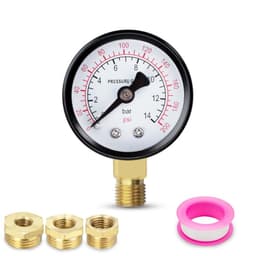
A parallel BSP thread seals on a washer, often copper, on the spigot. A tapered thread, BSPT or NPT, seals on the cone with PTFE tape, paste, or an anaerobic sealant. Tape on a parallel thread can stop the washer seating, and a dry taper usually weeps. Look at the fitting: a small BSP male may not have a washer face. A garden-tap tester is a third joint, a nut and a washer. One Stowberry review used PTFE on the tap thread. That is a reported fix, not the default for every parallel pipe gauge. GERUI’s title and attribute disagree on NPT, so seal the thread you can see. Reducers change size only. They do not convert NPT into BSP. Range and mount are on the pressure gauge buying guide.

Tighten the flats, not the case

Brannan says to put the spanner on the flats, not around the case, and to finish with the dial at 12 o’clock. The case holds the movement. Using it as a handle pulls that movement. On a taper, wrap the tape the way the thread turns on, leave the first thread bare, and stop when the joint is tight. On a parallel thread, fit the washer, then tighten until it seats. Another half-turn is how washers split. Uharbour’s UK reviews say the brass BSPT nut leaks unless it is tightened with a wrench, and tape is not in the box. Stowberry’s soft plastic nut often fails hand-tight. Snug it until the washer seats, and stop if the plastic gives.

A spray at the nut is not a mains-pressure reading

Water at the blue ring, at the tap coupling, or along the hose means you do not have a supply figure yet. Stowberry’s UK reviews describe a flush washer and a leak at the blue ring. Uharbour’s file includes leaks until the nut is wrenched. Shut the tap, dry the nut, and look at the washer before you blame the mains. Only a joint that stays dry, with the needle stable, is a reading. What that number means against Ofwat’s 0.7 bar floor is on the mains water pressure gauge page, because a garden tap is not the communication pipe. A hiss at a compressor bushing is a seal, not proof the cut-out is low.

Zero, liquid fill, and what not to cut

Before you open the valve, look at the needle. Above zero, with the port open to atmosphere, the movement may be damaged, the gauge may have been over-ranged, or a liquid-filled case may be holding pressure. If the gauge has a compensating valve, Brannan and WIKA say you open it after fitting and then close it. Open that valve only when you can see one. These listings do not say they have a vent. Do not cut a rubber plug you were not shown. Check zero, then the joint, then the number. Stop when the job leaves a household tap or a small compressor port. Steam, oxygen, refrigerants, an unvented cylinder, and a workplace receiver that needs a written scheme are not a Saturday fitting.

Common questions

Do I wrap PTFE on every gauge?
Parallel BSP seals on a washer. BSPT and NPT seal on the taper with tape, paste, or an anaerobic sealant. A garden-tap nut seals on its washer first. One Stowberry review used PTFE on the tap thread and stopped a leak, so that fix is reported, not a rule for every parallel pipe thread. The GERUI attribute says NPT and the title does not, so you seal the thread you can see.
Where do I put the spanner?
On the flats of the stem, not around the case. Brannan also finishes with the dial at 12 o’clock so you are not twisting the movement afterwards. A plastic tap nut is the exception: if a wrench chews the flats, stop. Uharbour’s brass nut is the one UK reviews say needs a wrench before it stops leaking.
Why does the tap tester spray from the blue ring?
On Stowberry, UK reviews describe a soft plastic nut and a washer that sits flush, with water at the blue ring. That spray is a failed seal, not a mains-pressure reading. Dry the joint and reseat the washer. If the plastic is already damaged, another hard turn will not create a washer face.
The needle is above zero before I open the tap. Is the gauge broken?
It might be. With the port open to atmosphere the needle should sit on the stop or on zero. A liquid-filled gauge can also show case pressure if it has a compensating valve. Open that valve only when you can see one, then close it. Do not cut a rubber plug. If the needle stays off zero with the port open, the movement is suspect.
Should I cut the rubber plug on a glycerin gauge?
Not from these listings or from Brannan’s UK install note. If a small valve is visible on the case, open it after fitting and close it again. Cutting a plug is a different instruction, and it is not a step to invent on a Hansfelds dial.
Static reading or reading while another tap is open?
For a spot check, shut the other outlets, let the needle settle, and read that. An open tap elsewhere is a lower figure. Neither figure is Ofwat’s test in the communication pipe. A near-zero needle, especially in the bottom tenth of a long scale, is not proof the line is empty.
When do I stop and call a plumber or a gauge fitter?
Call a plumber for a leak inside the house, a joint you cannot make dry, or an unvented cylinder. Call the person responsible for the system for steam, oxygen, refrigerant, or a workplace receiver that needs a written scheme. A household tap or a matched compressor port, with a dry joint and a needle that started at zero, is what this page covers.

Related pages

Sources

Public UK sources from the research digest. Shelf prices and star lines are the amazon.co.uk figures captured with these twelve listings. The price bands are this set, not a market average.

  1. PSSR 2000, regulation 8 (retrieved 22 October 2026)
  2. HSE: using pressure systems (retrieved 22 October 2026)
  3. Ofwat: water pressure (retrieved 22 October 2026)
  4. Ofwat: guaranteed standards scheme summary, June 2026 (retrieved 22 October 2026)
  5. BSI: BS EN 837-1:1998 Bourdon tube pressure gauges (retrieved 22 October 2026)
  6. Highway Code annex 6: vehicle maintenance (retrieved 22 October 2026)
  7. Stewarts Group: guidance on use (retrieved 22 October 2026)
  8. GNW: BS EN 837 pressure gauge accuracy classes (retrieved 22 October 2026)