Independent comparisons. We may earn from shop links. More info

True RMS multimeter

Updated: October 2026

Some boxes print True RMS or TRMS, and others never mention it. A true RMS multimeter is for an AC wave that is not a clean sine. A DC battery check does not get better because the title says TRMS. One method scales a rectified average. The other computes a heating value. This page is that decision, not a ranking. The buying order stays on the [multimeter buying guide](/hub/measuring-equipment/multimeter/sub/multimeter-buying-guide), and the table of all eleven is the [multimeter comparison](/hub/measuring-equipment/multimeter). Peter F. used Fluke's published figure on 17 October 2026. A qualifying purchase can earn us a commission at no extra cost to you.

Some boxes print True RMS or TRMS, and others never mention it. A true RMS multimeter is for an AC wave that is not a clean sine. A DC battery check does not get better because the title says TRMS.

Our top picks

VENLAB VENLAB VM-600M

Best overall

VENLAB VENLAB VM-600M
9.4/10about £26.99
TESMEN TESMEN TM-510

Preis-Tipp

TESMEN TESMEN TM-510
9.2/10about £16.99
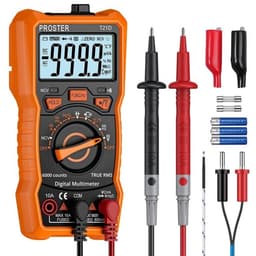
Proster Proster T21D

Alternative

Proster Proster T21D
9.2/10about £16.99
On this page

What the two methods assume

An average-responding meter takes the rectified average of the AC wave and multiplies by about 1.11, so a pure sine reads the same as its RMS value. Fluke's UK note says this shortcut is fine for a clean sine, and names induction motors, heaters and incandescent lamps. Martindale says average responding is uncertain once the wave is distorted. True RMS is the heating value of the wave, the equivalent DC that would warm a resistor the same way, whatever the shape. Fluke's page says an averaging meter can read up to 40% low, or 10% high, on non-sinusoidal waves. That is Fluke's figure, not a test we ran on these meters. A mains sine from a resistive heater can suit an average-responding meter. If you do not know the shape, look for the words True RMS. A vague RMS label is not the same claim.

Jobs that need the words True RMS

You need those words when the load chops or reshapes the wave. A dimmer does that. Many LED drivers do that. A variable-speed tool with an electronic control does that. An average-responding display can then sit well away from the heating value, by as much as the Fluke band above. A listing that never mentions True RMS leaves you without that claim. True RMS is not unlimited accuracy, and it does nothing for safety by itself. A meter can print TRMS and still have no CAT voltage. No crest-factor number is printed for any ASIN in this set. How the leads and the function are set is on how to use a multimeter.
VENLAB VENLAB VM-600M

Testsieger

VENLAB VENLAB VM-600M
9.4/10about £26.99

Jobs that do not need True RMS

A DC reading does not use the sine assumption. On a battery, a USB rail or a car's 12 V posts, True RMS does not improve the number. Continuity is a beep, not an AC wave. If those are the only jobs, ignore the TRMS badge and decide on the category, the voltage and whether current is even listed. A rested voltage near 12.6 V, the RAC's engine-off figure, is a DC state-of-charge reading. Buying True RMS so that 12.6 V will be more true spends money on a method the measurement never calls. If a listing says not stated, leave it as not stated. That absence is not proof the meter is average-responding.

What this set prints

Four listings print the claim. The VENLAB VM-600M and the FNIRSI DMT-99 say TRMS in the title. The Proster T21D and the Aicevoos AS-118D state True RMS in the features. The VENLAB also states CAT III 600 V, at £26.99 with 4.7 from 623 reviews. The Proster states True RMS at £16.99 and does not print a CAT number. The FNIRSI states TRMS at £49.99 with a small UK review sample. Those four are not one quality band. The Crenova MS8233D states CAT III 600 V and does not state True RMS. Every other meter in the set is not stated. A higher count can still use the 1.11 shortcut. Who should buy which listing is on the best multimeter page.

Common questions

What does True RMS measure?
It measures the heating value of an AC wave, the DC voltage that would warm a resistor by the same amount. An average-responding meter instead takes a rectified average and multiplies by about 1.11 so that a pure sine reads correctly. Martindale describes True RMS as the method that does not depend on that sine. The screen figure is still only as good as the range and the leads.
When is an average-responding meter accurate enough?
It is the matching method when the wave is a clean sine. Fluke's examples of linear loads are induction motors, heaters and incandescent lamps. A plain resistive heater on an undimmed socket is the sort of job where the 1.11 assumption is what the meter was scaled for. Once a dimmer, a switched-mode driver or a speed control reshapes the wave, that assumption is the wrong method.
How far out can a non-sine reading be?
Fluke says an averaging meter can be up to 40% low, or 10% high, on non-sinusoidal waves. That is Fluke's published range, not a measurement we took on the meters in this set. The direction depends on the shape of the wave, so the display can sit either side of the heating value. If that error band is unacceptable for the job, choose a listing that prints True RMS.
Do I need True RMS for a 12 V car battery?
You do not. A car-battery voltage check is DC. The sine-wave shortcut never enters the reading, so a TRMS badge does not make 12.6 V more meaningful. Use a DC volts range that covers the battery. True RMS belongs to distorted AC, not to the posts on a 12 V lead-acid battery.
Which meters in this set actually print True RMS?
The VENLAB VM-600M, the Proster T21D, the Aicevoos AS-118D and the FNIRSI DMT-99. The first and the last put TRMS in the title. The other two state True RMS in the features. The Crenova states CAT III 600 V and does not state True RMS. Every remaining listing is not stated, which means you should not assume either method.
Does True RMS make a meter safer?
It changes how AC is calculated. It does not set the category, the voltage, the fuse or the lead quality. A meter can state True RMS and omit a CAT number, as the Proster file does. Safety for a live installation still starts with GS38: a multimeter is the wrong tool for proving a circuit dead, whether or not the box says TRMS.

Related pages

Sources

Public UK sources from the research digest for this comparison: HSE, legislation.gov.uk, Martindale, Megger, Fluke, Electrical Safety First, the RAC and GOV.UK. Listing prices, star lines and review themes are the stored amazon.co.uk figures for these ASINs, not a fresh page view. Updated 17 October 2026.

  1. HSE GS38, electrical test equipment for electricians (retrieved 17 October 2026)
  2. Electricity at Work Regulations 1989, regulation 16 (retrieved 17 October 2026)
  3. Martindale, how to choose a multimeter (retrieved 17 October 2026)
  4. Megger, measurement category (retrieved 17 October 2026)
  5. Fluke, what is true-RMS (retrieved 17 October 2026)
  6. Electrical Safety First, Best Practice Guide 2 (retrieved 17 October 2026)
  7. RAC, car battery voltage (retrieved 17 October 2026)
  8. GOV.UK, Approved Document P (retrieved 17 October 2026)