Independent comparisons. We may earn from shop links. More info

How to use a laser measure

Updated: October 2026

How to use a laser measure, for the handheld distance meters in our [laser rangefinder comparison](/hub/measuring-equipment/laser-rangefinder), comes down to three checks. Set the reference edge, see the dot on a flat target, and take the reading twice before you write it down. If any of those fail, stop and use a tape. This page is the method for a wall, a floor, or a volume in metres. Peter F. used the amazon.co.uk listings and UK review notes on 16 October 2026, not a site survey. Golf yards are on the [golf rangefinder or laser distance meter](/hub/measuring-equipment/laser-rangefinder/sub/laser-rangefinder-golf-or-distance-meter) page. If you buy through our links, we may earn a commission at no extra cost to you.

How to use a laser measure, for the handheld distance meters in our laser rangefinder comparison, comes down to three checks.

Our top picks

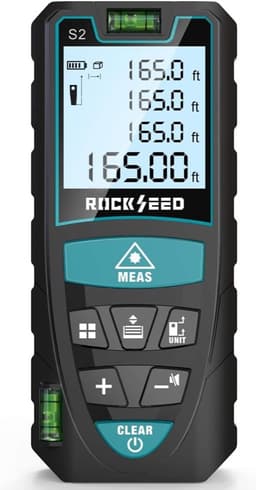
RockSeed RockSeed S2-50

Best overall

RockSeed RockSeed S2-50
9.0/10about £19.99
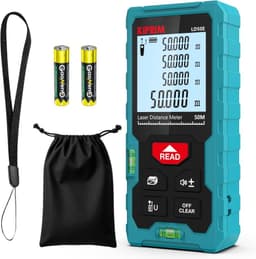
Kiprim Kiprim LD50E

Alternative

Kiprim Kiprim LD50E
8.8/10about £15.99
MiLESEEY MiLESEEY D5T

Preis-Tipp

MiLESEEY MiLESEEY D5T
8.8/10about £15.96
On this page

Set the edge you are measuring from

The length you want is from one surface to the other. The laser does not start at the wall unless you tell it to. Put the rear of the meter against the wall, so the reading includes the body. BuildWiz puts a wrong reference at about 50–150 mm. Our figures use about 11 cm of body as the same idea. One UK review on the D5T is the only note in this file that selects front or back. If every wall is out by the same few centimetres, check that setting before you blame the laser. Look at the icon for the front or the rear, then take one known length you can also reach with a tape. The laser rangefinder buying guide is where you choose 50 m or 100 m. Once the meter is in your hand, the edge matters more than the title range.

Put the dot on a flat target

Aim at a flat, matt surface, not at a corner, a gloss tile edge, or a gap behind a door. Hold the meter still until the number settles. Two bubble levels on the RockSeed and Kiprim listings are there so the body is square to the wall. A tilt changes the path the beam travels, and the screen will still show a confident figure. On the RockSeed S2-100, UK reviewers say the measure button can nudge the unit as you press it. Brace the back of the meter before you press. A corner is a poor target because the dot splits across two planes. If the mode is unclear in the booklet, measure to a flat board held in the corner and add nothing you cannot see.
RockSeed RockSeed S2-50

Testsieger

RockSeed RockSeed S2-50
9.0/10about £19.99

If you cannot see the dot, you are not aiming

These four meters use a red dot and have no pointfinder camera. If you cannot see the dot on the target, you do not know which point the number belongs to. UK reviews on the RockSeed S2-50 describe trouble past about 10 m on a bright day, and a garden attempt at about 35 yards that returned a low-signal error. The D5T listing recommends indoor use, or light under 3,000 lux. Do not stare into the beam to find it. The D5T and the Kiprim state Class 2, under 1 mW. GOV.UK treats Class 2 as a short glance, not a look down the aperture. The RockSeed listings do not state a class. A pale board at the far end is how you catch a weak dot, not your eye.

Repeat it and write it down

One beep is not a measurement you should cut from. Take the length, step back, and take it again. If the two figures agree, write both down with the room name and which edge you used. That habit is not a claim that a budget meter is a survey tool. A bedroom that comes out longer than the landing outside it needs another shot, not a new cabinet order. For anything under about 100 mm, pick up a tape. Pythagoras modes are on these listings. Use them only when you can still check a leg with a tape. The best laser rangefinder page compares which meter has the deeper review file. It does not change this sequence.

When to stop

Stop when the number will set out structure, a measured survey, or a sale by quantity. A floor area you will pay a fitter from needs a competent person. These meters are consumer listings. An intermittent beam, which UK Kiprim reviews mention, is a reason to abandon the shot, not to average a flicker. You can measure an ordinary room on your own if the edge is set, the dot is visible, and two readings agree. You should not sign off a boundary or a dispute about floor area.

Common questions

Where do I hold the meter against the wall?
For a room length, put the rear of the meter on the wall you are measuring from, and set the reference to that rear edge. If the mode is the front, the body length drops out of the figure. Builders’ guides put that miss at roughly 50–150 mm. One UK review on the D5T is the note in this set that selects front or back on purpose.
Why is every reading out by the same few centimetres?
Because the reference edge is probably wrong by about the length of the body, around 11 cm in the figures we use. The error repeats on every wall. Check the front or rear icon, then measure one length you can also take with a tape. Do not add a homemade offset until that check agrees.
What if I cannot see the red dot?
You are not aiming at a known point. These meters have no camera. UK reviews describe the RockSeed dot failing in sun, including trouble past about 10 m, and the D5T listing says indoor use or under 3,000 lux. Move to shade, use a pale board as the target, or stop. Do not look into the beam.
Should I trust the first beep?
No. Take a second reading and write both down. If they disagree, the beam moved, the button nudged the RockSeed, or the target was wrong. A single number is not enough to cut timber or order a carpet. Under about 100 mm, use a tape instead.
What should I do if the number will set out structure?
Hand that measurement to a competent person. A consumer laser from this set is not a measured survey, and we do not claim it meets ISO 16331-1. If the figure decides an opening, a priced floor area, or a boundary, repeating a beep is not the method that should stand.

Related pages

Sources

GOV.UK, the Health and Safety Executive, the R&A and ISO 16331-1, plus the amazon.co.uk listings read on 16 October 2026. Prices move. Nothing was measured on a course or in a lab.

  1. GOV.UK, Laser radiation: safety advice (retrieved 16 October 2026)
  2. HSE, Lasers (retrieved 16 October 2026)
  3. The Control of Artificial Optical Radiation at Work Regulations 2010 (retrieved 16 October 2026)
  4. ISO 16331-1:2017 (retrieved 16 October 2026)
  5. The R&A, Distance-measuring devices (retrieved 16 October 2026)
  6. World Handicap System clarification 2.1b/2 (retrieved 16 October 2026)
  7. England Golf, Rules of Handicapping (retrieved 16 October 2026)
  8. amazon.co.uk Best Sellers, Laser Distance Meters (retrieved 16 October 2026)